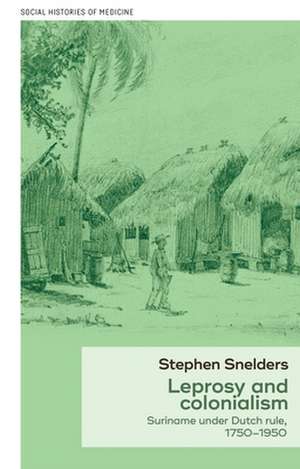
Leprosy and Colonialism
Autor Stephen Sneldersen Limba Engleză Hardback – 18 mai 2017
Although leprosy is now a neglected tropical disease, its study today is vital in recognising the the influence of our colonial heritage and in exploring the perspectives of other cultures on the contemporary management of health and disease. this is in light of the current global migration movements which make the permeability of boundaries and the transmission of humans and therefore diseases, more common than perhaps ever before in human history.
The book will be of interest to students of colonial history, colonial medicine, and management of infectious disease in multi-ethnic and multi-cultural societies.
Preț: 723.65 lei
Preț vechi: 939.81 lei
-23%
Puncte Express: 1085
Carte tipărită la comandă
Livrare economică 16-30 octombrie
Livrare prin curier în România Termenul estimat este afișat lângă disponibilitate.
Transport gratuit pentru acest produs Plată online sau ramburs, în funcție de opțiunile comenzii.
Retur gratuit în 14 zile Comandă securizată și suport în română.
Specificații
ISBN-13: 9781526112996
ISBN-10: 152611299X
Pagini: 288
Dimensiuni: 140 x 216 x 18 mm
Greutate: 0.48 kg
Editura: MANCHESTER UNIVERSITY PRESS
ISBN-10: 152611299X
Pagini: 288
Dimensiuni: 140 x 216 x 18 mm
Greutate: 0.48 kg
Editura: MANCHESTER UNIVERSITY PRESS
V-ar putea interesa
-
 Byzantium #2 The ApogeeJohn Julius NorwichPreț: 119.81 lei
 -
 Singapore BurningColin Smith-28%Preț: 88.38 lei122.18 lei
 -
 The Tragedy of Sohrab and RostamAbol-Qasem FerdowsiPreț: 228.24 lei
 -
 The End of Imperial Russia, 1855–1917Peter WaldronPreț: 236.40 lei
 -
 -26%Preț: 72.85 lei99.11 lei
 -
 The IraniansSandra MackeyPreț: 75.71 lei
 -
 The Case for IsraelAlan DershowitzPreț: 122.64 lei
 -
 Martin del RioPeter Maxwell-StuartPreț: 225.35 lei
 -
 The secret battleMichael RoperPreț: 275.52 lei
 -
 The Nine Years' War and the British army 1688-97John ChildsPreț: 280.51 lei
 -
 The West Bank Wall: Unmaking PalestineRay DolphinPreț: 208.66 lei
 -
 Preț: 70.05 lei
 -
 Kershner, I: BarrierIsabel KershnerPreț: 153.99 lei
 -
 Voice of HezbollahSayyed Hassan NasrallahPreț: 180.21 lei
 -
 Wobblies!Paul BuhlePreț: 223.33 lei
 -
 PoliticideBaruch KimmerlingPreț: 164.76 lei
Cuprins
Introduction Part I: Leprosy in a slave society 1. The making of a colonial disease in the eighteenth century 2. A policy of 'Great Confinement', 1815-1863 3. Slaves and medicine: black perspectives 4. 'Battleground in the jungle': the Batavia leprosy asylum in the age of slavery Part II: Leprosy in a modern colonial state 5. Transformations and discussion, Suriname and the Netherlands, 1863-1890 6. Towards a modern colonial state: reorganizing leprosy care, 1890-1900 7. Developing modern leprosy politics, 1900-1950 8. Colonial medicine and folk beliefs in the modern era 9. Complex microcosms: asylums and treatments, 1900-1950 Conclusion Sources and select bibliography
Notă biografică
Stephen Snelders is Research Fellow in the Freudenthal Institute of the Faculty of Science, Utrecht University, The Netherlands
Descriere
Leprosy and colonialism investigates the history of leprosy in Suriname within the context of Dutch colonial power and racial conflict, from the plantation economy and the age of slavery to its legacy in the modern colonial state. -- .