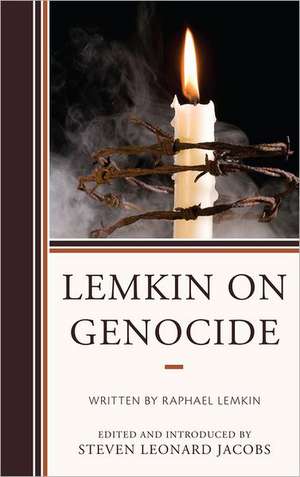
Lemkin on Genocide
Autor Steven Leonard Jacobsen Limba Engleză Hardback – 9 aug 2012
| Toate formatele și edițiile | Preț | Express |
|---|---|---|
| Paperback (1) | 335.04 lei 6-8 săpt. | |
| Bloomsbury Publishing – 12 mar 2014 | 335.04 lei 6-8 săpt. | |
| Hardback (1) | 869.13 lei 6-8 săpt. | |
| Bloomsbury Publishing – 9 aug 2012 | 869.13 lei 6-8 săpt. |
Preț: 869.13 lei
Preț vechi: 1128.74 lei
-23%
Puncte Express: 1304
Preț estimativ în valută:
153.86€ • 179.01$ • 133.43£
153.86€ • 179.01$ • 133.43£
Carte tipărită la comandă
Livrare economică 28 februarie-14 martie
Preluare comenzi: 021 569.72.76
Specificații
ISBN-13: 9780739145265
ISBN-10: 0739145266
Pagini: 430
Dimensiuni: 159 x 232 x 39 mm
Greutate: 0.79 kg
Ediția:Adnotată
Editura: Bloomsbury Publishing
Colecția Lexington Books
Locul publicării:New York, United States
ISBN-10: 0739145266
Pagini: 430
Dimensiuni: 159 x 232 x 39 mm
Greutate: 0.79 kg
Ediția:Adnotată
Editura: Bloomsbury Publishing
Colecția Lexington Books
Locul publicării:New York, United States
Recenzii
[In Lemkin on Genocide] we gain a new appreciation for the depth of Lemkin's theoretical understanding and the breadth of his research. In addition, reading Jacob's book provides us a richer sense of how Lemkin fit into the ideological currents of his time. In editing this work, Steve has done a great service to all those interested in genocide.
Steven L. Jacobs' edition of Raphael Lemkin's seminal study of genocide is long overdue. This remarkable volume is the first systematic investigation of the crime that, until Lemkin, had no name. A must for all students of genocide, it explores the phenomenon from the Assyrian conquests in the ancient world to the German exploitation of colonial Africa. Jacobs' highly informative introduction situates Lemkin's research within the context of his life and work. The analytical annotations of Lemkin's findings reflect Jacobs' encyclopedic familiarity with the multi-disciplinary field. They provide helpful insights into the relation between the founder of the field of genocide studies and all who have followed him.
Steven Leonard Jacobs has undertaken the mammoth task of annotating and reproducing Lemkin's original text, a work requiring care, erudition, and extensive knowledge. He is to be commended for his effort and his initiative in rescuing Lemkin's huge work and bringing it, after eight decades of oblivion, finally to fruition.
Scholars and students alike will benefit from Steven Leonard Jacobs' careful scholarly work elucidating obscure references, clarifying incomplete footnotes, and updating bibliographies in Raphael Lemkin's History of Genocide. Jacobs' Lemkin on Genocide will prove to be an indispensable reference for scholars and serious students of genocide.
Steven Jacobs has rendered a valuable service to genocide scholars with the appearance of this book. Jacobs, himself a distinguished genocide scholar, makes accessible Raphael Lemkins' previously unpublished Introduction to the Study of Genocide and three-part History of Genocide. Professor Jacobs' Introduction and notes makes this an indispensable work. If Lemkin is the "Father of Genocide studies," Steven Jacobs is one of his worthy intellectual sons.
Steven L. Jacobs' edition of Raphael Lemkin's seminal study of genocide is long overdue. This remarkable volume is the first systematic investigation of the crime that, until Lemkin, had no name. A must for all students of genocide, it explores the phenomenon from the Assyrian conquests in the ancient world to the German exploitation of colonial Africa. Jacobs' highly informative introduction situates Lemkin's research within the context of his life and work. The analytical annotations of Lemkin's findings reflect Jacobs' encyclopedic familiarity with the multi-disciplinary field. They provide helpful insights into the relation between the founder of the field of genocide studies and all who have followed him.
Steven Leonard Jacobs has undertaken the mammoth task of annotating and reproducing Lemkin's original text, a work requiring care, erudition, and extensive knowledge. He is to be commended for his effort and his initiative in rescuing Lemkin's huge work and bringing it, after eight decades of oblivion, finally to fruition.
Scholars and students alike will benefit from Steven Leonard Jacobs' careful scholarly work elucidating obscure references, clarifying incomplete footnotes, and updating bibliographies in Raphael Lemkin's History of Genocide. Jacobs' Lemkin on Genocide will prove to be an indispensable reference for scholars and serious students of genocide.
Steven Jacobs has rendered a valuable service to genocide scholars with the appearance of this book. Jacobs, himself a distinguished genocide scholar, makes accessible Raphael Lemkins' previously unpublished Introduction to the Study of Genocide and three-part History of Genocide. Professor Jacobs' Introduction and notes makes this an indispensable work. If Lemkin is the "Father of Genocide studies," Steven Jacobs is one of his worthy intellectual sons.