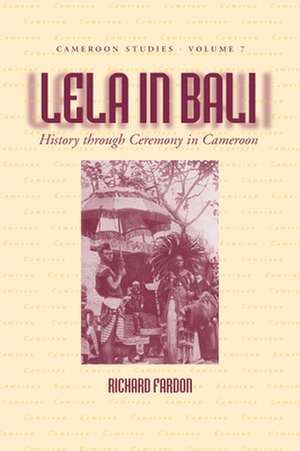
Lela in Bali: Cameroon Studies, cartea 7
Autor Richard Fardonen Limba Engleză Hardback – 20 dec 2006
"...constitutes an outstanding contribution in the study of history outside the traditional perspective of recourse to narrative sources (whether these be oral or written)." African Affairs
"This amazing book...represents a model for scholars seeking to blend the tools of history writing and political/ cultural anthropology; its value is applicable not only in Cameroon, but elsewhere." International Journal for African Historical Studies
"With the suspense of a detective novel, [this slim, richly detailed volume] proceeds in a series of comparisons...This charming book is an exacting exercise in comparison and historical reconstruction." Bulletin of the School of Oriental and African Studies
"...an important contribution - not only to the local history of the Grasslands of Cameroon. It offers a better understanding of processes of transformation of rituals and asks important methodological questions, which should be of interest to anybody dealing with the history of early photography in Africa and visual anthropology. As to be expected from the "Cameroon Studies" series the volume is rounded up by a comprehensive bibliography and a very useful index." Anthropos
"As in his previous works, Fardon does not make it easy for his readers to labour through his dense writing. However, it is absolutely worthwhile. This unconventional book contains a wealth of insights with far-reaching methodological consequences. It demonstrates how to recover history without even for a moment losing sight of the constructivity of the knowledge produced." Journal of African History
Lela in Bali tells the story of an annual festival of eighteenth-century kingdoms in Northern Cameroon that was swept up in the migrations of marauding slave-raiders during the nineteenth century and carried south towards the coast. Lela was transformed first into a mounted durbar, like those of the Muslim states, before evolving in tandem with the German colonial project into a festival of arms. Reinterpreted by missionaries and post-colonial Cameroonians, Lela has become one of the most important of Cameroonian festivals and a crucial marker of identity within the state. Richard Fardon's recuperation of two hundred years of history is an essential contribution not only to Cameroonian studies but also to the broader understanding of the evolution of African cultures.
Richard Fardon, Professor of West African Anthropology in the University of London, is the author of four monographs on West Africa, as well as numerous works of anthropological theory. Since 1988 he has taught at the School of Oriental and African Studies, where he chaired the University of London's Centre of African Studies for eight years. In addition to its obvious archival sources, this book draws upon ethnographic research he began in Nigeria (from 1976) and in Cameroon (from 1984). Richard Fardon has been editor of the journal AFRICA since 2001.



Preț: 757.29 lei
Preț vechi: 983.49 lei
-23%
Puncte Express: 1136
Carte tipărită la comandă
Livrare economică 23 noiembrie-07 decembrie
Livrare prin curier în România Termenul estimat este afișat lângă disponibilitate.
Transport gratuit pentru acest produs Plată online sau ramburs, în funcție de opțiunile comenzii.
Retur gratuit în 14 zile Comandă securizată și suport în română.
Specificații
ISBN-13: 9781845452155
ISBN-10: 1845452151
Pagini: 178
Dimensiuni: 157 x 235 x 14 mm
Greutate: 0.42 kg
Editura: BERGHAHN BOOKS
Colecția Cameroon Studies
Seria Cameroon Studies
ISBN-10: 1845452151
Pagini: 178
Dimensiuni: 157 x 235 x 14 mm
Greutate: 0.42 kg
Editura: BERGHAHN BOOKS
Colecția Cameroon Studies
Seria Cameroon Studies
V-ar putea interesa
-
 Malcolm XManning Marable-27%Preț: 88.79 lei121.51 lei
 -
 -23%Preț: 219.42 lei284.93 lei
 -
 The Works of Alain LockeCharles Molesworth-30%Preț: 578.54 lei831.37 lei
 -
 Jones, C: Behind the DreamClarence B. JonesPreț: 71.66 lei
 -
 A Breath of FreedomM. HöhnPreț: 468.05 lei
 -
 The Black Campus MovementIbram X KendiPreț: 276.28 lei
 -
 Mau Mau in Harlem?G. Horne-15%Preț: 602.14 lei708.40 lei
 -
 Head Off & Split: PoemsNikky FinneyPreț: 102.97 lei
 -
 The New BlackEvie ShockleyPreț: 85.48 lei
 -
 Politics of InnocenceSimon TurnerPreț: 225.45 lei
 -
 Hmong and American: From Refugees to CitizensVincent K. HerPreț: 133.53 lei
 -
 Our Southern Home-Scottsboro to Montgomery to BirminghamWaights Taylor JrPreț: 197.34 lei
 -
 Cultures and CrisesMary Douglas-15%Preț: 448.20 lei527.29 lei
 -
 Shoulda Been Jimi SavannahPatricia SmithPreț: 94.52 lei
 -
 Ira Aldridge – The African RosciusBernth LindforsPreț: 289.20 lei
Notă biografică
Richard Fardon, Professor of West African Anthropology in the University of London, is the author of four monographs on West Africa, as well as numerous works of anthropological theory. Since 1988 he has taught at the School of Oriental and African Studies, where he chaired the University of London's Centre of African Studies for eight years. In addition to its obvious archival sources, this book draws upon ethnographic research he began in Nigeria (from 1976) and in Cameroon (from 1984). Richard Fardon has been editor of the journal AFRICA since 2001.
Cuprins
Map and Figures
Preface
Acknowledgements
Chapter 1. Lela: Past Present, Present Past
References
Preface
Acknowledgements
Chapter 1. Lela: Past Present, Present Past
- Lela in the Early Post-Colony Bali
- Nyonga: A Thumbnail History
- Lela and Voma in Bali
- The Ethnologist and the Missionaries
- Ankermann and the Missionaries
- Photographed: The Second Photographer
- The Texts and the Photographs
- An Inventory of the Photographic Record of the 1908 Lela
- Conclusion
- The Missionaries' Version 1903 to 1913
- The Ethnologist's Version 1907 to 1908
- The Soldier's and Trader's Versions 1889 to 1906
- Interlude: The Bali Axis Unravels
- The Anthropologist and the Historian: A 1960s Version
- The Ba'ni before the Germans T
- he Apogee of Germano-Bali Majesty: The 1905 Paramountcy
- The Importance of Origins
- More is More
- Lela Adopted in the Grassfields
- Lela and Voma in the Bali kingdoms
- 'Spear Washing' in the Benue Chamba
- Chiefdoms: Flags, Gowns and Horses
- Adamawan Elements in Lela: Death, Killing and Commemoration
References
- Published References
- Unpublished References