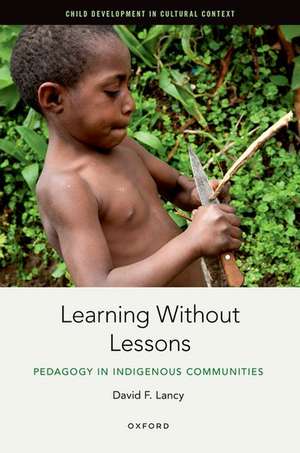
Learning Without Lessons: Pedagogy in Indigenous Communities: Child Development in Cultural Context
Autor David F. Lancyen Limba Engleză Hardback – 2 mar 2024

Preț: 551.68 lei
Preț vechi: 649.04 lei
-15%
Puncte Express: 828
Carte disponibilă
Livrare economică 05-19 noiembrie
Livrare express 22-28 octombrie pentru 37.44 lei
Livrare prin curier în România Termenul estimat este afișat lângă disponibilitate.
Transport gratuit pentru acest produs Plată online sau ramburs, în funcție de opțiunile comenzii.
Retur gratuit în 14 zile Comandă securizată și suport în română.
Specificații
ISBN-13: 9780197645598
ISBN-10: 0197645593
Pagini: 296
Ilustrații: 33 text boxes; 1 b/w photograph
Dimensiuni: 224 x 79 x 36 mm
Greutate: 0.61 kg
Editura: Oxford University Press
Colecția OUP USA
Seria Child Development in Cultural Context
Locul publicării:New York, United States
ISBN-10: 0197645593
Pagini: 296
Ilustrații: 33 text boxes; 1 b/w photograph
Dimensiuni: 224 x 79 x 36 mm
Greutate: 0.61 kg
Editura: Oxford University Press
Colecția OUP USA
Seria Child Development in Cultural Context
Locul publicării:New York, United States
Recenzii
A century on from Mead, childhood is an area where the world desperately needs anthropology, and Lancy's book is a valuable resource for showing why.
This book is a brilliant overview of Indigenous children's learning. I recommend it to teachers and parents. It challenges thinking about children's capabilities and preferences. It challenges claims about what aspects of human development are innate and universal.
Learning Without Lessons is about the acquisition of knowledge through these natural activities children are engaged in during their family and community routines of life. Bringing these ways of learning to life in rich detail is the first goal of this terrific book by David Lancy.
Recommended. Graduate students and faculty only.
I found this book a brilliant overview of Indigenous children's learning. I recommend it to teachers and parents. It will stimulate a re-assessment of whether WEIRD communities are adequately child-friendly. It challenges thinking about children's capabilities and preferences. It challenges claims about what aspects of developmental psychology are innate and universal.
Lancy draws on the research on learning from a wide range of authors from general anthropology and educational anthropology, psychological anthropology, developmental psychology, comparative education, and cultural psychology. He uses ethnographic texts from the books, articles, and monographs assembled in the Human Relations Area Files (HRAF) on learning, parenting, and child development. He includes a very wide range of examples and conceptual frameworks. Indeed, Lancy's reference list is a comprehensive go-to for those interested in this field.
I recommend supplementing Lancy's ethnological insights with analyses of why WEIRD societies approach childhood as they do (I introduce concepts such as adultism, White Saviour Complex, and binary dualisms, contextualised with history of Western science and imperialism). A century on from Mead, childhood is an area where the world desperately needs anthropology, and Lancy's book is a valuable resource forshowing why.
I typically dog-ear the pages of a new nonfiction book related to play, the bent folds serving as markers of ideas that I wished to return to at a later time. My copy of David Lancy's new book now looks like a concertina…Lancy's book offers case after case from Indigenous communities all over the world in an almost dizzying display of ethnographic wonder, that in many communities, the ethnography of record describes not just a lack of teaching, but teaching avoidance. Instead, there is much observation, a waiting for children's own individualized readiness to join in the tasks at hand. And as children practice, they play… Playworkers and play advocates who trust in children's ability to learn will smile with recognition here-children have much to teach each other and to teach us. Grownups may do them a favor by just getting out of the way.
Learning Without Lessons is a must-read for anthropologists, educators, and anyone interested in child development across cultures. Lancy's work serves as both a tribute to Indigenous communities and a call to reevaluate the rigid frameworks of modern education. I am sure it will not be too long before I meet someone who, in a casual conversation, upon hearing that I am an anthropologist of childhood, will mention how Learning Without Lessons has deeply inspired them to think otherwise about children and education.
This book is a brilliant overview of Indigenous children's learning. I recommend it to teachers and parents. It challenges thinking about children's capabilities and preferences. It challenges claims about what aspects of human development are innate and universal.
Learning Without Lessons is about the acquisition of knowledge through these natural activities children are engaged in during their family and community routines of life. Bringing these ways of learning to life in rich detail is the first goal of this terrific book by David Lancy.
Recommended. Graduate students and faculty only.
I found this book a brilliant overview of Indigenous children's learning. I recommend it to teachers and parents. It will stimulate a re-assessment of whether WEIRD communities are adequately child-friendly. It challenges thinking about children's capabilities and preferences. It challenges claims about what aspects of developmental psychology are innate and universal.
Lancy draws on the research on learning from a wide range of authors from general anthropology and educational anthropology, psychological anthropology, developmental psychology, comparative education, and cultural psychology. He uses ethnographic texts from the books, articles, and monographs assembled in the Human Relations Area Files (HRAF) on learning, parenting, and child development. He includes a very wide range of examples and conceptual frameworks. Indeed, Lancy's reference list is a comprehensive go-to for those interested in this field.
I recommend supplementing Lancy's ethnological insights with analyses of why WEIRD societies approach childhood as they do (I introduce concepts such as adultism, White Saviour Complex, and binary dualisms, contextualised with history of Western science and imperialism). A century on from Mead, childhood is an area where the world desperately needs anthropology, and Lancy's book is a valuable resource forshowing why.
I typically dog-ear the pages of a new nonfiction book related to play, the bent folds serving as markers of ideas that I wished to return to at a later time. My copy of David Lancy's new book now looks like a concertina…Lancy's book offers case after case from Indigenous communities all over the world in an almost dizzying display of ethnographic wonder, that in many communities, the ethnography of record describes not just a lack of teaching, but teaching avoidance. Instead, there is much observation, a waiting for children's own individualized readiness to join in the tasks at hand. And as children practice, they play… Playworkers and play advocates who trust in children's ability to learn will smile with recognition here-children have much to teach each other and to teach us. Grownups may do them a favor by just getting out of the way.
Learning Without Lessons is a must-read for anthropologists, educators, and anyone interested in child development across cultures. Lancy's work serves as both a tribute to Indigenous communities and a call to reevaluate the rigid frameworks of modern education. I am sure it will not be too long before I meet someone who, in a casual conversation, upon hearing that I am an anthropologist of childhood, will mention how Learning Without Lessons has deeply inspired them to think otherwise about children and education.
Notă biografică
David F. Lancy, Ph.D., is Emeritus Professor of Anthropology at Utah State University. Beginning in 1968 in Liberia, Lancy has done extensive cross-cultural fieldwork and repeated surveys of the ethnographic record with children as the focus. In total, he has authored eleven books and edited three. His current research interests center on the study of delayed personhood, the chore curriculum, children as a reserve labor force, children growing up in a Neontocracy, how children acquire their culture, socio-historical analyses of schooling, and the culture of street kids. His distinctions include the Utah State University Career Scholar award and Carnegie award for teaching excellence.
Cuprins
- Preface
- Chapter 1: Pedagogy and Culture
- Chapter 2: Babies as Students?
- Chapter 3: The Self-Starting Learner
- Chapter 4: Everyday Classrooms
- Chapter 5: The Chore Curriculum
- Chapter 6: The Transition to Structured Learning
- Chapter 7: Global WEIRDing
- References
- Index