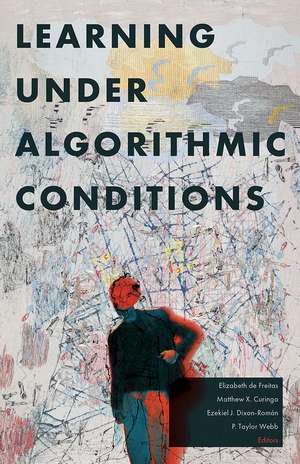
Learning Under Algorithmic Conditions
en Limba Engleză Paperback – 14 iul 2026
Learning Under Algorithmic Conditions presents twenty-seven concise essays that collectively chart the shifting terrain of learning in the age of artificial intelligence. Providing historical and philosophical context, this innovative volume features prominent scholars from the fields of media studies, philosophy, and education research, who shed light on how learning has become newly envisioned, machinic, and more-than-human. The contributors unravel various histories of machine intelligence and elucidate the current impact of machine learning technologies on practices of knowledge production. Teeming with theoretical and practical insights, Learning Under Algorithmic Conditions is an interdisciplinary guide for those working across the humanities and social sciences as well as anyone interested in understanding our changing social, political, and technical infrastructures.
Contributors: Craig Carson, Adelphi U; Felicity Coleman, U of the Arts London; Ed Dieterle; Shayan Doroudi, U of California, Irvine; David Gauthier, Utrecht U; Cathrine Hasse, Aarhus U; Talha Can İşsevenler, CUNY; Goda Klumbytė; Robb Lindgren, U of Illinois Urbana-Champaign; Michael Madiao; Henry Neim Osman; Luciana Parisi, Duke U; Carolyn Pedwell, Lancaster U; Arkady Plotnitsky, Purdue U; Julian Quiros, U of Pennsylvania; Sina Rismanchian; Warren Sack, U of California, Santa Cruz; R. Joshua Scannell, The New School; Gregory J. Seigworth, Millersville U; Rebecca Uliasz, U of Michigan; David Wagner, U of New Brunswick; Ben Williamson, U of Edinburgh.
Retail e-book files for this title are screen-reader friendly with images accompanied by short alt text and/or extended descriptions.
Preț: 195.08 lei
Precomandă
Puncte Express: 293
Carte nepublicată încă
Livrare prin curier în România Precomanda se expediază când titlul devine disponibil.
Transport gratuit de la 400.00 lei Plată online sau ramburs, în funcție de opțiunile comenzii.
Retur gratuit în 14 zile Comandă securizată și suport în română.
Doresc să fiu notificat când acest titlu va fi disponibil:
Se trimite...
Specificații
ISBN-13: 9781517920050
ISBN-10: 1517920051
Pagini: 336
Ilustrații: 19 black and white illustrations and 1 table
Dimensiuni: 140 x 216 x 23 mm
Greutate: 0.43 kg
Editura: University of Minnesota Press
Colecția Univ Of Minnesota Press
ISBN-10: 1517920051
Pagini: 336
Ilustrații: 19 black and white illustrations and 1 table
Dimensiuni: 140 x 216 x 23 mm
Greutate: 0.43 kg
Editura: University of Minnesota Press
Colecția Univ Of Minnesota Press
Notă biografică
Elizabeth de Freitas is professor at Adelphi University. She is author of Posthuman Social Science and Computational Culture: Essays on Methodology, Theory, and Practice and coauthor of Mathematics and the Body: Material Entanglements in the Classroom.
Matthew X. Curinga is a software developer, associate professor of educational technology and computer science education at Adelphi University, and cofounder of the MIXI Institute for STEM and the Imagination.
Ezekiel J. Dixon-Román is professor of critical race, media, and educational studies and director of the Edmund W. Gordon Institute for Advanced Study at Teachers College, Columbia University. He is author of Inheriting Possibility: Social Reproduction and Quantification in Education (Minnesota, 2017).
P. Taylor Webb is professor in the Department of Educational Studies at the University of British Columbia. He is coauthor of Education Policy and Racial Biopolitics in Multicultural Cities and Algorithms of Education: How Datafication and Artificial Intelligence Shape Policy (Minnesota, 2022).
Matthew X. Curinga is a software developer, associate professor of educational technology and computer science education at Adelphi University, and cofounder of the MIXI Institute for STEM and the Imagination.
Ezekiel J. Dixon-Román is professor of critical race, media, and educational studies and director of the Edmund W. Gordon Institute for Advanced Study at Teachers College, Columbia University. He is author of Inheriting Possibility: Social Reproduction and Quantification in Education (Minnesota, 2017).
P. Taylor Webb is professor in the Department of Educational Studies at the University of British Columbia. He is coauthor of Education Policy and Racial Biopolitics in Multicultural Cities and Algorithms of Education: How Datafication and Artificial Intelligence Shape Policy (Minnesota, 2022).
Cuprins
Contents
Introduction
Elizabeth de Freitas, Matthew X. Curinga, Ezekiel J. Dixon-Román, and P. Taylor Webb
Part I. Imitation, Thought, and Reason {~?~TN: Book page 1}
1. Technics and Text: Guided by Gilbert Simondon
Elizabeth de Freitas
2. Deviation Games: Desire and the Pedagogy of Thought
Arkady Plotnitsky
3. Number Sense in Large Language Models
Julian Quiros
Part II. Bodies, Brains, and Common Sense
4. Neuro-symbolic Algorithms and the Infant Mind
Elizabeth de Freitas
5. The Problem of Algorithmic Commonsense Learning
Carolyn Pedwell
6. Learning on the Neuromorphic Circuit
Henry Neim Osman
Part III. Curriculum, Control, and Computation
7. Who Controls the Curriculum for AI? The Limits of Participatory Design for Educational AI
Michael Madaio
8. Learning to Program
Warren Sack
9. Computational Thinking and Software Studies
Matthew X. Curinga
Part IV. Mysticism, Robots, and Genetic Algorithms
10. Machine Learning Ecologies and Self-Organization
Craig Carson
11. Meaningful Robot Learning
Cathrine Hasse
12. Bioinformatic Algorithms and Educational Genomics
Ben Williamson
Part V. Viral Affect and School Interfaces
13. The Urban Public School as Cybernetic Apparatus
Rebecca Uliasz
14. Algorithms and Immediacy
Gregory J. Seigworth
15. Responsible AI and Learning to Language
David Wagner
Part VI. The Onto-Epistemology of Colonial Instrumental Reason
16. Machining Coloniality and Learning Otherwise
R. Joshua Scannell
17. Noisy Compression and Colonial Violence
Luciana Parisi
18. Instrumentalizing Colonial Reason
Ezekiel Dixon-Román
Part VII. Life and the Limits of Computation
19. Learning in the New Dispersed Prime Time
Talha Can İşsevenler
20. Machine Learning and the Digital Archiving of Death
Felicity Colman
21. Thinking Softly with Incomputability
P. Taylor Webb
Part VIII. Multimodal Learning with Unruly Tools
22. Learning by Co-constructing with Stupid (but Useful) Generative AI
Sina Rismanchian and Shayan Doroudi
23. Digital Technologies and Perceptual Curation
Robb Lindgren
24. Technosocial Scotomas in the Algorithmic Age
Edward Dieterle
Part IX. The Disruptive Technical Being of Generative AI
25. Prompt Battles and the Conundrums of Logos
David Gauthier
26. Machine Learning and Its Operational Diagrams
Goda Klumbytė
27. Algorithmic Creativity, Deception, and Delirium
Elizabeth de Freitas
Acknowledgments
Contributors
Introduction
Elizabeth de Freitas, Matthew X. Curinga, Ezekiel J. Dixon-Román, and P. Taylor Webb
Part I. Imitation, Thought, and Reason {~?~TN: Book page 1}
1. Technics and Text: Guided by Gilbert Simondon
Elizabeth de Freitas
2. Deviation Games: Desire and the Pedagogy of Thought
Arkady Plotnitsky
3. Number Sense in Large Language Models
Julian Quiros
Part II. Bodies, Brains, and Common Sense
4. Neuro-symbolic Algorithms and the Infant Mind
Elizabeth de Freitas
5. The Problem of Algorithmic Commonsense Learning
Carolyn Pedwell
6. Learning on the Neuromorphic Circuit
Henry Neim Osman
Part III. Curriculum, Control, and Computation
7. Who Controls the Curriculum for AI? The Limits of Participatory Design for Educational AI
Michael Madaio
8. Learning to Program
Warren Sack
9. Computational Thinking and Software Studies
Matthew X. Curinga
Part IV. Mysticism, Robots, and Genetic Algorithms
10. Machine Learning Ecologies and Self-Organization
Craig Carson
11. Meaningful Robot Learning
Cathrine Hasse
12. Bioinformatic Algorithms and Educational Genomics
Ben Williamson
Part V. Viral Affect and School Interfaces
13. The Urban Public School as Cybernetic Apparatus
Rebecca Uliasz
14. Algorithms and Immediacy
Gregory J. Seigworth
15. Responsible AI and Learning to Language
David Wagner
Part VI. The Onto-Epistemology of Colonial Instrumental Reason
16. Machining Coloniality and Learning Otherwise
R. Joshua Scannell
17. Noisy Compression and Colonial Violence
Luciana Parisi
18. Instrumentalizing Colonial Reason
Ezekiel Dixon-Román
Part VII. Life and the Limits of Computation
19. Learning in the New Dispersed Prime Time
Talha Can İşsevenler
20. Machine Learning and the Digital Archiving of Death
Felicity Colman
21. Thinking Softly with Incomputability
P. Taylor Webb
Part VIII. Multimodal Learning with Unruly Tools
22. Learning by Co-constructing with Stupid (but Useful) Generative AI
Sina Rismanchian and Shayan Doroudi
23. Digital Technologies and Perceptual Curation
Robb Lindgren
24. Technosocial Scotomas in the Algorithmic Age
Edward Dieterle
Part IX. The Disruptive Technical Being of Generative AI
25. Prompt Battles and the Conundrums of Logos
David Gauthier
26. Machine Learning and Its Operational Diagrams
Goda Klumbytė
27. Algorithmic Creativity, Deception, and Delirium
Elizabeth de Freitas
Acknowledgments
Contributors