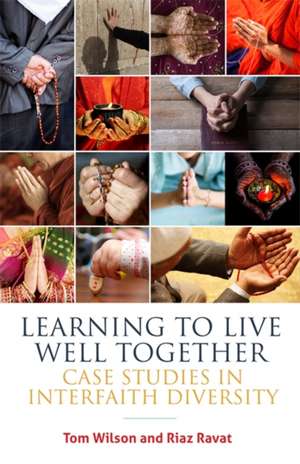
Learning to Live Well Together: Case Studies in Interfaith Diversity
Autor Revd. Tom Wilson, Riaz Ravaten Limba Engleză Paperback – iun 2017
This ground-breaking book draws on the work at the St Philip's Centre in Leicester and presents a collection of case studies to show how people from a variety of religious backgrounds and ethical convictions have learnt to coexist peacefully. Without shying away from the conflicts and challenges that have occurred, the book focuses on the lessons learnt and offers real examples of how to promote positive interfaith relationships.
This is an excellent resource for anyone wishing to understand the issues of religion and belief that may arise at local and national levels, and develop appropriate attitudes and actions for peaceful resolution.
Preț: 183.11 lei
Preț vechi: 243.29 lei
-25%
Puncte Express: 275
Carte disponibilă
Livrare economică 16-30 noiembrie
Livrare prin curier în România Termenul estimat este afișat lângă disponibilitate.
Transport gratuit de la 400.00 lei Plată online sau ramburs, în funcție de opțiunile comenzii.
Retur gratuit în 14 zile Comandă securizată și suport în română.
Specificații
ISBN-13: 9781785921940
ISBN-10: 1785921940
Pagini: 176
Ilustrații: 10 black and white photographs
Dimensiuni: 156 x 216 x 11 mm
Greutate: 0.23 kg
Editura: JESSICA KINGSLEY PUBLISHERS
Colecția Jessica Kingsley Publishers
Locul publicării:London, United Kingdom
ISBN-10: 1785921940
Pagini: 176
Ilustrații: 10 black and white photographs
Dimensiuni: 156 x 216 x 11 mm
Greutate: 0.23 kg
Editura: JESSICA KINGSLEY PUBLISHERS
Colecția Jessica Kingsley Publishers
Locul publicării:London, United Kingdom
V-ar putea interesa
-
 The Story of the Design MuseumTom Wilson-14%Preț: 67.72 lei78.77 lei
 -
 365 Ways to Raise Your FrequencyMelissa AlvarezPreț: 110.59 lei
 -
 Preț: 103.79 lei
 -
 Rebuild Aircooled VW Engines HP255Tom WilsonPreț: 221.16 lei
 -
 Preț: 212.76 lei
 -
 Spiritual EnlightenmentJed MckennaPreț: 137.34 lei
 -
 Preț: 121.01 lei
 -
 Tantric Sex for Men: Making Love a MeditationDiana Richardson-24%Preț: 87.53 lei115.50 lei
 -
 Unclouded by Longing: Meditations on Autism and Being Present in an Overwhelming WorldChristopher Goodchild-20%Preț: 101.95 lei127.98 lei
 -
 If You Sit Very StillMarian Partington-19%Preț: 119.26 lei147.17 lei
 -
 Life After DeathDeepak Chopra-20%Preț: 85.64 lei106.64 lei
 -
 Why Is God Laughing?Deepak ChopraPreț: 91.93 lei
Recenzii
Modern Britain is diverse and this is an exemplar of imaginative interfaith work from Leicester. Now with much experience of changing contexts, the authors maturely celebrate what is possible whilst addressing the hard challenges. Here we see some next steps to try out as we attempt living well together.
Even before moving to Leicester, I had heard much talk of the 'Leicester model' of social cohesion. As this book makes clear, there is much that is unique about Leicester, but also much that this wonderful city can teach us about one of the defining questions of our time: how we can learn to live well together.
I urge all to read this book and learn from Tom Wilson's and Riaz Ravat's exciting work in Leicester. This excellent book will develop your understanding of living and integrating in a multicultural society that the UK so clearly is today.
Undoubtedly a well-researched, highly readable book. It highlights the importance of living well and working together for the shared common good through mutual understanding of the traditions, teachings and practices of diverse communities. The book presents the St Philip's Centre's positive approach to community cohesion and inter-faith issues.
Learning to Live Well Together gives real world examples of how individuals and communities can build safer, stronger and happier lives by engaging in dialogue, interaction and in the development of social connections that ensure more resilient communities. Today, the global challenges have grown and ensuring that people and communities can weather some of the winds that buffet us, is key. This book highlights these practical and real world examples and therefore can also inspire many to be the 'forces for good' that this country continuously needs.
An Unexpected Treasure... Perhaps no community in the world has generated the kind of transforming interfaith dialogue with measurable results that Leicester is experiencing. During and after the Brexit vote, hate crimes doubled in Leicester; but they multiplied five-fold in the rest of the country. This well-documented and indexed 178-page narrative sheds light on how and why Leicester did so much better. The book is a clear candidate for best interfaith book of 2017...
This is a pioneering book that sets our assumptions topsy-turvy, makes us rethink the whole process of dialogue with 'the other,' and offers directions for a peaceful world in spite of all the conflict we face today. It is an invaluable resource for interfaith activists. With this kind of approach, the possibilities of an authentic, effective interfaith movement become brighter. Co-authors Tom Wilson, director of St. Philip's Centre, and Riaz Ravat, deputy director, have done their homework and leave us with tools to empower any interfaith activist.
Learning to live well together is vitally important in over-coming prejudice, in healing society's divisions and reducing the dangers of extremism... The [St Philip's] Centre is, as I know from some personal knowledge of its activities, doing excellent work. Leaders of local interfaith groups, many of which are doing similar important work, will be helped by reading it [Learning to Live Well Together].
Even before moving to Leicester, I had heard much talk of the 'Leicester model' of social cohesion. As this book makes clear, there is much that is unique about Leicester, but also much that this wonderful city can teach us about one of the defining questions of our time: how we can learn to live well together.
I urge all to read this book and learn from Tom Wilson's and Riaz Ravat's exciting work in Leicester. This excellent book will develop your understanding of living and integrating in a multicultural society that the UK so clearly is today.
Undoubtedly a well-researched, highly readable book. It highlights the importance of living well and working together for the shared common good through mutual understanding of the traditions, teachings and practices of diverse communities. The book presents the St Philip's Centre's positive approach to community cohesion and inter-faith issues.
Learning to Live Well Together gives real world examples of how individuals and communities can build safer, stronger and happier lives by engaging in dialogue, interaction and in the development of social connections that ensure more resilient communities. Today, the global challenges have grown and ensuring that people and communities can weather some of the winds that buffet us, is key. This book highlights these practical and real world examples and therefore can also inspire many to be the 'forces for good' that this country continuously needs.
An Unexpected Treasure... Perhaps no community in the world has generated the kind of transforming interfaith dialogue with measurable results that Leicester is experiencing. During and after the Brexit vote, hate crimes doubled in Leicester; but they multiplied five-fold in the rest of the country. This well-documented and indexed 178-page narrative sheds light on how and why Leicester did so much better. The book is a clear candidate for best interfaith book of 2017...
This is a pioneering book that sets our assumptions topsy-turvy, makes us rethink the whole process of dialogue with 'the other,' and offers directions for a peaceful world in spite of all the conflict we face today. It is an invaluable resource for interfaith activists. With this kind of approach, the possibilities of an authentic, effective interfaith movement become brighter. Co-authors Tom Wilson, director of St. Philip's Centre, and Riaz Ravat, deputy director, have done their homework and leave us with tools to empower any interfaith activist.
Learning to live well together is vitally important in over-coming prejudice, in healing society's divisions and reducing the dangers of extremism... The [St Philip's] Centre is, as I know from some personal knowledge of its activities, doing excellent work. Leaders of local interfaith groups, many of which are doing similar important work, will be helped by reading it [Learning to Live Well Together].
Cuprins
Introduction. 1. The Leicester Context. 2. The St Philip's Centre. 3. Encounter. 4. Understand. 5. Trust. 6. Co-operate. 7. Inter-faith in the Twenty-first Century. 8. Where Next? References.