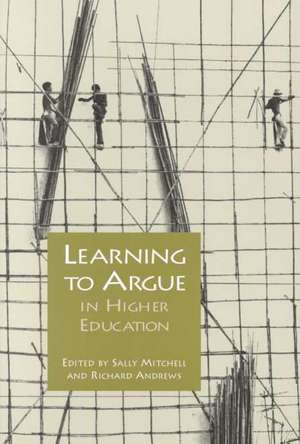
Learning to Argue in Higher Education
en Limba Engleză Paperback – 24 mar 2000
This volume makes a significant contribution to the current thinking about argument, addressing why we teach argument in the first place, how it currently figures in teaching and learning, and how me might think about it in more productive ways. Covering everything from formal discussion in seminars to tutorials and written essays, these authors approach the problem from different angles: critical accounts of practice, classroom pedagogy, as well theoretical models of argument, students' perspective on learning, and the dynamics involved in teaching and learning. The book represents a range of disciplines, including architecture, law, social science, work-based education, as well as writing and composition.
Preț: 422.49 lei
Puncte Express: 634
Carte indisponibilă temporar
Doresc să fiu notificat când acest titlu va fi disponibil:
Se trimite...
Specificații
ISBN-13: 9780867094985
ISBN-10: 0867094982
Pagini: 192
Dimensiuni: 153 x 228 x 11 mm
Greutate: 0.27 kg
Editura: Heinemann Educational Books
ISBN-10: 0867094982
Pagini: 192
Dimensiuni: 153 x 228 x 11 mm
Greutate: 0.27 kg
Editura: Heinemann Educational Books
Descriere
Learning to Argue in Higher Education promises to make a substantial contribution to the thinking about argument in rhetoric and composition.
- John M. Trimbur, Worcester Polytechnical University
"Argument" is perhaps one of the most misunderstood terms in higher education, meaning different things in different disciplines. Yet on one thing most educators agree: it is almost impossible to attain success at the highest levels in the humanities, arts, social sciences, and other language-based disciplines without a command of argumentative skills. Learning to Argue in Higher Education was written to allow for a cross-fertilization of ideas about argument between different disciplines and traditions, and to encourage conversation about their approaches to its teaching and learning.- John M. Trimbur, Worcester Polytechnical University
This volume makes a significant contribution to the current thinking about argument, addressing why we teach argument in the first place, how it currently figures in teaching and learning, and how me might think about it in more productive ways. Covering everything from formal discussion in seminars to tutorials and written essays, these authors approach the problem from different angles: critical accounts of practice, classroom pedagogy, as well theoretical models of argument, students' perspective on learning, and the dynamics involved in teaching and learning. The book represents a range of disciplines, including architecture, law, social science, work-based education, as well as writing and composition.
Cuprins
Contents: Introduction: Learning to Argue in Higher Education, R. Andrews
Innocent Concepts? A Paradigmatic Approach to Argument, A. Eisenschitz
Rhetoric and Architecture, P. Medway
Blinded by the Enlightenment: Epistemological Constraints and Pedagogical Restraints in the Pursuit of "Critical" Thinking, D. Sweet & D. Swanson
Improving Argument by Parts, M. Riddle
A Workable Balance: Self and Sources in Argumentative Writing, N. Groom
"I Don't Have to Argue My Design-The Visual Speaks for Itself": A Case Study of Mediated Activity in an Introductory Mechanical Engineering Course, M. Mathison
"Context Cues Cognition": Writing, Rhetoric, and Legal Argumentation, P. Maharg
Eager Interpreters: Student Writers and the Art of Writing Research, C. Woods
Citation as an Argumentation Strategy in the Reflective Writing of Work-Based Learning Students, C. Costley & K. Doncaster 1
Teaching Writing Theory as Liberatory Practice: Helping Students Chart the Dangerous Waters of Academic Discourse Across Disciplines in Higher Education, C. Davidson 1
"Argument" as a Term in Talk About Student Writing, J. Giltrow 1
Putting Argument into the Mainstream, S. Mitchell
Innocent Concepts? A Paradigmatic Approach to Argument, A. Eisenschitz
Rhetoric and Architecture, P. Medway
Blinded by the Enlightenment: Epistemological Constraints and Pedagogical Restraints in the Pursuit of "Critical" Thinking, D. Sweet & D. Swanson
Improving Argument by Parts, M. Riddle
A Workable Balance: Self and Sources in Argumentative Writing, N. Groom
"I Don't Have to Argue My Design-The Visual Speaks for Itself": A Case Study of Mediated Activity in an Introductory Mechanical Engineering Course, M. Mathison
"Context Cues Cognition": Writing, Rhetoric, and Legal Argumentation, P. Maharg
Eager Interpreters: Student Writers and the Art of Writing Research, C. Woods
Citation as an Argumentation Strategy in the Reflective Writing of Work-Based Learning Students, C. Costley & K. Doncaster 1
Teaching Writing Theory as Liberatory Practice: Helping Students Chart the Dangerous Waters of Academic Discourse Across Disciplines in Higher Education, C. Davidson 1
"Argument" as a Term in Talk About Student Writing, J. Giltrow 1
Putting Argument into the Mainstream, S. Mitchell
Recenzii
¬Learning to Argue in Higher Education promises to make a substantial contribution to the thinking about argument in rhetoric and composition.‾ªJohn M. Trimbur, Worcester Polytechnical University
Notă biografică
Richard Andrews is Professor and Chair in Education at The University of Hull in England. He is author of a number of books on narrative, argument, and poetry in education, and is associate editor of the international journal Education, Communication & Information.
Sally Mitchell has worked on two research projects that have explored the nature and role of argument in higher education and have sought ways of helping staff improve the ability of students to employ arguments effectively in their disciplinary studies. Her other works include Competing and Consensual Voices, coedited with P.J.M. Costello, and Essays in Argument, written with Richard Andrews.
Sally Mitchell has worked on two research projects that have explored the nature and role of argument in higher education and have sought ways of helping staff improve the ability of students to employ arguments effectively in their disciplinary studies. Her other works include Competing and Consensual Voices, coedited with P.J.M. Costello, and Essays in Argument, written with Richard Andrews.