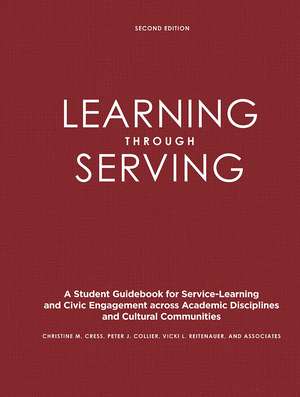
Learning Through Serving: A Student Guidebook for Service-Learning and Civic Engagement Across Academic Disciplines and Cultural Communities
Autor Christine M. Cress, Peter J. Collier, Vicki L. Reitenaueren Limba Engleză Hardback – 10 iul 2013
Each chapter has been developed to be read and reviewed, in sequence, over the term of a service-learning course. Students in a semester course might read just one chapter each week, while those in a quarter-term course might need to read one to two chapters per week. The chapters are intentionally short, averaging 8 to 14 pages, so they do not interfere with other course content reading.
This edition presents four new chapters on Mentoring, Leadership, Becoming a Change Agent, and Short-Term Immersive and Global Service-Learning experiences. The authors have also revised the original chapters to more fully address issues of social justice, privilege/power, diversity, intercultural communication, and technology; have added more disciplinary examples; incorporated additional academic content for understanding service-learning issues (e.g., attribution theory); and cover issues related to students with disabilities, and international students.
This text is a student-friendly, self-directed guide to service-learning that:
- Develops the skills needed to succeed
- Clearly links service-learning to the learning goals of the course
- Combines self-study and peer-study workbook formats with activities that can be incorporated in class, to give teachers maximum flexibility in structuring their service-learning courses
- Promotes independent and collaborative learning
- Equally suitable for courses of a few weeks’ or a few months’ duration
- Shows students how to assess progress and communicate end-results
- Written for students participating in service learning as a class, but also suitable for students working individually on a project.
This Instructor Manual discusses the following six key areas for aligning your course with use of Learning through Serving, whether you teach a senior-level high school class, freshman studies course, or a college capstone class:
1. Course and syllabus design
2. Community-partner collaboration
3. Creating class community
4. Strategic teaching techniques
5. Developing intercultural competence
6. Impact assessment
Preț: 1144.61 lei
Preț vechi: 1486.50 lei
-23%
Puncte Express: 1717
Carte disponibilă
Livrare economică 07-21 noiembrie
Livrare prin curier în România Termenul estimat este afișat lângă disponibilitate.
Transport gratuit pentru acest produs Plată online sau ramburs, în funcție de opțiunile comenzii.
Retur gratuit în 14 zile Comandă securizată și suport în română.
Specificații
ISBN-13: 9781579229894
ISBN-10: 1579229891
Pagini: 242
Dimensiuni: 213 x 280 x 20 mm
Greutate: 0.61 kg
Ediția:2nd edition
Editura: Taylor & Francis
Colecția Routledge
Locul publicării:Oxford, United Kingdom
ISBN-10: 1579229891
Pagini: 242
Dimensiuni: 213 x 280 x 20 mm
Greutate: 0.61 kg
Ediția:2nd edition
Editura: Taylor & Francis
Colecția Routledge
Locul publicării:Oxford, United Kingdom
Public țintă
PostgraduateCuprins
FIGURES EXERCISES ACKNOWLEDGMENTS PREFACE INTRODUCTION: Why a Book about Learning through Serving? - Christine M. Cress PART ONE: UNDERSTANDING THE LEARNING-THROUGH-SERVING PROPOSITION 1. WHAT IS SERVICE-LEARNING? – Christine M. Cress 2. BUILDING AND MAINTAINING COMMUNITY PARTNERSHIPS – Vicki L. Reitenauer, Amy Spring, Kevin Kecskes, Seanna M. Kerrigan, Christine M. Cress, and Peter J. Collier 3. BECOMING COMMUNITY: Moving From I to We – Vicki L. Reitenauer PART TWO: LEARNING THE LANDSCAPE, LEARNING THE LANGUAGE 4. GROUPS ARE FUN, GROUPS ARE NOT FUN: Teamwork for the Common Good – Peter J. Collier and Janelle D. Voegele 5. CREATING CULTURAL CONNECTIONS: Navigating Difference, Investigating Power, Unpacking Privilege – Vicki L. Reitenauer, Christine M. Cress, and Janet Bennett PART THREE: FACILITATING LEARNING AND MEANING-MAKING INSIDE AND OUTSIDE THE CLASSROOM 6. REFLECTION IN ACTION: The Learning–Doing Relationship – Peter J. Collier and Dilafruz R. Williams 7. MENTORING: Relationship Building for Empowerment – Peter J. Collier Mentoring 8. LEADERSHIP AND SERVICE-LEARNING: Leveraging Change – Peter J. Collier 9. FAILURE WITH THE BEST OF INTENTIONS: When Things Go Wrong – Janelle D. Voegele and Devorah Lieberman 10. EXPANDING HORIZONS: New Views of Course Concepts – Christine M. Cress and Judy Patton PART FOUR: ASSESSING THE ENGAGEMENT EFFORT 11. BEYOND A GRADE: Are We Making a Difference? The Benefits and Challenges of Evaluating Learning and Serving – Sherril B. Gelmon, Susan Agre-Kippenhan, and Christine M. Cress 12. GLOBAL AND IMMERSIVE SERVICE-LEARNING: What You Need to Know as You Go – Christine M. Cress, Stephanie T. Stokamer, Thomas J. Van Cleave, Chithra Edwin 13. START ANYWHERE, FOLLOW IT EVERYWHERE: Agents of Change – Vicki Reitenauer 14. LOOKING BACK, LOOKING FORWARD: Where Do You Go from Here? – Peter J. Collier and Vicki L. Reitenauer ABOUT THE AUTHORS INDEX
Recenzii
"First published in 2005, Learning through Serving is a collection of critical thought on the nature of service learning, as well as a practical field guide for educators looking to expand their skills in this arena.
Learning through Serving is intentionally transdisciplinary, and will certainly be helpful for religious studies or theology educators who employ community-based learning or service-learning models. The wealth of experience the authors share, their diverse voices, and lucid consideration of socially-engaged pedagogy yield great value for those seeking to deepen their practice of service-learning.
The authors’ goals are to assist educators and students in thinking through their community service experiences, in the interest of holistic conscientious formation.
This guide was constructed with the intention that it would be read in the context of an academic class – thus the chapters are arranged to build on one another throughout the course of a semester. Learning through Serving is composed as a textbook, placing great emphasis on clarity and structure, without sacrificing substance for the sake of readability. The different chapters oscillate between hands-on course planning and more theoretical treatments of civic engagement and democratic philosophy. The new edition makes a particular effort to attend to the global interconnectedness that increasingly defines contemporary digital realities.
Learning through Serving offers a wealth of pedagogical advice for service-learning courses, but also situates service-learning within a larger commitment to civic engagement and building a more just society. It contains invaluable nuts-and-bolts course planning assistance, and gives wise counsel on how to develop enduring, reciprocal community partnerships that build capacity for the long haul. "
Reflective Teaching (Wabash Center) - .
REVIEW OF THE FIRST EDITION
"[This] is a self-directed guide for college students engaged in service-learning. The purpose of the book is to walk the reader through elements of learning and serving by focusing on how students can 'best provide meaningful service to a community agency or organization while simultaneously gaining new skills, knowledge, and understanding as an integrated aspect of the [student's] academic program.' [The authors] bring their expertise to the pages of this helpful and practical guide for college students engaged in service-learning. Intended as a textbook, this work reads like a conversation between the authors and the college student learner. The publication is student-friendly, comprehensive, easy to follow, and full of helpful activities."
Journal of College Student Development - .
REVIEW OF THE FIRST EDITION
"Finally, a companion reader for students in service-learning courses! It is filled with meaningful exercises to help students make sense of their service experience and relate it to the course content. This is an important contribution to the field of service learning and faculty should utilize this book to help students understand and make the most of their service-learning experience."
Elaine K. Ikeda, Executive Director - California Campus Compact
Learning through Serving is intentionally transdisciplinary, and will certainly be helpful for religious studies or theology educators who employ community-based learning or service-learning models. The wealth of experience the authors share, their diverse voices, and lucid consideration of socially-engaged pedagogy yield great value for those seeking to deepen their practice of service-learning.
The authors’ goals are to assist educators and students in thinking through their community service experiences, in the interest of holistic conscientious formation.
This guide was constructed with the intention that it would be read in the context of an academic class – thus the chapters are arranged to build on one another throughout the course of a semester. Learning through Serving is composed as a textbook, placing great emphasis on clarity and structure, without sacrificing substance for the sake of readability. The different chapters oscillate between hands-on course planning and more theoretical treatments of civic engagement and democratic philosophy. The new edition makes a particular effort to attend to the global interconnectedness that increasingly defines contemporary digital realities.
Learning through Serving offers a wealth of pedagogical advice for service-learning courses, but also situates service-learning within a larger commitment to civic engagement and building a more just society. It contains invaluable nuts-and-bolts course planning assistance, and gives wise counsel on how to develop enduring, reciprocal community partnerships that build capacity for the long haul. "
Reflective Teaching (Wabash Center) - .
REVIEW OF THE FIRST EDITION
"[This] is a self-directed guide for college students engaged in service-learning. The purpose of the book is to walk the reader through elements of learning and serving by focusing on how students can 'best provide meaningful service to a community agency or organization while simultaneously gaining new skills, knowledge, and understanding as an integrated aspect of the [student's] academic program.' [The authors] bring their expertise to the pages of this helpful and practical guide for college students engaged in service-learning. Intended as a textbook, this work reads like a conversation between the authors and the college student learner. The publication is student-friendly, comprehensive, easy to follow, and full of helpful activities."
Journal of College Student Development - .
REVIEW OF THE FIRST EDITION
"Finally, a companion reader for students in service-learning courses! It is filled with meaningful exercises to help students make sense of their service experience and relate it to the course content. This is an important contribution to the field of service learning and faculty should utilize this book to help students understand and make the most of their service-learning experience."
Elaine K. Ikeda, Executive Director - California Campus Compact
Notă biografică
Christine M. Cress is Professor of Educational Leadership, Higher Education Policy, and Community Engagement at Portland State University. She received her Ph.D. from UCLA and was a Fulbright Senior Scholar at Middle East Technical University in Ankara, Turkey. She has conducted professional trainings on curricular integration and the scholarship of service-learning at scores of colleges in North America, Europe, Japan, India, and Nepal. Earlier in her career, she was an academic and career adviser at Western Washington University, Whatcom Community College, and Northwest Indian College. For the last twenty years at PSU, she has directed Master and Doctoral degrees and a fully on-line Graduate Certificate in Service-Learning including facilitation of short-term international service-learning and COIL/Virtual Exchange classes in India, Japan, Morocco, and Turkey. Her cultural privilege is primarily northern European American with Cherokee (non-tribal affiliation) and Sene-Gambian heritage. She is a first-generation college student, adoptee and adoptive parent, and member of a multi-racial lesbian family. These myriad social positions influence her scholarship which addresses intersectionality, systemic oppression, and equity-centered education and community engagement.
Descriere
This substantially expanded new edition of this widely-used and acclaimed text maintains the objectives and tenets of the first. It is designed to help students understand and reflect on their community service experiences both as individuals and as citizens of communities.