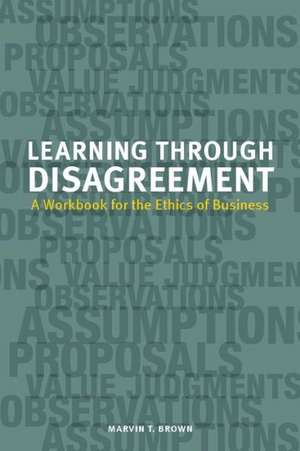
Learning through Disagreement: A Workbook for the Ethics of Business
Autor Marvin T. Brownen Limba Engleză Paperback – 5 iun 2014
Preț: 103.39 lei
Preț vechi: 125.74 lei
-18%
Puncte Express: 155
Carte disponibilă
Livrare economică 06-20 noiembrie
Livrare prin curier în România Termenul estimat este afișat lângă disponibilitate.
Transport gratuit de la 400.00 lei Plată online sau ramburs, în funcție de opțiunile comenzii.
Retur gratuit în 14 zile Comandă securizată și suport în română.
Specificații
ISBN-13: 9781554812172
ISBN-10: 1554812178
Pagini: 88
Dimensiuni: 152 x 229 x 5 mm
Greutate: 0.23 kg
Editura: BROADVIEW PR
Colecția Broadview Press
Locul publicării:Peterborough, Canada
ISBN-10: 1554812178
Pagini: 88
Dimensiuni: 152 x 229 x 5 mm
Greutate: 0.23 kg
Editura: BROADVIEW PR
Colecția Broadview Press
Locul publicării:Peterborough, Canada
V-ar putea interesa
-
 Preț: 97.37 lei
 -
 Preț: 113.55 lei
 -
 Preț: 132.06 lei
 -
 Preț: 333.14 lei
 -
 -26%Preț: 89.23 lei121.05 lei
 -
 Conflict Resolution at Work For DummiesVivian ScottPreț: 101.63 lei
 -
 The Ethical Slut WorkbookJanet W HardyPreț: 107.74 lei
 -
 NegotiationMax H. BazermanPreț: 174.09 lei
 -
 The Leader's Guide to CollaborationGuy LubitshPreț: 120.92 lei
 -
 The Workshop Book 2ePamela HamiltonPreț: 103.93 lei
 -
 The Financial Times Guide to Business EthicsPablo Hepworth LloydPreț: 210.15 lei
 -
 From Conflict to ConvergenceRobert FershPreț: 146.65 lei
 -
 Hostage at the TableGeorge KohlrieserPreț: 193.47 lei
 -
 Valuation WorkbookTim KollerPreț: 389.28 lei
 -
 From Values to ActionHarry M Jansen KraemerPreț: 188.69 lei
 -
 I Respectfully DisagreeJustin Jones-Fosu-20%Preț: 112.24 lei140.17 lei
 -
 Leadership and Self-Deception, Fourth EditionArbinger Institute-20%Preț: 102.03 lei127.52 lei
 -
 Why Are We Yelling?Buster Benson-34%Preț: 52.20 lei78.99 lei
 -
 -28%Preț: 65.71 lei91.05 lei
 -
 Humble Inquiry, 3rd EditionEdgar H ScheinPreț: 133.41 lei
Recenzii
Learning through Disagreement offers practical instruction in how to locate underlying assumptions and values so as to identify points of overlap that can serve as building blocks for agreement. Three key ethical approaches are concisely presented, not as abstract theories but as tools for good decision making. Realistic examples of common workplace disagreements are discussed, and detachable perforated worksheets for individual or group use are interspersed throughout.
“Learning through Disagreement is an excellent auxiliary text for any business ethics course. The book's dialogical (as opposed to debating) orientation is a refreshingly constructive approach to dealing with contentious issues in the subject. The result is a most useful tool for facilitating fruitful student discussions.” — Gary James Jason, California State University, Fullerton
“As a management professor, I enjoy employing a variety of classroom activities and experiential exercises that help my students enhance their critical thinking skills. Challenging their underlying assumptions and biases—and working through them—is necessary for effective ethical decision making. Learning through Disagreement is a great addition to a student’s management and leadership toolkit.” — Laquita Blockson, Saint Leo University
“Learning through Disagreement is an excellent auxiliary text for any business ethics course. The book's dialogical (as opposed to debating) orientation is a refreshingly constructive approach to dealing with contentious issues in the subject. The result is a most useful tool for facilitating fruitful student discussions.” — Gary James Jason, California State University, Fullerton
“As a management professor, I enjoy employing a variety of classroom activities and experiential exercises that help my students enhance their critical thinking skills. Challenging their underlying assumptions and biases—and working through them—is necessary for effective ethical decision making. Learning through Disagreement is a great addition to a student’s management and leadership toolkit.” — Laquita Blockson, Saint Leo University
Cuprins
Preface: About this Workbook
Introduction
CHAPTER ONE: A Dialogical Approach
Introduction
CHAPTER ONE: A Dialogical Approach
- Worksheet 1-1: Dialogical Capacity
Worksheet 1-2: Engaging in Dialogue
- Table 2.1: Resources for Making Decisions
Identifying Resources for Making Decisions
Table 2.2: Steps Involved in Sharing Resources
Creating Valid Syllogisms
Exploring Assumptions
Table 2.3: Sample Argument
Worksheet 2-1: Sorting Out Different Resources
Worksheet 2-2: Discovering Implicit Value Judgments
Worksheet 2-3: Developing Valid Syllogisms
Worksheet 2-4: Assumptions about Ourselves
Worksheet 2-5: Uncovering Assumptions
Worksheet 2-6: Discovering the Resources of Alternative Views
- The Visionary, the Judge, and the Assessor
The Ethics of Purpose
The Ethics of Principle
Table 3.1: Principles of Distributive Justice
The Ethics of Consequence
Applying an Ethics of Purpose
Applying an Ethics of Principle
Applying an Ethics of Consequence
Developing the Modified Proposal
Worksheet 3-1: Applying an Ethics of Purpose
Worksheet 3-2: Applying an Ethics of Principle
Worksheet 3-3: Applying an Ethics of Consequence
- Working Offline
Working Online
Developing Argumentative Dialogues
A Sample Argumentative Dialogue on Worker Cooperatives
Worksheet 4-1: An Outline for Your Argumentative Dialogues