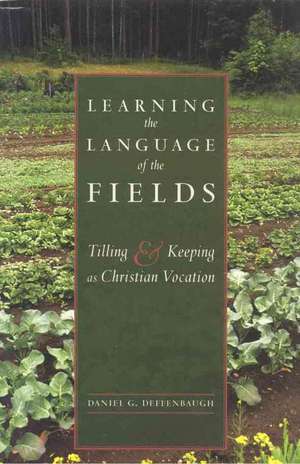
Learning the Language of the Fields
Autor Daniel G. Deffenbaughen Limba Engleză Paperback – 25 dec 2006
Preț: 91.18 lei
Preț vechi: 107.39 lei
-15%
Puncte Express: 137
Carte tipărită la comandă
Livrare economică 26 noiembrie-10 decembrie
Livrare prin curier în România Termenul estimat este afișat lângă disponibilitate.
Transport gratuit de la 400.00 lei Plată online sau ramburs, în funcție de opțiunile comenzii.
Retur gratuit în 14 zile Comandă securizată și suport în română.
Specificații
ISBN-13: 9781561012824
ISBN-10: 1561012823
Pagini: 266
Dimensiuni: 140 x 216 x 14 mm
Greutate: 0.37 kg
Editura: COWLEY PUBN
Locul publicării:New York, United States
ISBN-10: 1561012823
Pagini: 266
Dimensiuni: 140 x 216 x 14 mm
Greutate: 0.37 kg
Editura: COWLEY PUBN
Locul publicării:New York, United States
Recenzii
Something is bound to go terribly wrong when so many Christians see the planet as an unimportant holding place where we await salvation; or when preachers and teachers of the faith place too much emphasis on humanity's privileged status without also explaining our responsibilities to tend the garden; or when Christians see God as transcendent but not immanently present in creation. The result, according to religious studies professor Daniel Deffenbaugh, is twofold: an ecological crisis and an 'evident exodus' of ecologically sensitive individuals from churches across the country.
Deffenbaugh calls Christians back to a reverence for place instead of the traditional eschewing of time on earth coupled with a yearning to be with God in heaven. . . . [He] brings ecology down to earth and challenges the Christian community to develop a new spirituality of place.
Learning the Language of the Fields would be more than adequate as a book about a Christian view of ecology and environmental stewardship. And heaven knows we need to be reading those kinds of creation-care books. But it is more. As the back cover states, it 'connects ecology with ritual and spirituality with community.' Deffenbaugh writes in gentle, flowing prose even as he argues forcefully that our aggressive agricultural models have been disastrous. It is a very nice book.
Deffenbaugh calls Christians back to a reverence for place instead of the traditional eschewing of time on earth coupled with a yearning to be with God in heaven. . . . [He] brings ecology down to earth and challenges the Christian community to develop a new spirituality of place.
Learning the Language of the Fields would be more than adequate as a book about a Christian view of ecology and environmental stewardship. And heaven knows we need to be reading those kinds of creation-care books. But it is more. As the back cover states, it 'connects ecology with ritual and spirituality with community.' Deffenbaugh writes in gentle, flowing prose even as he argues forcefully that our aggressive agricultural models have been disastrous. It is a very nice book.