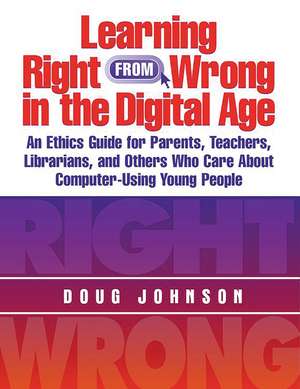
Learning Right from Wrong in the Digital Age: An Ethics Guide for Parents, Teachers, Librarians, and Others Who Care About Computer-Using Young People
Autor Douglas A. Johnsonen Limba Engleză Paperback – 2003
. Help students explore the ethics of digital technology
. Includes the Ten Commandments of Computer Ethics with key moral imperatives for students of all ages
Preț: 257.73 lei
Preț vechi: 348.88 lei
-26%
Puncte Express: 387
Carte tipărită la comandă
Livrare economică 26 noiembrie-10 decembrie
Livrare prin curier în România Termenul estimat este afișat lângă disponibilitate.
Transport gratuit de la 400.00 lei Plată online sau ramburs, în funcție de opțiunile comenzii.
Retur gratuit în 14 zile Comandă securizată și suport în română.
Specificații
ISBN-13: 9781586831318
ISBN-10: 1586831313
Pagini: 175
Dimensiuni: 216 x 279 x 8 mm
Greutate: 0.34 kg
Editura: Bloomsbury Publishing
Colecția Linworth
Locul publicării:New York, United States
ISBN-10: 1586831313
Pagini: 175
Dimensiuni: 216 x 279 x 8 mm
Greutate: 0.34 kg
Editura: Bloomsbury Publishing
Colecția Linworth
Locul publicării:New York, United States
V-ar putea interesa
-
 TubesAndrew Blum-20%Preț: 67.53 lei84.42 lei
 -
 Starting on a ShoestringArnold S GoldsteinPreț: 237.47 lei
 -
 E-CommerceChan-20%Preț: 590.25 lei737.82 lei
 -
 Preț: 90.49 lei
 -
 The Classroom Teacher's Technology Survival GuideDoug JohnsonPreț: 170.50 lei
 -
 The Internet For Dummies 14eJohn R. Levine-20%Preț: 134.15 lei167.69 lei
 -
 Discord For DummiesTee MorrisPreț: 127.75 lei
 -
 School Libraries Head for the Edge: Rants, Recommendations, and ReflectionsDouglas A. Johnson-25%Preț: 270.09 lei359.62 lei
 -
 Minds OnlinePaul Smart-20%Preț: 497.75 lei622.19 lei
 -
 Right First TimeDoug JohnsonPreț: 122.41 lei
 -
 Apache Solr 4 CookbookRafa Ku-20%Preț: 245.55 lei306.95 lei
 -
 Mobile BiometricsGuodong Guo-18%Preț: 941.58 lei1148.27 lei
 -
 User-Centric Privacy and Security in BiometricsClaus Vielhauer-20%Preț: 1067.75 lei1334.69 lei
 -
 Data Security in Cloud ComputingVimal Kumar-20%Preț: 891.65 lei1114.56 lei
 -
 Surveillance ValleyYasha LevinePreț: 86.95 lei
 -
 Mastering MamboTobias HauserPreț: 247.86 lei
 -
 The Nighttime Adventures of Elliott the MouseDoug JohnsonPreț: 106.16 lei
Recenzii
Johnson's guide should be required reading. It makes elementary what is often unclear and ambiguous and provides analogies of situations to point out how stealing is stealing whether it's in a store or in a virtual situation. His approach is to entice discussion and allow the students to discover the answer to the ethics question in a variety of settings. After an overview of the difference between the physical and virtual world in regard to ethical codes, several sections are devoted to scenarios of various behaviors that involve privacy, property, and appropriate use of information. Each scenario provides discussion topics as well as the relationship to National Learning Standards. Resources such as privacy and search policies, and Web sites are provided for more information. One section specifically instructs teachers, librarians and parents on what students need to know in order to practice ethical behavior with computers. It offers information about Acceptable Use policies, Web Site Guidelines, Library Rules, and Plagiarism Guidelines. It reminds teachers how to create plagiarism proof assignments and describes what parents can do at home to teach and encourage ethical behavior. Finally, appendixes offer sample documents of those policies that all schools and libraries should have available. Highly Recommended.