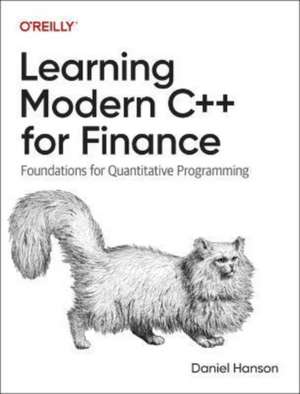
Learning Modern C++ for Finance: Foundations for Quantitative Programming
Autor Daniel Hansonen Limba Engleză Paperback – mar 2024
This practical book demonstrates why C++ is still one of the dominant production-quality languages for financial applications and systems. Many programmers believe that C++ is too difficult to learn. Author Daniel Hanson demonstrates that this is no longer the case.
Preț: 369.54 lei
Preț vechi: 401.68 lei
-8%
Carte disponibilă
Livrare economică 02-16 noiembrie
Livrare express 16-22 octombrie pentru 45.72 lei
Specificații
ISBN-10: 1098100808
Pagini: 428
Dimensiuni: 178 x 233 x 24 mm
Greutate: 0.68 kg
Editura: O'Reilly
Descriere
A lot of financial modeling has gravitated toward Python, R, and VBA, but many developers hit a wall with these languages when it comes to performance. This practical book demonstrates why C++ is still one of the dominant production-quality languages for financial applications and systems. Many programmers believe that C++ is too difficult to learn. Author Daniel Hanson demonstrates that this is no longer the case.
Financial programmers coming from Python or another interpreted language will discover how to leverage C++ abstractions that enable safer and quicker implementation of financial models. You'll also explore how popular open source libraries provide additional weapons for attacking mathematical problems. C++ programmers unfamiliar with financial applications will also benefit from this handy guide.
- Learn C++ basics: syntax, inheritance, polymorphism, composition, STL containers, and algorithms
- Dive into newer features and abstractions including functional programming using lambdas, task-based concurrency, and smart pointers
- Employ common but nontrivial financial models in modern C++
- Explore external open source math libraries, particularly Eigen and Boost
- Implement basic numerical routines in modern C++
- Understand best practices for writing clean and efficient code
Notă biografică
Daniel Hanson spent over 20 years in quantitative development in finance, primarily with C++ implementation of option pricing and portfolio risk models, trading systems, and library development. He now holds a full-time lecturer position in the Department of Applied Mathematics at the University of Washington, teaching quantitative development courses in the Computational Finance & Risk Management (CFRM) undergraduate and graduate programs. Among the classes he teaches is graduate-level sequence in C++ for quantitative finance, ranging from an introductory level through advanced. He also mentors Google Summer of Code student projects involving mathematical model implementations in C++ and R.