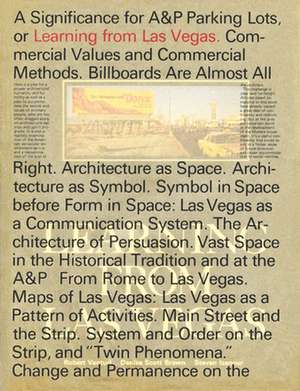
Learning from Las Vegas, facsimile edition
Autor Robert Venturi, Denise Scott Brown, Steven Izenouren Limba Engleză Hardback – 22 sep 2017
Această ediție facsimil în format mare (hardback) reprezintă recuperarea unui obiect de cult în istoria designului și arhitecturii. Reținem faptul că, la apariția sa în 1972, Learning from Las Vegas, facsimile edition a provocat o undă de șoc prin argumentul său revoluționar: panourile publicitare și cazinourile din Las Vegas merită aceeași atenție academică precum monumentele istorice. Putem afirma că experiența senzorială a acestui volum este unică; designul realizat de Muriel Cooper este în sine o capodoperă modernistă, deși autorii au considerat ulterior că estetica sa monumentală intra în contradicție cu elogiul adus „urâtului și obișnuitului”. Simțim greutatea celor 216 pagini bogat ilustrate cu 456 de imagini care documentează expansiunea urbană. Ca și Robert Venturi and Denise Scott Brown: Learning from Las Vegas de Kester Rattenbury, acest volum pune în valoare impactul pe care proiectul l-a avut asupra modului în care gândim arhitectura astăzi, dar cu un accent pe obiectul fizic original, inaccesibil publicului timp de decenii. Ne-a atras atenția în mod deosebit noua prefață semnată de Denise Scott Brown, care oferă contextul necesar pentru a înțelege de ce această formă grafică a devenit o piesă de colecție căutată de bibliofili. În contextul operei autorului, lucrarea continuă direcția începută în Robert Venturi: Complexity and Contradiction in Architecture, rafinând rebeliunea postmodernă împotriva purismului. Dacă în scrierile anterioare Robert Venturi pleda pentru o arhitectură non-lineară, aici, alături de Denise Scott Brown și Steven Izenour, transformă cercetarea de teren într-un manifest vizual care a redefinit studiile urbane.
Preț: 541.17 lei
Preț vechi: 647.19 lei
-16%
Carte disponibilă
Livrare economică 05-12 mai
Livrare express 18-24 aprilie pentru 142.72 lei
Specificații
ISBN-10: 0262036967
Pagini: 216
Ilustrații: 100 col/ 356 b&w illus.
Dimensiuni: 281 x 365 x 30 mm
Greutate: 2.0099999999999998 kg
Ediția:facsimile edition
Editura: The MIT Press
V-ar putea interesa
-
 Learning from Las Vegas, Revised EditionRobert Venturi-18%Preț: 169.90 lei207.49 lei
 -
 Robert Venturi: Complexity and Contradiction in ArchitectureRobert VenturiPreț: 199.38 lei
 -
 Preț: 81.11 lei
 -
 Application of Computer Aided Design to Town Planning PracticeKilanko Tolulope G.Preț: 313.05 lei
 -
 Etude de la logique socio-morphique des tissus vernaculairesAbdelmalek Arrouf-19%Preț: 506.09 lei624.81 lei
 -
 München und seine BautenBayerischer Architekten- und Ingenieur-VereinPreț: 480.87 lei
De ce să citești această carte
Recomandăm această ediție arhitecților și designerilor grafici care doresc să dețină o piesă istorică de o calitate excepțională. Cititorul câștigă acces la designul original al lui Muriel Cooper, însoțit de analizele tăioase ale autorilor despre simbolismul urban. Este o oportunitate rară de a studia un text care a „răsturnat vacile sfinte” ale modernismului, prezentat acum exact așa cum a fost conceput inițial pentru The MIT Press.
Despre autor
Robert Venturi (1925–2018) a fost un arhitect laureat al Premiului Pritzker și un teoretician influent, a cărui carieră a fost marcată de o colaborare strânsă cu partenera sa, Denise Scott Brown. Opera sa include proiecte emblematice precum Sainsbury Wing a National Gallery din Londra și revoluționara Vanna Venturi House. Denise Scott Brown, o figură centrală în urbanismul contemporan, a adus o perspectivă sociologică și analitică esențială cercetărilor lor comune. Împreună, au redefinit teoria arhitecturală, îndepărtând-o de dogmele rigide ale modernismului către o înțelegere mai bogată și mai umană a spațiului construit.
Descriere scurtă
Learning from Las Vegas begins with the Las Vegas Strip and proceeds to Ugly and Ordinary Architecture, or the Decorated Shed, on symbolism in architecture and the iconography of urban sprawl. As Scott Brown says in her introduction, the book "upended sacred cows ... would not bad-mouth bad taste, and redefined architectural research."
Notă biografică
Denise Scott Brown is an architect, writer, and planner. She and Robert Venturi are founding principals of the influential architectural firm Venturi, Scott Brown, and Associates (VSBA), whose work and ideas have influenced generations of architects and planners.
Steven Izenour (1940-2001) was coauthor of Learning from Las Vegas (MIT Press, 1977) and a principal in the Philadelphia firm Venturi, Scott Brown and Associates, Inc (VSBA). His most noted projects at VSBA include Philadelphia's Basco showroom, the George D. Widener Memorial Treehouse at the Philadelphia Zoo, the Camden Children's Garden, and the house he designed for his parents in Stony Creek, Connecticut.