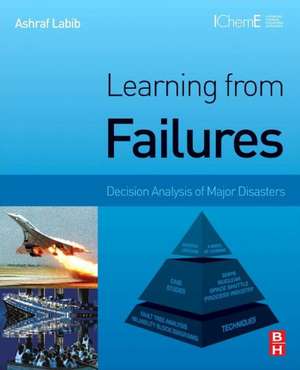
Learning from Failures
Autor Ashraf Labiben Limba Engleză Hardback – 20 iun 2014
This book discusses the value in applying different models as mental maps to analyze disasters. The analysis of these case studies helps to demonstrate how subjectivity that relies on opinions of experts can be turned into modeling approaches that can ensure repeatability and consistency of results. The book explains how the lessons learned by studying these individual cases can be applied to a wide range of industries.
This work is an ideal resource for undergraduate and postgraduate students, and will also be useful for industry professionals who wish to avoid repeating mistakes that resulted in devastating consequences.
- Explores the root cause of disasters and various preventative measures
- Links theory with practice in regard to risk, safety, and reliability analyses
- Uses analytical techniques originating from reliability analysis of equipment failures, multiple criteria decision making, and artificial intelligence domains
Preț: 611.34 lei
Preț vechi: 686.90 lei
-11%
Puncte Express: 917
Carte disponibilă
Livrare economică 09-23 noiembrie
Livrare prin curier în România Termenul estimat este afișat lângă disponibilitate.
Transport gratuit pentru acest produs Plată online sau ramburs, în funcție de opțiunile comenzii.
Retur gratuit în 14 zile Comandă securizată și suport în română.
Specificații
ISBN-13: 9780124167278
ISBN-10: 0124167276
Pagini: 336
Ilustrații: Approx. 150 illustrations
Dimensiuni: 184 x 241 x 22 mm
Greutate: 0.86 kg
Editura: ELSEVIER SCIENCE
ISBN-10: 0124167276
Pagini: 336
Ilustrații: Approx. 150 illustrations
Dimensiuni: 184 x 241 x 22 mm
Greutate: 0.86 kg
Editura: ELSEVIER SCIENCE
V-ar putea interesa
-
 Inequality: What Everyone Needs to Know®James K. Galbraith-18%Preț: 65.26 lei79.63 lei
 -
 Letters to a Young ContrarianChristopher Hitchens-27%Preț: 76.30 lei105.08 lei
 -
 -39%Preț: 97.81 lei161.23 lei
 -
 Consumer Culture and ModernityDon SlaterPreț: 257.22 lei
 -
 -25%Preț: 48.85 lei65.05 lei
 -
 India ReloadedD. SinhaPreț: 258.55 lei
 -
 -15%Preț: 420.43 lei494.63 lei
 -
 Introduction to Crowd ScienceG Keith Still-18%Preț: 1116.77 lei1361.91 lei
 -
 -27%Preț: 47.70 lei64.99 lei
 -
 Our Kids: The American Dream in CrisisRobert D. Putnam-17%Preț: 66.48 lei80.39 lei
 -
 -27%Preț: 1387.79 lei1890.14 lei
 -
 Partnership working – Policy and practiceSusan BallochPreț: 318.16 lei
Cuprins
1: Introduction to the Concept of Learning from Failures 2: Introduction to Failure Analysis Techniques in Reliability Modeling 3: Introduction to the Analytic Hierarchy Process 4: The Bhopal Disaster - Learning from Failures and Evaluating Risk 5: BP Deepwater Horizon 6: Case Study: BP Texas City Disaster 7: Chernobyl Disaster 8: The Concorde Crash 9: Fukushima Nuclear Disaster 10: Hurricane Katrina Disaster 11: NASA's Space Shuttle Columbia Accident 12: The Titanic 13: Introduction to the Concept of Generic Lesson as an Outcome of Learning from Failures 14: A Model of Learning and Unlearning from Failures
Recenzii
"...create systematic ways of analysing the causes of disasters, using diagrams such as fault tree analysis (FTA) and reliability block diagrams."--Chemistry & Industry
"...makes interesting reading and should be read by all those who want to specialize in the area of reliability engineering and understand the genesis of tragic events..."-International Journal of Performability Engineering
"This is a must-read book for all students, engineers, leaders and managers concerned with safety and security during the life cycle of physical assets. The author presents clear in-depth analysis of disasters in a holistic manner underpinned by state-of-the-art scientific knowledge and innovative research providing concise practical lessons as well as models to learn from failures".
Dr Ayman Nassif
Principal Lecturer in Structural Engineering/Admissions Tutor
University of Portsmouth-School of Civil Engineering and Surveying
"The author says that for organizations to successfully avoid major disasters they need to undertake risk and reliability analysis" (Irish Independent)
"Experiencing failure and avoiding over-confidence could have prevented some of the world’s greatest disasters such as sinking the Titanic and the loss of two NASA space shuttles, according to new research by Professor Labib of the University of Portsmouth" (Belfast Telegraph)
"The issue of the institutional safety culture is under intense scrutiny. This book provides a helpful alternative view of the evolution of information within an evolving safety culture. As such, it will be an important guide to risk managers and project supervisors". Neal Langerman, Advanced Chemical Safety INC
"...makes interesting reading and should be read by all those who want to specialize in the area of reliability engineering and understand the genesis of tragic events..."-International Journal of Performability Engineering
"This is a must-read book for all students, engineers, leaders and managers concerned with safety and security during the life cycle of physical assets. The author presents clear in-depth analysis of disasters in a holistic manner underpinned by state-of-the-art scientific knowledge and innovative research providing concise practical lessons as well as models to learn from failures".
Dr Ayman Nassif
Principal Lecturer in Structural Engineering/Admissions Tutor
University of Portsmouth-School of Civil Engineering and Surveying
"The author says that for organizations to successfully avoid major disasters they need to undertake risk and reliability analysis" (Irish Independent)
"Experiencing failure and avoiding over-confidence could have prevented some of the world’s greatest disasters such as sinking the Titanic and the loss of two NASA space shuttles, according to new research by Professor Labib of the University of Portsmouth" (Belfast Telegraph)
"The issue of the institutional safety culture is under intense scrutiny. This book provides a helpful alternative view of the evolution of information within an evolving safety culture. As such, it will be an important guide to risk managers and project supervisors". Neal Langerman, Advanced Chemical Safety INC