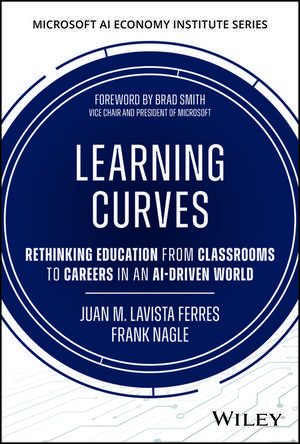
Learning Curves: Microsoft AI Economy Institute Series
Autor Frank Nagle, Juan M. Lavista Ferresen Limba Engleză Hardback – 14 oct 2026
Learning Curves: Rethinking Education from Classrooms to Careers in an AI-driven World is the second book in the Microsoft AI Economy Institute series. Authored by Juan M. Lavista Ferres, Frank Nagle, and a distinguished group of international contributors, including globally recognized scholars and industry experts, this volume examines how generative AI is reshaping education systems, labor markets, and workforce development across sectors and geographies worldwide.
The book examines AI's effects on K-12 teaching, community colleges, technical and vocational institutions, and entry-level employment. It investigates the barriers to AI adoption, whether they are technical, institutional, regulatory, economic, or cultural, and explores global differences in AI diffusion. Contributors offer research-backed insights for policymakers, educators, employers, and workers navigating the transition to an AI-driven economy.
Readers will find:
- Analysis of how generative AI tools are changing experiences for both educators and students across institutional settings
- Research on AI's impact on entry-level jobs and evolving employer expectations for workforce readiness and skills
- Examination of barriers to equitable AI adoption, including technical, regulatory, economic, and cultural factors worldwide
- Insights drawn from the Microsoft AI Economy Institute's structured collaboration between leading scholars and industry practitioners
- Global-scale analysis of AI diffusion differences and their implications for education systems and labor markets
Preț: 179.13 lei
Preț vechi: 223.92 lei
-20% Precomandă
Puncte Express: 269
Carte nepublicată încă
Livrare prin curier în România Precomanda se expediază când titlul devine disponibil.
Transport gratuit de la 400.00 lei Plată online sau ramburs, în funcție de opțiunile comenzii.
Retur gratuit în 14 zile Comandă securizată și suport în română.
Doresc să fiu notificat când acest titlu va fi disponibil:
Se trimite...
Specificații
ISBN-13: 9781394452453
ISBN-10: 1394452454
Pagini: 432
Dimensiuni: 158 x 231 x 31 mm
Greutate: 0.82 kg
Editura: John Wiley & Sons, Inc.
Colecția Microsoft AI Economy Institute Series
Seria Microsoft AI Economy Institute Series
ISBN-10: 1394452454
Pagini: 432
Dimensiuni: 158 x 231 x 31 mm
Greutate: 0.82 kg
Editura: John Wiley & Sons, Inc.
Colecția Microsoft AI Economy Institute Series
Seria Microsoft AI Economy Institute Series
Notă biografică
JUAN M. LAVISTA FERRES is Microsoft's Chief Data Scientist and Corporate Vice President, serving as Lab Director of Microsoft's AI for Good Lab and Director of the AI Economy Institute.
FRANK NAGLE is Microsoft's Chief AI Economist, based in the AI Economy Institute within Microsoft's AI for Good Lab. He is also a research scientist at the Initiative on the Digital Economy at MIT.
Featuring Additional Distinguished Authors: Bashar Alhafni, Pierre-Alexandre Balland, Paul Bigby, Carolina Calvo Asencio, Bharat Chandar, Yung Chun, Somalis Chy, Jerik Cruz, Antonio Delgado, Wendy DuBow, Laura M. Evans, S. Kiersten Ferguson, Carla Z. Glave, Nizar Habash, Peng He, Manuel Hoffmann, Nicole Immorlica, Stephen Michael Impink, Jason Jabbari, Ekaterina Kochmar, Tingting Li, Carolina Lopez, Fengchun Miao, Milan Miric, Ezequiel Molina, Laura Nurski, Joseph Onderi Orero, Sarah L. Rodriguez, Amy Rubinson, Malle Schilling, Catherine Schwarz, Robert Seamans, Andrew Stokols, Sarayu Sundar, Arun Sundararajan, Inbal Talgam-Cohen, Hung Vo, Catherine Wu, Román Andrés Zárate, Xin Zhao (Skye).
FRANK NAGLE is Microsoft's Chief AI Economist, based in the AI Economy Institute within Microsoft's AI for Good Lab. He is also a research scientist at the Initiative on the Digital Economy at MIT.
Featuring Additional Distinguished Authors: Bashar Alhafni, Pierre-Alexandre Balland, Paul Bigby, Carolina Calvo Asencio, Bharat Chandar, Yung Chun, Somalis Chy, Jerik Cruz, Antonio Delgado, Wendy DuBow, Laura M. Evans, S. Kiersten Ferguson, Carla Z. Glave, Nizar Habash, Peng He, Manuel Hoffmann, Nicole Immorlica, Stephen Michael Impink, Jason Jabbari, Ekaterina Kochmar, Tingting Li, Carolina Lopez, Fengchun Miao, Milan Miric, Ezequiel Molina, Laura Nurski, Joseph Onderi Orero, Sarah L. Rodriguez, Amy Rubinson, Malle Schilling, Catherine Schwarz, Robert Seamans, Andrew Stokols, Sarayu Sundar, Arun Sundararajan, Inbal Talgam-Cohen, Hung Vo, Catherine Wu, Román Andrés Zárate, Xin Zhao (Skye).
Cuprins
Foreword: Brad Smith xi
Introduction: The Next Generation in the Age of AI xvii
Juan M. Lavista Ferres
SECTION I: LAYING THE FOUNDATIONS: AI, EDUCATION, AND THE NEXT GENERATION 1
Chapter 1: AI and K-12 Education: The Good, the Bad, and the Ugly 2
Juan M. Lavista Ferres
Chapter 2: Education as Economic Infrastructure in the Age of AI 17
Frank Nagle
SECTION II: THE DIFFUSION OF AI: TURNING INVENTION INTO SHARED PROGRESS 26
Introduction: Juan M. Lavista Ferres
Chapter 3: Technology Transfer in the Age of AI: Old Lessons for New Technologies 31
Carolina Calvo Asencio
Chapter 4: AI as a Tool for Development in Southeast Asia: Lessons from Singapore, Malaysia, and Indonesia 47
Andrew Stokols, Jerik Cruz, and Hung Vo
Chapter 5: Rethinking AI Exposure: From Occupations to Sectors 66
Laura Nurski and Pierre-Alexandre Balland
SECTION III: K-12 EDUCATION FOR THE AI-NATIVE GENERATION 86
Introduction: Laylah Bulman
Chapter 6: AI and the Redistribution of Epistemic Authority in Education: Toward a Distributed Authority Framework 93
Tingting Li and Peng He
Chapter 7: The Future Classroom in Africa: Game-Based Learning with AI-Enabled African Languages Model 116
Joseph Onderi Orero
Chapter 8: AI and Arabic Education: Barriers and Opportunities for Generative AI in K-12 Arabic Education 136
Bashar Alhafni, Ekaterina Kochmar, and Nizar Habash
Chapter 9: AI in the Classroom: A Case Study from Metropolitan Lima 156
Carla Z. Glave, Carolina Lopez, Ezequiel Molina, and Román Andrés Zárate
SECTION IV: TECHNICAL AND VOCATIONAL TRAINING FOR AI 173
Introduction: Alex Swartsel
Chapter 10: Developing AI Competency for Higher Education: Addressing Inclusion Gaps 179
Xin Zhao Skye and Fengchun Miao
Chapter 11: Considerations of Equity in the Diffusion of AI in U.S. Four-Year Colleges and Universities 193
Wendy DuBow, Sarayu Sundar, and S. Kiersten Ferguson
Chapter 12: Understanding the Importance of Community Colleges in AI Workforce Development 208
Sarah L. Rodriguez, Malle Schilling, Amy Rubinson, Antonio Delgado, and Paul Bigby
SECTION V: AI, WORK, AND THE ORGANIZATION OF LABOR 223
Introduction: Blake Lawit
Chapter 13: AI and Labor: Present and Future Scenarios 228
Bharat Chandar
Chapter 14: The Uneven AI Revolution: Experience, Gender, and the New Nature of Work 248
Manuel Hoffmann and Frank Nagle
Chapter 15: Teaming Up with AI: Coordination and Cooperation 266
Nicole Immorlica and Inbal Talgam-Cohen
Chapter 16: The Effect of Generative AI on Work Productivity: A Synthesis of the Early Literature 289
Robert Seamans, Arun Sundararajan, and Catherine Wu
SECTION VI: ALTERNATIVE PATHWAYS TO AN AI WORKFORCE 308
Introduction: Pat Yongpradit
Chapter 17: Rethinking Human Capital Development in the Age of AI 312
Jason Jabbari, Yung Chun, Somalis Chy, Catherine Schwarz, and Laura Evans
Chapter 18: Apprenticeships for Digital Tools: Evidence from Swiss Watchmaking 337
Stephen Michael Impink and Milan Miric
Chapter 19: Conclusion: Navigating AI Futures 351
Deborah Morgan
AI Economy Institute Working Team 359
About the Book Leaders 360
More About Our Guest Authors 365
Acknowledgments 368
References 370
Index 393
Introduction: The Next Generation in the Age of AI xvii
Juan M. Lavista Ferres
SECTION I: LAYING THE FOUNDATIONS: AI, EDUCATION, AND THE NEXT GENERATION 1
Chapter 1: AI and K-12 Education: The Good, the Bad, and the Ugly 2
Juan M. Lavista Ferres
Chapter 2: Education as Economic Infrastructure in the Age of AI 17
Frank Nagle
SECTION II: THE DIFFUSION OF AI: TURNING INVENTION INTO SHARED PROGRESS 26
Introduction: Juan M. Lavista Ferres
Chapter 3: Technology Transfer in the Age of AI: Old Lessons for New Technologies 31
Carolina Calvo Asencio
Chapter 4: AI as a Tool for Development in Southeast Asia: Lessons from Singapore, Malaysia, and Indonesia 47
Andrew Stokols, Jerik Cruz, and Hung Vo
Chapter 5: Rethinking AI Exposure: From Occupations to Sectors 66
Laura Nurski and Pierre-Alexandre Balland
SECTION III: K-12 EDUCATION FOR THE AI-NATIVE GENERATION 86
Introduction: Laylah Bulman
Chapter 6: AI and the Redistribution of Epistemic Authority in Education: Toward a Distributed Authority Framework 93
Tingting Li and Peng He
Chapter 7: The Future Classroom in Africa: Game-Based Learning with AI-Enabled African Languages Model 116
Joseph Onderi Orero
Chapter 8: AI and Arabic Education: Barriers and Opportunities for Generative AI in K-12 Arabic Education 136
Bashar Alhafni, Ekaterina Kochmar, and Nizar Habash
Chapter 9: AI in the Classroom: A Case Study from Metropolitan Lima 156
Carla Z. Glave, Carolina Lopez, Ezequiel Molina, and Román Andrés Zárate
SECTION IV: TECHNICAL AND VOCATIONAL TRAINING FOR AI 173
Introduction: Alex Swartsel
Chapter 10: Developing AI Competency for Higher Education: Addressing Inclusion Gaps 179
Xin Zhao Skye and Fengchun Miao
Chapter 11: Considerations of Equity in the Diffusion of AI in U.S. Four-Year Colleges and Universities 193
Wendy DuBow, Sarayu Sundar, and S. Kiersten Ferguson
Chapter 12: Understanding the Importance of Community Colleges in AI Workforce Development 208
Sarah L. Rodriguez, Malle Schilling, Amy Rubinson, Antonio Delgado, and Paul Bigby
SECTION V: AI, WORK, AND THE ORGANIZATION OF LABOR 223
Introduction: Blake Lawit
Chapter 13: AI and Labor: Present and Future Scenarios 228
Bharat Chandar
Chapter 14: The Uneven AI Revolution: Experience, Gender, and the New Nature of Work 248
Manuel Hoffmann and Frank Nagle
Chapter 15: Teaming Up with AI: Coordination and Cooperation 266
Nicole Immorlica and Inbal Talgam-Cohen
Chapter 16: The Effect of Generative AI on Work Productivity: A Synthesis of the Early Literature 289
Robert Seamans, Arun Sundararajan, and Catherine Wu
SECTION VI: ALTERNATIVE PATHWAYS TO AN AI WORKFORCE 308
Introduction: Pat Yongpradit
Chapter 17: Rethinking Human Capital Development in the Age of AI 312
Jason Jabbari, Yung Chun, Somalis Chy, Catherine Schwarz, and Laura Evans
Chapter 18: Apprenticeships for Digital Tools: Evidence from Swiss Watchmaking 337
Stephen Michael Impink and Milan Miric
Chapter 19: Conclusion: Navigating AI Futures 351
Deborah Morgan
AI Economy Institute Working Team 359
About the Book Leaders 360
More About Our Guest Authors 365
Acknowledgments 368
References 370
Index 393