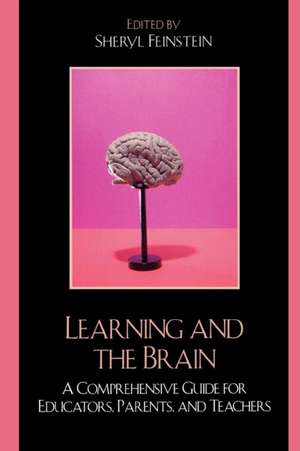
Learning and the Brain: A Comprehensive Guide for Educators, Parents, and Teachers
Editat de Sheryl Feinsteinen Limba Engleză Paperback – 29 iun 2007
Ideal for educators, parents and teachers, this encyclopedia provides a wealth of knowledge about why educational experiences are structured the way they are and how this helps students learn more. Cognitive neuroscience and its practical use in education provides much of the research for this book, however, the entries are written at a level appropriate for a general reader.
Preț: 376.11 lei
Preț vechi: 469.69 lei
-20%
Puncte Express: 564
Carte tipărită la comandă
Livrare economică 28 noiembrie-12 decembrie
Livrare prin curier în România Termenul estimat este afișat lângă disponibilitate.
Transport gratuit de la 400.00 lei Plată online sau ramburs, în funcție de opțiunile comenzii.
Retur gratuit în 14 zile Comandă securizată și suport în română.
Specificații
ISBN-13: 9781578866151
ISBN-10: 1578866154
Pagini: 554
Dimensiuni: 154 x 234 x 37 mm
Greutate: 0.92 kg
Editura: Bloomsbury Publishing
Colecția R&L Education
Locul publicării:New York, United States
ISBN-10: 1578866154
Pagini: 554
Dimensiuni: 154 x 234 x 37 mm
Greutate: 0.92 kg
Editura: Bloomsbury Publishing
Colecția R&L Education
Locul publicării:New York, United States
Cuprins
Chapter 1 List of A - Z entries
Chapter 2 Guide to Related Topics
Chapter 3 Preface
Chapter 4 Acknowledgements
Chapter 5 Introduction
Chapter 6 Chapters A - W
Chapter 7 Glossary of Brain Terms
Chapter 8 Bibliography
Chapter 9 About the Contributors
Chapter 10 Index
Chapter 2 Guide to Related Topics
Chapter 3 Preface
Chapter 4 Acknowledgements
Chapter 5 Introduction
Chapter 6 Chapters A - W
Chapter 7 Glossary of Brain Terms
Chapter 8 Bibliography
Chapter 9 About the Contributors
Chapter 10 Index
Recenzii
Written in an easily understood, jargon-free style, this [book] offers information on current issues in education, educational psychology, cognition, instruction, and curriculum development. Entries on teaching and learning address students' characteristics, hindrances to learning, and implications for classroom instruction. Sample topics include at-risk behavior, classroom management, emotional or behavioral issues, learning styles, learning theories, physical and emotional development, and reading. Authors are experts in the fields of neuroscience, psychology, and education. The primary focus is K-12, with additional information on preschool and adult learners. Nearly 100 entries are listed alphabetically, with cross-references and short lists of further readings. Besides the index, a list of A-Z entries and a guide to related topics facilitate navigation. The book includes an extensive bibliography and a glossary of terms relevant to the science of brain structure and function. Recommended. Lower-division undergraduates through researchers/faculty; general readers.
With nearly 100 accessibly-written entries, a glossary and well-prepared bibliography, this A-Z guide to education, educational psychology, cognition, instruction and curriculum development will appeal to parents as well as teachers. Entries include concise lists of further reading and describe such topics as the ageing brain, at-risk behavior, creativity, critical thinking, distributed intelligence, the brain in early childhood, gender differences, language acquisitions and disorders, moral development, nutrition, poverty, reading and fluency, self-esteem, spirituality, trauma and writing. The editors provide a helpful guide to related topics.
[W]ill be useful for educators, parents and teachers, as it provides a wealth of knowledge about why educational experiences are structured the way they are, and how this structure helps students learn more.
With nearly 100 accessibly-written entries, a glossary and well-prepared bibliography, this A-Z guide to education, educational psychology, cognition, instruction and curriculum development will appeal to parents as well as teachers. Entries include concise lists of further reading and describe such topics as the ageing brain, at-risk behavior, creativity, critical thinking, distributed intelligence, the brain in early childhood, gender differences, language acquisitions and disorders, moral development, nutrition, poverty, reading and fluency, self-esteem, spirituality, trauma and writing. The editors provide a helpful guide to related topics.
[W]ill be useful for educators, parents and teachers, as it provides a wealth of knowledge about why educational experiences are structured the way they are, and how this structure helps students learn more.