Cantitate/Preț
Produs

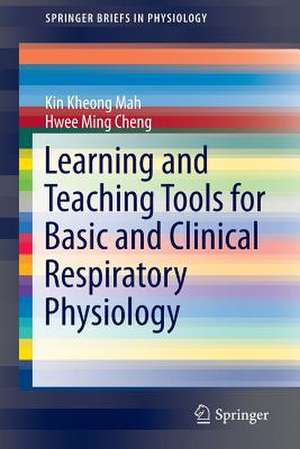
Learning and Teaching Tools for Basic and Clinical Respiratory Physiology: SpringerBriefs in Physiology

Autor Kin Kheong Mah, Hwee Ming Cheng
en Limba Engleză Paperback – 14 iul 2015

Actualizarea recomandărilor în educația medicală pune un accent tot mai mare pe tranziția de la memorarea brută la înțelegerea mecanismelor homeostatice. În acest context, Learning and Teaching Tools for Basic and Clinical Respiratory Physiology propune o abordare inovatoare, menită să simplifice dinamica schimbului de gaze și mecanica respiratorie prin metode interactive. Ne-a atras atenția modul în care autorii, Kin Kheong Mah și Hwee Ming Cheng, reușesc să transforme rigoarea clinică într-un proces de învățare activ, utilizând instrumente precum „Respi-CARDology”. Subliniem faptul că volumul nu se dorește a fi un tratat exhaustiv, ci un ghid de sinteză care prioritizează integrarea sistemelor. Structura este riguros împărțită: prima secțiune revizuiește fundamentele esențiale (difuzia, transportul O2 și CO2, reglarea respirației), în timp ce a doua secțiune este dedicată scenariilor de învățare, inclusiv adaptarea în medii ostile. Această abordare este o continuare firească a viziunii lui Hwee Ming Cheng din lucrarea sa anterioară, Defining Physiology: Principles, Themes, Concepts. Volume 2, unde accentul cade pe definirea temelor majore și a scenariilor fiziologice specifice. Ca alternativă la Respiratory Care Anatomy and Physiology de Will Beachey pentru rezidenți, acest volum din seria SpringerBriefs in Physiology oferă avantajul unui format compact și al unei organizări axate pe exerciții practice, fiind mult mai ușor de parcurs în timpul pregătirii pentru examene. Spre deosebire de abordarea integrată patologic din Respiratory: An Integrated Approach to Disease, lucrarea de față rămâne ancorată în fiziologia pură, oferind claritatea necesară pentru a stăpâni bazele înainte de a trece la studiul bolii.
Citește tot Restrânge

Din seria SpringerBriefs in Physiology

Preț: 37958 lei

Puncte Express: 569

Carte tipărită la comandă

Livrare economică 12-26 octombrie

Livrare prin curier în România Termenul estimat este afișat lângă disponibilitate.
Transport gratuit de la 40000 lei Plată online sau ramburs, în funcție de opțiunile comenzii.
Retur gratuit în 14 zile Comandă securizată și suport în română.

Specificații

ISBN-13: 9783319205250
ISBN-10: 3319205250
Pagini: 112
Ilustrații: XI, 100 p. 35 illus.
Dimensiuni: 155 x 235 x 7 mm
Greutate: 0.18 kg
Ediția:2015
Editura: Springer
Colecția SpringerBriefs in Physiology
Seria SpringerBriefs in Physiology

Locul publicării:Cham, Switzerland

Public țintă

Research

De ce să citești această carte

Această carte se adresează studenților la medicină și rezidenților care doresc să stăpânească fiziologia respiratorie fără a se pierde în detalii colaterale. Cititorul câștigă o înțelegere profundă a mecanismelor de control și a transportului de gaze prin metode pedagogice moderne. Este un instrument esențial pentru cei care caută o recapitulare rapidă, dar conceptuală, înainte de examenele de specialitate sau stagii clinice.


Descriere scurtă

This volume synthesizes pathways in respiratory mechanics and the dynamics of air-blood and blood-cellular gas exchange for students and teachers in respiratory physiology. The authors strive to make physiology fun to learn. This aspect of knowledge acquisition is reflected in the way topics are approached, for example by using playing cards in what is coined ‘Respi-CARDology’. The first section of this book reviews the framework and foundations of basic respiratory physiology. Since this book was not written to be a comprehensive physiology text, the authors have focused on leading students to appreciate and understand integrative principles and homeostatic mechanisms in lung function. The second section of this book mainly deals with the clinical application of fundamental knowledge of respiratory physiology.

Cuprins

Section 1:Respiration Essentials Revisited.- 1. Mechanics of Respiration.- 2. Diffusion, Blood O2, CO2 Content and Transport.- 3. Regulation of Respiration.- 4. Respiratory Physiological Integration.- Section 2: Learning Scenarios.- 5. Mechanics of Respiration.- 6. Oxygen Cascade and Blood O2 Content and Transport.- 7. Regulation of Respiration.- 8. Respiratory Physiology in Hostile Environment.

Caracteristici

Creative methodologies to teach Respiratory Physiology Combination of basic knowledge and clinically orientated scenarios Looking at the big picture in Respiratory Physiology Includes supplementary material: sn.pub/extras

Notă biografică

Dr. Cheng Hwee Ming graduated from University of Liverpool with a Joint Honors (Biochemistry/Cell Biology, 1980) and PhD (Immunology, 1983). He has taught Physiology at the Universiti Malaya in Kuala Lumpur since 1985. Dr Cheng has an interest in understanding how students think, learn and in helping them unmask misconceptions in Physiology. His academic books include ' Thinking Through Physiology ' and the Springer's 'Physiology Question-based Learning' title. Dr Cheng is also the initiator of the annual International Physiology Quiz now in its 18th year, each event participated by more than 90 medical schools from over 20 countries. He is married to Gaik Cheng, a general practitioner, and they have two children, Timothy, Ruth and a grandson, Caleb.
Dr. Kumar Seluakumaran received his medical degree from University of Malaya in 2002 and his Ph.D from the University of Western Australia in 2007. He has since been working as a senior lecturer at the Department of Physiology, Faculty of Medicine, University of Malaya. He has been teaching neurophysiology to undergraduate and postgraduate students for the past 13 years. His research interest is in the area of auditory neuroscience and he has published peer-reviewed articles related to central auditory neuronal responses, audiology and psychoacoustics.
Assoc Prof Dr Mah Kin Kheong graduated from University Malaya in 1985 and later trained as an anaesthetist in Malaysia and Australia, obtaining his Masters in Anaesthesiology from University Malaya in 1992 and his Fellowship from the Australian and New Zealand College of Anaesthetist in 1994. He was inducted as a Fellow in the Academy of Medicine in Malaysia in 2007. He teaches at the Royal College of Medicine Perak, University Kuala Lumpur. He was the Head of Physiology and the current Deputy Dean of the college. He is also a trainer and examiner in the Conjoint Master of Anaesthesia programme in Malaysia.