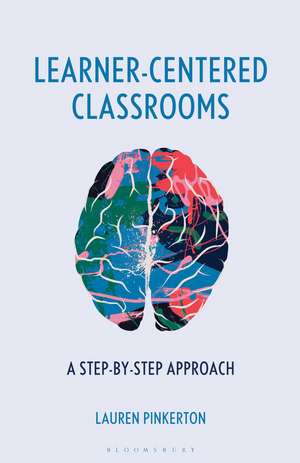
Learner-Centered Classrooms: A Step-by-Step Approach
Autor Professor Lauren Pinkertonen Limba Engleză Hardback – 15 oct 2026
Designed with empathy and practicality in mind, this book meets educators where they are on their pedagogical journey. It moves beyond theory and avoids the preachy tone common in academic texts, offering instead a conversational, accessible, and encouraging approach. Each chapter breaks down the learner-centered education (LCE) framework into manageable, actionable steps that can be implemented in even the most challenging environments.
Whether you're new to LCE or looking to refine your approach, Learner Centered Classrooms provides the tools, strategies, and real-life guidance you need to create engaging, student-driven learning experiences-no matter your circumstances.
Preț: 669.44 lei
Preț vechi: 826.47 lei
-19% Nou
Puncte Express: 1004
Carte tipărită la comandă
Livrare economică 30 noiembrie-14 decembrie
Livrare prin curier în România Termenul estimat este afișat lângă disponibilitate.
Transport gratuit pentru acest produs Plată online sau ramburs, în funcție de opțiunile comenzii.
Retur gratuit în 14 zile Comandă securizată și suport în română.
Specificații
ISBN-13: 9798216369264
Pagini: 176
Ilustrații: 18 figures, 7 textboxes, 66 tables
Dimensiuni: 152 x 229 x 25 mm
Greutate: 0.48 kg
Editura: Bloomsbury Publishing
Colecția Bloomsbury Academic
Locul publicării:New York, United States
Pagini: 176
Ilustrații: 18 figures, 7 textboxes, 66 tables
Dimensiuni: 152 x 229 x 25 mm
Greutate: 0.48 kg
Editura: Bloomsbury Publishing
Colecția Bloomsbury Academic
Locul publicării:New York, United States
Cuprins
Chapter 1: Introduction
· Purpose and Scope of the Book
· Understanding Learner-Centered Education (LCE)
· Challenges in Traditional Teaching Environments
· How to Navigate This Book
Chapter 2: Preparing for Change
· The Role of the Teacher: Debunking Myths and Misconceptions of LCE
· Evaluating Your Current Teaching Practices
· Identifying and Addressing Classroom Constraints
· Setting Clear and Achievable Goals
· Building Your Support Network
Chapter 3: Classroom Management
· It Starts Before It Begins: Establishing a Student-Centered Classroom Culture
· Judge a Book by its Cover
· Taking Advantage of Your Physical Space
· Too Nice or Too Mean?
· Your Journey
· Step-by-Step Approaches
Chapter 4: Lesson Planning and Curriculum Design
· Work in Units-Not in Isolation
· From Abstract to Less-Abstract
· Your Journey
· Step-by-Step Approaches
Chapter 5: Administering Assessments
· Assessment and the Student
· Assessment and the Teacher
· Incorporating Differentiation While Maintaining Standards
· Your Journey
· Step-by-Step Approaches
Chapter 6: Providing Feedback
· Feedback Matters
· Your Journey
· A Step-by-Step Approach
Chapter 7: Teaching Modalities
· Making Multimodalities Your Lifeline
· The More You Speak, the Less They Learn
· Your Journey
· Step-by-Step Approaches
Chapter 8: The Worth of Digital Technology
· The Necessity of Technology
· Your Journey
· Step-by-Step Approaches
Chapter 9: Student Engagement and Motivation
· Activating Goal Contagion
· Intrinsic vs Extrinsic Motivation
· Your Journey
· Step-by-Step Approaches
Chapter 10: Conclusion· Recap of Key Insights
· Revisiting Your Practices and Goals
· Final Reflections and Encouragement
· Purpose and Scope of the Book
· Understanding Learner-Centered Education (LCE)
· Challenges in Traditional Teaching Environments
· How to Navigate This Book
Chapter 2: Preparing for Change
· The Role of the Teacher: Debunking Myths and Misconceptions of LCE
· Evaluating Your Current Teaching Practices
· Identifying and Addressing Classroom Constraints
· Setting Clear and Achievable Goals
· Building Your Support Network
Chapter 3: Classroom Management
· It Starts Before It Begins: Establishing a Student-Centered Classroom Culture
· Judge a Book by its Cover
· Taking Advantage of Your Physical Space
· Too Nice or Too Mean?
· Your Journey
· Step-by-Step Approaches
Chapter 4: Lesson Planning and Curriculum Design
· Work in Units-Not in Isolation
· From Abstract to Less-Abstract
· Your Journey
· Step-by-Step Approaches
Chapter 5: Administering Assessments
· Assessment and the Student
· Assessment and the Teacher
· Incorporating Differentiation While Maintaining Standards
· Your Journey
· Step-by-Step Approaches
Chapter 6: Providing Feedback
· Feedback Matters
· Your Journey
· A Step-by-Step Approach
Chapter 7: Teaching Modalities
· Making Multimodalities Your Lifeline
· The More You Speak, the Less They Learn
· Your Journey
· Step-by-Step Approaches
Chapter 8: The Worth of Digital Technology
· The Necessity of Technology
· Your Journey
· Step-by-Step Approaches
Chapter 9: Student Engagement and Motivation
· Activating Goal Contagion
· Intrinsic vs Extrinsic Motivation
· Your Journey
· Step-by-Step Approaches
Chapter 10: Conclusion· Recap of Key Insights
· Revisiting Your Practices and Goals
· Final Reflections and Encouragement
Recenzii
This book is recommended for all teachers seeking to enhance their pedagogy with learner-centered strategies. The activities and insights are built on evidence-based practices presented in an approachable and reflective way. Dr. Pinkerton is a true learner-centered teacher who provides a bridge from theory to practice!
Dr. Pinkerton has brilliantly synthesized years of reflective practice and rigorous inquiry to create a practical, classroom-ready guide designed to support teachers in any classroom context who are rethinking traditional instruction in favor of a learner-centered approach. Rich in evidence-based strategies and practical applications that guide educators in making meaningful and lasting changes in their classrooms, Learner-Centered Classrooms is a fantastic tool to inspire and sustain learner-centered teaching practices. Perfect for the educator looking to cultivate transformative, student-driven learning opportunities in their classroom.
Dr. Pinkerton has brilliantly synthesized years of reflective practice and rigorous inquiry to create a practical, classroom-ready guide designed to support teachers in any classroom context who are rethinking traditional instruction in favor of a learner-centered approach. Rich in evidence-based strategies and practical applications that guide educators in making meaningful and lasting changes in their classrooms, Learner-Centered Classrooms is a fantastic tool to inspire and sustain learner-centered teaching practices. Perfect for the educator looking to cultivate transformative, student-driven learning opportunities in their classroom.