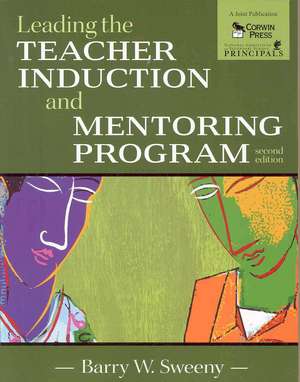
Leading the Teacher Induction and Mentoring Program
Autor Barry W. Sweenyen Limba Engleză Paperback – 18 sep 2007
Preț: 332.40 lei
Carte tipărită la comandă
Livrare economică 05-19 iunie
Specificații
ISBN-10: 1412944619
Pagini: 296
Dimensiuni: 216 x 279 x 18 mm
Greutate: 0.83 kg
Ediția:Second Edition
Editura: SAGE Publications
Colecția Corwin
Locul publicării:Thousand Oaks, United States
V-ar putea interesa
-
 Educating Youth for a World Beyond ViolenceH. ShapiroPreț: 291.50 lei
 -
 Teaching with ReverenceA. RudPreț: 289.81 lei
 -
 -15%Preț: 662.99 lei779.99 lei
 -
 A Therapeutic Approach to Teaching PoetryT. WilliamsPreț: 294.07 lei
 -
 -27%Preț: 190.14 lei259.25 lei
 -
 Preț: 354.21 lei
 -
 Teacher Education Around the World: Changing Policies and PracticesLinda Darling-HammondPreț: 461.35 lei
 -
 Passing PTLLS AssessmentsAnn GravellsPreț: 247.39 lei
 -
 Study Skills for PTLLSJacklyn WilliamsPreț: 279.50 lei
 -
 Teaching Politics and International RelationsC. Gormley-HeenanPreț: 375.41 lei
 -
 Preț: 284.39 lei
 -
 RESULTS Coaching: The New Essential for School LeadersKathryn M. KeePreț: 288.82 lei
 -
 Preț: 315.83 lei
 -
 The Teacher’s Journey: The Human DimensionsJeffrey A. KottlerPreț: 271.52 lei
 -
 Preț: 294.44 lei
 -
 The Trainee Teachers' Survival Guide 2nd EditionHazel Bennett-45%Preț: 96.26 lei176.21 lei
Recenzii
"Offers many suggestions and guiding principles for organizing mentoring programs and succinctly addresses many complex issues of program development and interpersonal relationships in mentoring roles. There is so much information in an easy-to-read, direct presentation."
"A very practitioner-oriented book that will be useful to leaders, program planners, and mentors in their work with new teachers. This book takes school leaders through the process of creating and sustaining an induction and mentoring program, challenging the reader to think beyond initial, short-term goals to a wider, long-term vision."
"An excellent resource for anyone wishing to develop a model for new teachers aimed at strengthening teacher and student performance. The step-by-step approach will particularly assist those who are trying to set up effective programs from scratch and don't have time to search the Internet for resource material."
Cuprins
Preface
Acknowledgments
About the Author
Introduction
Mentoring Questions Leaders Want Answered
Defining Mentoring, Induction, and Peer Coaching
The Increasing Importance of Mentoring and Induction
The Compelling Rationale for Mentoring and Induction
1. Getting Off to the Right Start
Differences Make All the Difference
Using a Model of Teacher Development to Guide Program and Practice
The Concerns-Based Adoption Model (CBAM)
Assessing and Using Data on New Teacher Needs
Three Concepts Essential for Program Success
The Big Picture: The High Impact Program Components
2. The Program Design Process
Design From the Destination
The First Step: Establish a Program Leadership Group
The Next Step: Identify a Program Coordinator
Roles of the Mentor Program Coordinator
The Sequence for Creating a Successful Program
Deciding the Sequence for Implementing Program Components
Defining Program Purposes, Goals, and Objectives
A Summary
3. Induction Structures for Effective New Teacher Development
Components for a High-Impact Induction Program
The Evolving Picture of Your Protégés
Using the CBAM to Design Induction
Designing an Effective Initial Orientation
Protégé Training
Protégé Observations of Expert Practitioners
Protégé Peer Support
Protégé Reflective Practice and the Professional Standards
Use of Professional Development Goals, Plans, and Portfolios
The Mentor in the Middle
Working Toward the Ideal Induction Program Model
4. Providing the Time for Effective Mentoring
Full- or Part-Time Mentoring?
Finding and Making Time for Mentoring
5. Designing Components of a High-Impact Mentoring Program
Roles and Tasks of the Ideal Mentor
Roles and Tasks of Protégés
Roles and Tasks of Site Administrators
Mentor Recruitment
Mentor Selection and Mentor-Protege Matching
How Does a Balanced Selection and Matching Process Work?
Matching Mentors and Protégés
Dealing With a Mentor-Protégé MISmatch
Mentor Support After Training
Mentoring of Mentors: Program Leader Support of Mentors
Mentor Incentives and Recognition
6. Designing a High-Impact Mentor Training
Who Should Lead Mentor Training?
What Are the Themes for High-Impact Mentor Training?
What Is the Sequence for Content and Activities in Mentor Training?
What Follow Up Support Is Needed to Ensure Mentor Implementation of Training?
7. Evaluating, Improving, and Sustaining the Program
The Program Evaluation Learning Agenda
Using the Research Showing Induction’s Impact on Results
Basic Evaluation Knowledge
Designing an Evaluation Process and Plan
Demonstrating Compelling Return on Investment From Induction
Other Strategies for Supporting and Sustaining the Program
Resources
I. Internet & Organization Resources for Mentoring
II. Mentor Training Activity: Practice in Identification of CBAM Stages of Concern
III. Mentor Practice Scenarios: Ending Your Conversations
References
Index
Notă biografică
Barry W. Sweeny is the president of Best Practice Resources, Inc. an independent educational consulting firm in Wheaton, Illinois. He has been a consultant, facilitator, trainer, and author, as well as a presenter and keynoter at educational conferences. Mr. Sweeny¿s specialty is the development of teacher mentoring and induction programs and practices that result in high quality instruction and increased student learning. Barry has trained thousands of mentors and administrators, and helped develop or improve hundreds of programs in school districts, professional associations and collaboratives, universities, regional agencies, community and governmental agencies, and businesses. His ¿High Impact¿ model of induction and mentoring is used all over the world for accomplishing the goals of supporting and guiding new teachers into the profession AND for creating programs that help districts accomplish their strategic initiatives. Barry is also known for his role in founding the ASCD Mentoring Leadership and Resource Network and is a Director Emeritus of the International Mentoring Association. In addition, Barry has worked in school improvement, peer coaching, staff development, and performance-based teaching, learning, and assessment. Previously, he was an award-winning classroom teacher for 22 years, a district staff developer and mentor program coordinator, and a program development manager at two regional offices of education.