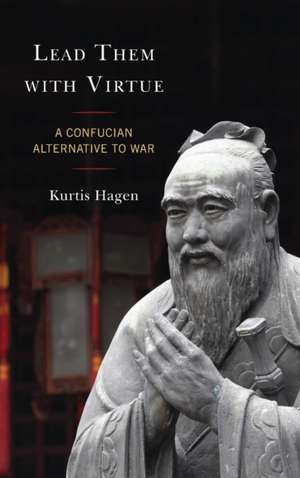
Lead Them with Virtue: A Confucian Alternative to War
Autor Kurtis Hagenen Limba Engleză Hardback – 20 aug 2021
Preț: 499.79 lei
Preț vechi: 790.35 lei
-37%
Puncte Express: 750
Carte tipărită la comandă
Livrare economică 08-22 decembrie
Livrare prin curier în România Termenul estimat este afișat lângă disponibilitate.
Transport gratuit pentru acest produs Plată online sau ramburs, în funcție de opțiunile comenzii.
Retur gratuit în 14 zile Comandă securizată și suport în română.
Specificații
ISBN-13: 9781793639707
ISBN-10: 1793639701
Pagini: 192
Dimensiuni: 158 x 232 x 18 mm
Greutate: 0.44 kg
Editura: Bloomsbury Publishing
Colecția Lexington Books
Locul publicării:New York, United States
ISBN-10: 1793639701
Pagini: 192
Dimensiuni: 158 x 232 x 18 mm
Greutate: 0.44 kg
Editura: Bloomsbury Publishing
Colecția Lexington Books
Locul publicării:New York, United States
Cuprins
Preface
Introduction
Chapter 1: A Brief Overview of Confucianism
Chapter 2: Western and Chinese Attitudes Regarding Warfare
Chapter 3: Anticipating Confucian Just War Theory
Chapter 4: Mencius on War and Humanitarian Intervention
Chapter 5: Xunzi on War and Humanitarian Intervention
Chapter 6: Mencius and Xunzi on Tyranny and Humanitarian Intervention: A Response to Twiss and Chan
Chapter 7: From Human Nature to the Clash of Civilizations
Chapter 8: Two Visions of Confucian World Order
Conclusion
Bibliography
Introduction
Chapter 1: A Brief Overview of Confucianism
Chapter 2: Western and Chinese Attitudes Regarding Warfare
Chapter 3: Anticipating Confucian Just War Theory
Chapter 4: Mencius on War and Humanitarian Intervention
Chapter 5: Xunzi on War and Humanitarian Intervention
Chapter 6: Mencius and Xunzi on Tyranny and Humanitarian Intervention: A Response to Twiss and Chan
Chapter 7: From Human Nature to the Clash of Civilizations
Chapter 8: Two Visions of Confucian World Order
Conclusion
Bibliography
Recenzii
"I thoroughly enjoyed reading this book. Moreover, I learned a great deal indeed from the reading. I have always enjoyed reading about Xunzi. I most highly recommend this excellent work."
Learning from early philosophers requires both getting the ancients right and applying their lessons astutely. In Lead Them With Virtue, Kurtis Hagen makes novel and powerful arguments on both counts. He shows that early Confucians were much less sanguine about 'just war' than has often been thought, and that we have much to learn from the 'Confucian solution' to peace and security. Over the long term, peace and prosperity come not from military strength but from benevolent governments held accountable by critical intellectuals.
Lead them with Virtue presents a Confucian perspective on topics including just war, dirty hands, the use of the military, humanitarian intervention, and global leadership. Hagen unifies these themes by placing strategic moral leadership at the centre of a sustainable, long-term, Confucian vision.
Through a thorough investigation of the Confucian views on warfare and the world order, this book has provided an original analysis and insightful discussion of the Confucian approach to political conflicts and their solutions, and argued for this approach to be a plausible alternative to various war and world order theories popular in the West, past and present. Academic by nature, the book nevertheless may well serve as a kind of handbook not only useful to those political leaders who hold the power to wage a war but also beneficial for the general public who are particularly concerned with justifications, procedures, and consequences of engaging war in an increasingly globalized world.
In this provocative book, Kurtis Hagen challenges the dominant view among the students of Chinese philosophy that early Confucians such as Mencius and Xunzi supported humanitarian intervention. Highlighting the similarity between early Mohists and early Confucians regarding the use of violence, Hagen contends that it is a mistake to understand early Confucians as the advocates of humanitarian intervention who justified military intervention for good consequences because their central concern was with winning the whole world by noncoercive means, virtue in particular. Hagen's book is one of the first attempts to systematically investigate the Confucian idea of just war and its core contention is worth serious attention and engagement.
Learning from early philosophers requires both getting the ancients right and applying their lessons astutely. In Lead Them With Virtue, Kurtis Hagen makes novel and powerful arguments on both counts. He shows that early Confucians were much less sanguine about 'just war' than has often been thought, and that we have much to learn from the 'Confucian solution' to peace and security. Over the long term, peace and prosperity come not from military strength but from benevolent governments held accountable by critical intellectuals.
Lead them with Virtue presents a Confucian perspective on topics including just war, dirty hands, the use of the military, humanitarian intervention, and global leadership. Hagen unifies these themes by placing strategic moral leadership at the centre of a sustainable, long-term, Confucian vision.
Through a thorough investigation of the Confucian views on warfare and the world order, this book has provided an original analysis and insightful discussion of the Confucian approach to political conflicts and their solutions, and argued for this approach to be a plausible alternative to various war and world order theories popular in the West, past and present. Academic by nature, the book nevertheless may well serve as a kind of handbook not only useful to those political leaders who hold the power to wage a war but also beneficial for the general public who are particularly concerned with justifications, procedures, and consequences of engaging war in an increasingly globalized world.
In this provocative book, Kurtis Hagen challenges the dominant view among the students of Chinese philosophy that early Confucians such as Mencius and Xunzi supported humanitarian intervention. Highlighting the similarity between early Mohists and early Confucians regarding the use of violence, Hagen contends that it is a mistake to understand early Confucians as the advocates of humanitarian intervention who justified military intervention for good consequences because their central concern was with winning the whole world by noncoercive means, virtue in particular. Hagen's book is one of the first attempts to systematically investigate the Confucian idea of just war and its core contention is worth serious attention and engagement.