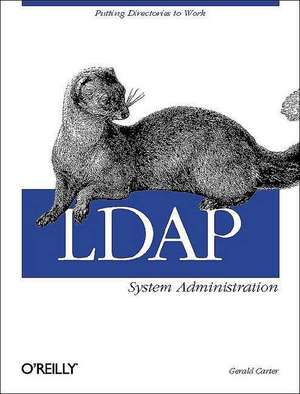
LDAP System Administration
Autor Gerald Carteren Limba Engleză Paperback – 29 apr 2003
Preț: 194.57 lei
Preț vechi: 243.21 lei
-20%
Puncte Express: 292
Carte disponibilă
Livrare economică 02-16 noiembrie
Livrare prin curier în România Termenul estimat este afișat lângă disponibilitate.
Transport gratuit de la 400.00 lei Plată online sau ramburs, în funcție de opțiunile comenzii.
Retur gratuit în 14 zile Comandă securizată și suport în română.
Specificații
ISBN-13: 9781565924918
ISBN-10: 1565924916
Pagini: 308
Ilustrații: Illustrations
Dimensiuni: 181 x 233 x 22 mm
Greutate: 0.52 kg
Editura: O'Reilly
ISBN-10: 1565924916
Pagini: 308
Ilustrații: Illustrations
Dimensiuni: 181 x 233 x 22 mm
Greutate: 0.52 kg
Editura: O'Reilly
V-ar putea interesa
-
 -20%Preț: 439.67 lei549.59 lei
 -
 CCNA 200-301 Hands-on Mastery with Packet TracerAnthony Sequeira-20%Preț: 302.09 lei377.61 lei
 -
 -20%Preț: 239.96 lei299.96 lei
 -
 -20%Preț: 294.73 lei368.41 lei
 -
 CCNA 200-301 Official Cert Guide LibraryWendell Odom-20%Preț: 457.94 lei572.43 lei
 -
 Practice of System and Network Administration, TheChristina Hogan-20%Preț: 397.36 lei496.69 lei
 -
 CCNA Certification Study Guide Volume 1Donald Robb-20%Preț: 303.74 lei379.68 lei
 -
 Networking All-In-One for DummiesDoug Lowe-20%Preț: 263.34 lei329.17 lei
 -
 SharePoint For DummiesKen Withee-20%Preț: 120.40 lei150.50 lei
 -
 Microsoft 365 Access for DummiesLaurie A Ulrich-20%Preț: 141.67 lei177.09 lei
 -
 SQL Essentials for DummiesRichard Blum-20%Preț: 65.77 lei82.21 lei
 -
 -20%Preț: 312.80 lei391.00 lei
 -
 CompTIA Linux+ Study GuideRichard Blum-19%Preț: 410.16 lei506.36 lei
 -
 Linux Command Line and Shell Scripting BibleRichard Blum-20%Preț: 410.86 lei513.56 lei
 -
 Acing the CCNA Exam Volume 1 Fundamentals and ProtocolsJeremy McDowell-20%Preț: 320.72 lei400.90 lei
 -
 System Programming in Linux: A Hands-On IntroductionStewart Weiss-35%Preț: 481.36 lei739.15 lei
 -
 Packet Tracer for Young Intermediate AdminsDamian Strojek-20%Preț: 260.94 lei326.17 lei
 -
 Packet Tracer for Young Advanced AdminsDamian Strojek-20%Preț: 260.24 lei325.30 lei
 -
 -20%Preț: 265.31 lei331.65 lei
 -
 SharePoint Online Administrator PlaybookDeviprasad Panda-20%Preț: 231.04 lei288.79 lei
Cuprins
Preface; How This Book Is Organized; Conventions Used in This Book; Comments and Questions; Acknowledgments; Part I: LDAP Basics; Chapter 1: "Now where did I put that...?", or "What is a directory?"; 1.1 The Lightweight Directory Access Protocol; 1.2 What Is LDAP?; 1.3 LDAP Models; Chapter 2: LDAPv3 Overview; 2.1 LDIF; 2.2 What Is an Attribute?; 2.3 What Is the dc Attribute?; 2.4 Schema References; 2.5 Authentication; 2.6 Distributed Directories; 2.7 Continuing Standardization; Chapter 3: OpenLDAP; 3.1 Obtaining the OpenLDAP Distribution; 3.2 Software Requirements; 3.3 Compiling OpenLDAP 2; 3.4 OpenLDAP Clients and Servers; 3.5 The slapd.conf Configuration File; 3.6 Access Control Lists (ACLs); Chapter 4: OpenLDAP: Building a Company White Pages; 4.1 A Starting Point; 4.2 Defining the Schema; 4.3 Updating slapd.conf; 4.4 Starting slapd; 4.5 Adding the Initial Directory Entries; 4.6 Graphical Editors; Chapter 5: Replication, Referrals, Searching, and SASL Explained; 5.1 More Than One Copy Is "a Good Thing"; 5.2 Distributing the Directory; 5.3 Advanced Searching Options; 5.4 Determining a Server's Capabilities; 5.5 Creating Custom Schema Files for slapd; 5.6 SASL and OpenLDAP; Part II: Application Integration; Chapter 6: Replacing NIS; 6.1 More About NIS; 6.2 Schemas for Information Services; 6.3 Information Migration; 6.4 The pam_ldap Module; 6.5 The nss_ldap Module; 6.6 OpenSSH, PAM, and NSS; 6.7 Authorization Through PAM; 6.8 Netgroups; 6.9 Security; 6.10 Automount Maps; 6.11 PADL's NIS/LDAP Gateway; Chapter 7: Email and LDAP; 7.1 Representing Users; 7.2 Email Clients and LDAP; 7.3 Mail Transfer Agents (MTAs); Chapter 8: Standard Unix Services and LDAP; 8.1 The Directory Namespace; 8.2 An FTP/HTTP Combination; 8.3 User Authentication with Samba; 8.4 FreeRadius; 8.5 Resolving Hosts; 8.6 Central Printer Management; Chapter 9: LDAP Interoperability; 9.1 Interoperability or Integration?; 9.2 Directory Gateways; 9.3 Cross-Platform Authentication Services; 9.4 Distributed, Multivendor Directories; 9.5 Metadirectories; 9.6 Push/Pull Agents for Directory Synchronization; Chapter 10: Net::LDAP and Perl; 10.1 The Net::LDAP Module; 10.2 Connecting, Binding, and Searching; 10.3 Working with Net::LDAP::LDIF; 10.4 Updating the Directory; 10.5 Advanced Net::LDAP Scripting; Part III: Appendixes; Appendix A: PAM and NSS; A.1 Pluggable Authentication Modules; A.2 Name Service Switch (NSS); Appendix B: OpenLDAP Command-Line Tools; B.1 Debugging Options; B.2 Slap Tools; B.3 LDAP Tools; Appendix C: Common Attributes and Objects; C.1 Schema Files; C.2 Attributes; C.3 Object Classes; Appendix D: LDAP RFCs, Internet-Drafts, and Mailing Lists; D.1 Requests for Comments; D.2 Mailing Lists; Appendix E: slapd.conf ACLs; E.1 What?; E.2 Who?; E.3 How Much?; E.4 Examples; Colophon;