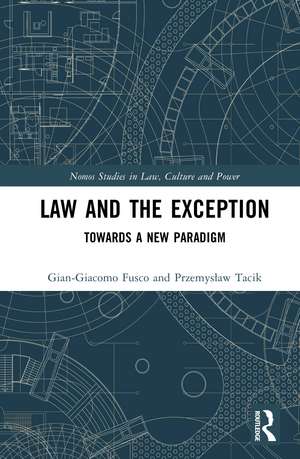
Law and the Exception: Towards a New Paradigm: Nomos Studies in Law, Culture and Power
Autor Gian-Giacomo Fusco, Przemysław Taciken Limba Engleză Hardback – 26 sep 2025
This book will interest scholars and researchers in legal and political theory, as well as continental philosophy.




Preț: 1059.85 lei
Preț vechi: 1292.51 lei
-18%
Puncte Express: 1590
Carte tipărită la comandă
Livrare economică 09-23 noiembrie
Livrare prin curier în România Termenul estimat este afișat lângă disponibilitate.
Transport gratuit pentru acest produs Plată online sau ramburs, în funcție de opțiunile comenzii.
Retur gratuit în 14 zile Comandă securizată și suport în română.
Specificații
ISBN-13: 9781032790848
ISBN-10: 1032790849
Pagini: 190
Dimensiuni: 156 x 234 x 15 mm
Greutate: 0.51 kg
Ediția:1
Editura: Taylor & Francis
Colecția Routledge
Seria Nomos Studies in Law, Culture and Power
Locul publicării:Oxford, United Kingdom
ISBN-10: 1032790849
Pagini: 190
Dimensiuni: 156 x 234 x 15 mm
Greutate: 0.51 kg
Ediția:1
Editura: Taylor & Francis
Colecția Routledge
Seria Nomos Studies in Law, Culture and Power
Locul publicării:Oxford, United Kingdom
Public țintă
PostgraduateCuprins
Introduction 1. What is (State of) Exception the Name of? 2. Exceptionality: Towards the General Theory of Exception 3. Exceptionalisation: Distributing Exceptionality 4. Exceptionality, Exceptionalisation and Sovereignty 5. Liberal Legalism and the Normalisation of the Exception 6. State Form and Liberalism Authoritarian Drives
Notă biografică
Gian-Giacomo Fusco is a lecturer in law at Kent Law School (University of Kent, Canterbury). He obtained his doctoral degree in law at the University of Kent. His research interests include jurisprudence, critical theory, history of ideas and urban studies. His more recent monograph, Form of Life: Agamben and the Destitution of Rules (2022), engaged with and developed further Agamben’s concept of destituent potential as a critique of the law.
Przemysław Tacik is Assistant Professor at the Institute of European Studies of the Jagiellonian University of Kraków, Poland, and Director of the Nomos: Centre for International Research on Law, Culture and Power. A philosopher, lawyer and sociologist by education, he holds PhDs in philosophy (2014) and international law (2016), as well as habilitation in law (2024). He has been a visiting scholar at numerous universities. In his academic work, he combines both philosophical and legal perspectives, attempting to approach them from an interdisciplinary angle. His current research is focused on critical legal theory and contemporary philosophy. He has authored five books as well as over 60 articles and two translations of a poetry volume (from French to Polish). His most recent monographs are A New Philosophy of Modernity and Sovereignty: Towards Radical Historicization (2021) and Deconstructing the Right to Self-Determination in International Law: Sovereignty, Exception, Biopolitics (2023).
Przemysław Tacik is Assistant Professor at the Institute of European Studies of the Jagiellonian University of Kraków, Poland, and Director of the Nomos: Centre for International Research on Law, Culture and Power. A philosopher, lawyer and sociologist by education, he holds PhDs in philosophy (2014) and international law (2016), as well as habilitation in law (2024). He has been a visiting scholar at numerous universities. In his academic work, he combines both philosophical and legal perspectives, attempting to approach them from an interdisciplinary angle. His current research is focused on critical legal theory and contemporary philosophy. He has authored five books as well as over 60 articles and two translations of a poetry volume (from French to Polish). His most recent monographs are A New Philosophy of Modernity and Sovereignty: Towards Radical Historicization (2021) and Deconstructing the Right to Self-Determination in International Law: Sovereignty, Exception, Biopolitics (2023).
Descriere
This book proposes a new understanding of 'the state of exception' in legal and political theory. It explores how exceptional measures are normalized outside traditional frameworks, revealing how emergency laws reflect broader exceptionality patterns and examining hidden authoritarian tendencies in liberal constitutionalism.