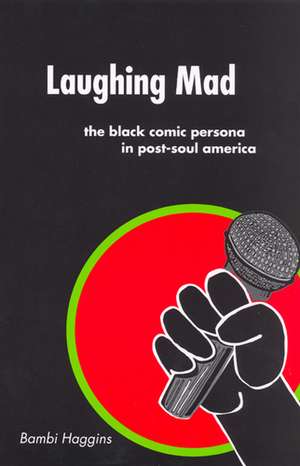
Laughing Mad: The Black Comic Persona in Post-Soul America
Autor Bambi Hagginsen Limba Engleză Paperback – 31 ian 2007
Winner of the 2008 Katherine Singer Kovacs Book Award
Prior to the civil rights movement, comedians performed for audiences that were clearly delineated by race. Black comedians performed for black audiences and white comedians performed for whites. Yet during the past forty-five years, black comics have become progressively more central to mainstream culture.
In Laughing Mad , Bambi Haggins looks at how this transition occurred in a variety of media and shows how this integration has paved the way for black comedians and their audiences to affect each other. Historically, African American performers have been able to use comedy as a pedagogic tool, interjecting astute observations about race relations while the audience is laughing. And yet, Haggins makes the convincing argument that the potential of African American comedy remains fundamentally unfulfilled as the performance of blackness continues to be made culturally digestible for mass consumption.
Rather than presenting biographies of individual performers, Haggins focuses on the ways in which the comic persona is constructed and changes across media, from stand-up, to the small screen, to film. She examines the comic televisual and cinematic personae of Dick Gregory, Bill Cosby, Flip Wilson, and Richard Pryor and considers how these figures set the stage for black comedy in the next four decades. She reads Eddie Murphy and Chris Rock as emblematic of the first and second waves of post-civil rights era African American comedy, and she looks at the socio-cultural politics of Whoopi Goldberg's comic persona through the lens of gender and crossover. Laughing Mad also explores how the comedy of Dave Chappelle speaks to and for the post-soul generation.
A rigorous analytic analysis, this book interrogates notions of identity, within both the African American community and mainstream popular culture. Written in engaging and accessible prose, it is also a book that will travel from the seminar room, to the barbershop, to the kitchen table, allowing readers to experience the sketches, stand-up, and film comedies with all the laughter they deserve.
Prior to the civil rights movement, comedians performed for audiences that were clearly delineated by race. Black comedians performed for black audiences and white comedians performed for whites. Yet during the past forty-five years, black comics have become progressively more central to mainstream culture.
In Laughing Mad , Bambi Haggins looks at how this transition occurred in a variety of media and shows how this integration has paved the way for black comedians and their audiences to affect each other. Historically, African American performers have been able to use comedy as a pedagogic tool, interjecting astute observations about race relations while the audience is laughing. And yet, Haggins makes the convincing argument that the potential of African American comedy remains fundamentally unfulfilled as the performance of blackness continues to be made culturally digestible for mass consumption.
Rather than presenting biographies of individual performers, Haggins focuses on the ways in which the comic persona is constructed and changes across media, from stand-up, to the small screen, to film. She examines the comic televisual and cinematic personae of Dick Gregory, Bill Cosby, Flip Wilson, and Richard Pryor and considers how these figures set the stage for black comedy in the next four decades. She reads Eddie Murphy and Chris Rock as emblematic of the first and second waves of post-civil rights era African American comedy, and she looks at the socio-cultural politics of Whoopi Goldberg's comic persona through the lens of gender and crossover. Laughing Mad also explores how the comedy of Dave Chappelle speaks to and for the post-soul generation.
A rigorous analytic analysis, this book interrogates notions of identity, within both the African American community and mainstream popular culture. Written in engaging and accessible prose, it is also a book that will travel from the seminar room, to the barbershop, to the kitchen table, allowing readers to experience the sketches, stand-up, and film comedies with all the laughter they deserve.
Preț: 300.08 lei
Puncte Express: 450
Carte tipărită la comandă
Livrare economică 18 noiembrie-02 decembrie
Livrare prin curier în România Termenul estimat este afișat lângă disponibilitate.
Transport gratuit de la 400.00 lei Plată online sau ramburs, în funcție de opțiunile comenzii.
Retur gratuit în 14 zile Comandă securizată și suport în română.
Specificații
ISBN-13: 9780813539850
ISBN-10: 0813539854
Pagini: 288
Ilustrații: 32
Dimensiuni: 152 x 229 x 20 mm
Greutate: 0.43 kg
Ediția:None edition
Editura: Rutgers University Press
Colecția Rutgers University Press
ISBN-10: 0813539854
Pagini: 288
Ilustrații: 32
Dimensiuni: 152 x 229 x 20 mm
Greutate: 0.43 kg
Ediția:None edition
Editura: Rutgers University Press
Colecția Rutgers University Press
V-ar putea interesa
-
 Tales from a Korean Maiden in AmericaDorothy M. HongPreț: 50.27 lei
 -
 Fear of a Black AmericaDonald Earl CollinsPreț: 90.13 lei
 -
 A Field Negroes HandbookNapoleon WellsPreț: 58.89 lei
 -
 The New ScapegoatsKwame Jr. Okoampa-AhoofePreț: 77.82 lei
 -
 Dancing and Crying to Be FreeJohn H. HallPreț: 186.28 lei
 -
 Sport and the Talented TenthRobert E. WellsPreț: 301.44 lei
 -
 Hidden in the Shadow of TruthE. Hicks Reginald E. HicksPreț: 144.80 lei
 -
 Frederick Douglass.Booker T. WashingtonPreț: 157.94 lei
 -
 Cold Wind from the NorthVulindlela I. WobogoPreț: 211.07 lei
 -
 The History of the Negro ChurchCarter G. Woodson Ph. D.Preț: 145.59 lei
 -
 Historias de Exclusion.Teresa PorzecanskiPreț: 124.10 lei
 -
 Frederick Douglass. the Colored OratorFrederic May HollandPreț: 160.41 lei
 -
 An AutobiographyIsrael CampbellPreț: 130.90 lei
 -
 A History of African American Baptists in Alabama and North CarolinaCharles Octavius BoothePreț: 136.06 lei
 -
 The Black African Crisis in the Age of a Black PresidentDwayne Wong (Omowale)Preț: 63.69 lei
 -
 Creating Revolution as They AdvanceDr James Thomas Jones IIIPreț: 169.47 lei
 -
 L.C.B. Lovely Coach BundyDr Rosemary GrayPreț: 149.64 lei
 -
 Black Relationships Mating & MarriageErnestine WalkerPreț: 53.69 lei
 -
 Ain't No Whistle on This Here Train A'Blowin'John W. WorkPreț: 84.16 lei
 -
 Preț: 72.78 lei
 -
 Die sozio-ökonomische Situation der Hausmädchen in Segou, MaliAnnett FleischerPreț: 184.88 lei
 -
 Preț: 64.49 lei
 -
 Der Tanz der WeltkulturenGebhard DeißlerPreț: 70.04 lei
 -
 A critical race analysis of black studies in the post civil rights eraJr. Charles E. Becknell-8%Preț: 463.69 lei504.02 lei
Notă biografică
Bambi Haggins is an assistant professor in Screen Arts and Cultures at the University of Michigan in Ann Arbor.
Cuprins
Introduction: Enter laughing
From Negro to Black: coming of comic age in the Civil Rights era
Murphy and Rock: from the "Black guy" to the "Rock star"
Post-soul comedy goes to the movies: cinematic adjustments and [pop] cultural currency
Crossover diva: Whoopi Goldberg and persona politics
Dave Chappelle: provocateur in the promised land
Epilogue: Laughing sad, laughing mad
From Negro to Black: coming of comic age in the Civil Rights era
Murphy and Rock: from the "Black guy" to the "Rock star"
Post-soul comedy goes to the movies: cinematic adjustments and [pop] cultural currency
Crossover diva: Whoopi Goldberg and persona politics
Dave Chappelle: provocateur in the promised land
Epilogue: Laughing sad, laughing mad
Recenzii
This enormously valuable book will have a major impact on the ways in which scholars and general readers alike think about race, gender, and comic performance.
In Laughing Mad, Bambi Haggins deftly uses comedy to complicate the construction, performance, and masquerade of blackness especially as it relates to racial politics, white supremacy, and black critique.
Descriere
In Laughing Mad , Bambi Haggins looks at how this transition occurred in a variety of media and shows how this integration has paved the way for black comedians and their audiences to affect each other. Historically, African American performers have been able to use comedy as a pedagogic tool, interjecting astute observations about race relations while the audience is laughing. And yet, Haggins makes the convincing argument that the potential of African American comedy remains fundamentally unfulfilled as the performance of blackness continues to be made culturally digestible for mass consumption.