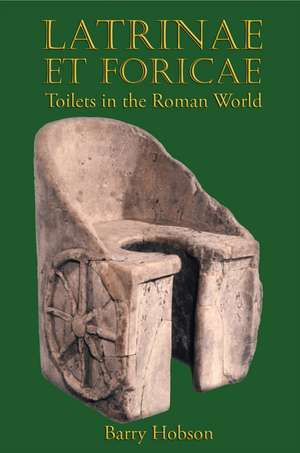
Latrinae Et Foricae
Autor Barry Hobsonen Limba Engleză Paperback – apr 2013
In this well-illustrated overview, Barry Hobson describes toilets in the Roman empire from Iberia to Syria, and from North Africa to Hadrian's Wall. Particular emphasis is given to Pompeii, where many toilets are preserved and where some evidence for change over time can be found. The discussion encompasses not only details of location, construction and decoration of toilets, but also questions of privacy, sewage, rubbish disposal, health issues, references in Latin literature, and graffiti.
Preț: 142.41 lei
Preț vechi: 231.76 lei
-39%
Puncte Express: 214
Preț estimativ în valută:
25.19€ • 29.53$ • 21.92£
25.19€ • 29.53$ • 21.92£
Carte tipărită la comandă
Livrare economică 05-19 martie
Preluare comenzi: 021 569.72.76
Specificații
ISBN-13: 9780715638507
ISBN-10: 0715638505
Pagini: 202
Ilustrații: 1
Dimensiuni: 154 x 232 x 14 mm
Greutate: 0.32 kg
Editura: BLOOMSBURY 3PL
Locul publicării:London, United Kingdom
ISBN-10: 0715638505
Pagini: 202
Ilustrații: 1
Dimensiuni: 154 x 232 x 14 mm
Greutate: 0.32 kg
Editura: BLOOMSBURY 3PL
Locul publicării:London, United Kingdom
V-ar putea interesa
-
 The Romans and TradeAndré Tchernia-23%Preț: 934.24 lei1218.31 lei
 -
 East of Asia MinorTimothy Bruce Mitford-23%Preț: 2179.10 lei2830.00 lei
 -
 -27%Preț: 951.11 lei1307.10 lei
 -
 -33%Preț: 798.45 lei1191.59 lei
 -
 Urban Craftsmen and Traders in the Roman WorldAndrew Wilson-22%Preț: 966.74 lei1241.70 lei
 -
 Settlement, Urbanization, and PopulationAlan Bowman-18%Preț: 224.80 lei273.34 lei
 -
 The Economics of the Roman Stone TradeBen Russell-19%Preț: 263.65 lei324.79 lei
 -
 -27%Preț: 921.28 lei1263.40 lei
 -
 -8%Preț: 334.53 lei364.31 lei
 -
 The Oxford Handbook of Roman BritainMartin Millett-17%Preț: 987.49 lei1189.30 lei
 -
 Rome and its Frontiers: The Dynamics of EmpireC. R. Whittaker-15%Preț: 416.84 lei490.40 lei
 -
 -15%Preț: 421.00 lei495.29 lei
 -
 -23%Preț: 460.84 lei598.49 lei
 -
 Preț: 229.22 lei
 -
 -14%Preț: 691.51 lei804.08 lei
 -
 -25%Preț: 963.50 lei1277.85 lei
 -
 Sanctuaries in Roman DaciaCsaba SzabóPreț: 341.95 lei
 -
 The Construction of the Roman Legionary Fortress at InchtuthilElizabeth A. M. Shirley-8%Preț: 541.48 lei588.57 lei
 -
 Rural Sanctuaries in Roman SyriaAnn Irvine SteinsapirPreț: 390.52 lei
 -
 -34%Preț: 916.40 lei1387.20 lei
 -
 The Danube FrontierMichael SchmitzPreț: 137.44 lei
Cuprins
Acknowledgements
Preface
1. Toilets in the Roman world: an introduction
2. Roman Britain
3. Pompeii
4. Chronology of toilets
5. Upstairs toilets
6. Privacy
7. Rubbish and its disposal
8. Dirt, smell and culture
9. Water supply, usage and disposal
10. Who used these toilets?
11. Motions, maladies and medicine
12. Who cares about latrines?
13. Future research?
Glossary
Bibliography
Index of Places
Preface
1. Toilets in the Roman world: an introduction
2. Roman Britain
3. Pompeii
4. Chronology of toilets
5. Upstairs toilets
6. Privacy
7. Rubbish and its disposal
8. Dirt, smell and culture
9. Water supply, usage and disposal
10. Who used these toilets?
11. Motions, maladies and medicine
12. Who cares about latrines?
13. Future research?
Glossary
Bibliography
Index of Places
Recenzii
This volume is both informative and sensibly structured with a basic factual overview of the topic and archaeological evidence, followed by in depth discussion of more theoretical issues, such as privacy and social issues.
Dr Hobson is... to be
congratulated for helping to fill an
obvious gap in the literature, and for
getting his publisher to agree to a
less than glamorous subject.
Dr Hobson is... to be
congratulated for helping to fill an
obvious gap in the literature, and for
getting his publisher to agree to a
less than glamorous subject.