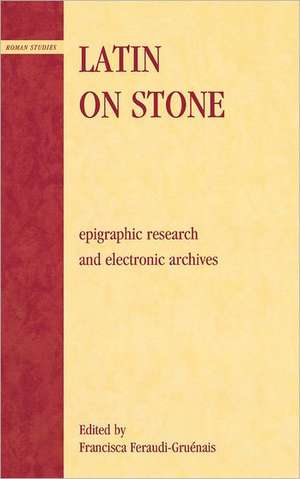
Latin on Stone: Epigraphic Research and Electronic Archives: Roman Studies: Interdisciplinary Approaches
Editat de Francisca Feraudi-Gruénais Contribuţii de Sarolta A. Takács, William Stenhouse, Rebecca R. Benefiel, Christian Witschel, Gabriel Bodard, Silvia Evangelisti, Amina Kroppen Limba Engleză Hardback – 20 mai 2010
Alongside these complex synergies, on the rise are interdisciplinary associations based on web-based data transfer. All of the new visions and achievements discussed in the volume can only be fully realized, however, if the traditional roots of epigraphy are maintained. Rather than being blinded by a sort of "electronic madness," scholars must recall the rich heritage of epigraphic transmission as a source of information that has yet to be exhausted. This volume is not only a plea for an increased use of modern (electronic) technology but also a warning against putting trust solely in such technology. It should come as no surprise, given the continuing process of globalization, that the contributors are drawn from both Europe and America. Each scholar is engaged in an attempt not only to scrutinize epigraphic culture afresh, but also to search for common denominators among such a variety of material. Their efforts will increase the diversity of the cross-linking of, and the search possibilities in, the data provided by epigraphic source material. It is a matter of strengthening, increasing, and contextualizing both the epigraphic sources and the data decoded from them.


Preț: 593.04 lei
Preț vechi: 909.66 lei
-35%
Puncte Express: 890
Carte tipărită la comandă
Livrare economică 30 noiembrie-14 decembrie
Livrare prin curier în România Termenul estimat este afișat lângă disponibilitate.
Transport gratuit pentru acest produs Plată online sau ramburs, în funcție de opțiunile comenzii.
Retur gratuit în 14 zile Comandă securizată și suport în română.
Specificații
ISBN-13: 9780739145906
ISBN-10: 0739145908
Pagini: 198
Ilustrații: 1
Dimensiuni: 152 x 232 x 20 mm
Greutate: 0.38 kg
Ediția:New.
Editura: Bloomsbury Publishing
Colecția Lexington Books
Seria Roman Studies: Interdisciplinary Approaches
Locul publicării:New York, United States
ISBN-10: 0739145908
Pagini: 198
Ilustrații: 1
Dimensiuni: 152 x 232 x 20 mm
Greutate: 0.38 kg
Ediția:New.
Editura: Bloomsbury Publishing
Colecția Lexington Books
Seria Roman Studies: Interdisciplinary Approaches
Locul publicării:New York, United States
Cuprins
Chapter 1 Foreword
Chapter 2 Preface
Chapter 3 Chapter 1. Latin in Stone: Epigraphy and Databases
Part 4 Part I. Epigraphic Research and (Electronic) Technologies
Chapter 5 Chapter 2. Epigraphy and Technology in the Renaissance: The Impact of the Printing Press
Chapter 6 Chapter 3. Rome in Pompeii: Wall Inscriptions and GIS
Chapter 7 Chapter 4. The Epigraphic Habit in Late Antiquity: An Electronic Archive of Late Roman Inscriptions Ready for Open Access
Part 8 Part II. Electronic Archives of Inscriptions
Chapter 9 Chapter 5. EpiDoc: Epigraphic Documents in XML for Publication and Interchange
Chapter 10 Chapter 6.EDR: History, Purpose, and Structure
Chapter 11 Chapter 7. Ancient Magic through an Electronic Database
Chapter 12 Chapter 8. An Inventory of the Main Electronic Archives of Latin Inscriptions
Chapter 2 Preface
Chapter 3 Chapter 1. Latin in Stone: Epigraphy and Databases
Part 4 Part I. Epigraphic Research and (Electronic) Technologies
Chapter 5 Chapter 2. Epigraphy and Technology in the Renaissance: The Impact of the Printing Press
Chapter 6 Chapter 3. Rome in Pompeii: Wall Inscriptions and GIS
Chapter 7 Chapter 4. The Epigraphic Habit in Late Antiquity: An Electronic Archive of Late Roman Inscriptions Ready for Open Access
Part 8 Part II. Electronic Archives of Inscriptions
Chapter 9 Chapter 5. EpiDoc: Epigraphic Documents in XML for Publication and Interchange
Chapter 10 Chapter 6.EDR: History, Purpose, and Structure
Chapter 11 Chapter 7. Ancient Magic through an Electronic Database
Chapter 12 Chapter 8. An Inventory of the Main Electronic Archives of Latin Inscriptions
Recenzii
The aim of this edited collection is to showcase the research possibilities inherent in the application of digital technology, notably electronic databases, to the study of Latin inscriptions. The editor, Francisca Feraudi-Gruenais, head researcher at the Heidelberg Epigraphic Database, is admirably positioned to undertake such a task, and she has invited contributions from scholars in Europe and North America who are using this technology to ask new and interesting questions of the epigraphic material.