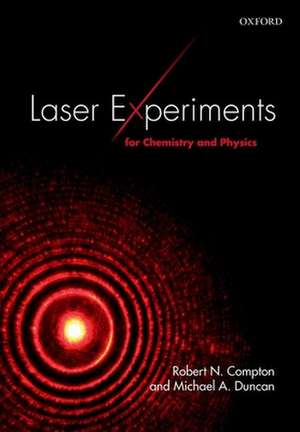
Laser Experiments for Chemistry and Physics
Autor Robert N. Compton, Michael A. Duncanen Limba Engleză Paperback – 12 noi 2015
Preț: 394.94 lei
Preț vechi: 416.01 lei
-5%
Puncte Express: 592
Carte disponibilă
Livrare economică 12-17 noiembrie
Livrare prin curier în România Termenul estimat este afișat lângă disponibilitate.
Transport gratuit de la 400.00 lei Plată online sau ramburs, în funcție de opțiunile comenzii.
Retur gratuit în 14 zile Comandă securizată și suport în română.
Specificații
ISBN-13: 9780198742982
ISBN-10: 0198742983
Pagini: 414
Dimensiuni: 191 x 246 x 20 mm
Greutate: 0.87 kg
Editura: OUP OXFORD
Colecția OUP Oxford
Locul publicării:Oxford, United Kingdom
ISBN-10: 0198742983
Pagini: 414
Dimensiuni: 191 x 246 x 20 mm
Greutate: 0.87 kg
Editura: OUP OXFORD
Colecția OUP Oxford
Locul publicării:Oxford, United Kingdom
V-ar putea interesa
-
 Invertebrate Surveys for ConservationT. R. New-28%Preț: 378.79 lei528.72 lei
 -
 The Lab – Creativity and CultureDavid EdwardsPreț: 319.04 lei
 -
 Searching for Science PolicyJonathan B. Imber-15%Preț: 517.59 lei608.93 lei
 -
 At the HelmKathy BarkerPreț: 540.81 lei
 -
 -18%Preț: 1418.62 lei1730.03 lei
 -
 -18%Preț: 2076.00 lei2531.71 lei
 -
 Online Science LearningKevin Downing-15%Preț: 602.81 lei709.19 lei
 -
 Computational Methods for Agricultural ResearchHércules Antonio Do Prado-18%Preț: 1038.89 lei1266.94 lei
 -
 Preț: 134.90 lei
 -
 Raman Spectroscopy Under Liquid Nitrogen (RUN)Robert N. Compton-18%Preț: 919.48 lei1121.32 lei
 -
 Pulp Bleaching TodayHans Ulrich Suess-23%Preț: 1930.27 lei2506.85 lei
 -
 Wood Chemistry and Wood BiotechnologyMonica Ek-19%Preț: 705.44 lei870.91 lei
 -
 Pulping Chemistry and TechnologyMonica Ek-19%Preț: 715.02 lei882.74 lei
 -
 Paper Chemistry and TechnologyMonica Ek-19%Preț: 710.57 lei877.24 lei
 -
 Paper Products Physics and TechnologyMonica Ek-19%Preț: 707.53 lei873.49 lei
 -
 Physical Analytics in Materials ScienceDragan Krecar-8%Preț: 519.58 lei564.76 lei
 -
 High Solid BindersMircea Manea-23%Preț: 1297.01 lei1684.43 lei
 -
 -18%Preț: 1169.34 lei1426.03 lei
 -
 Electrochemical DNA BiosensorsMehmet Sengun Ozsoz-18%Preț: 920.47 lei1122.52 lei
Recenzii
Laser Experiments for Chemistry and Physics is a file resource for experienced physics instructors looking to set up new experiments in advanced lab courses. Compton and Duncan provide both guidance and inspiration in their outstanding collection of laser experiments.
a high-quality and useful book ... instructors and students specially focused in the fields of physical chemistry and spectroscopy will most likely find the highest interest; however, readers interested in broader areas of chemistry and physics should also find this work very useful. If you belong to this potential audience, the purchase of Laser Experiments for Chemistry and Physics will doubtless be a good investment.
a high-quality and useful book ... instructors and students specially focused in the fields of physical chemistry and spectroscopy will most likely find the highest interest; however, readers interested in broader areas of chemistry and physics should also find this work very useful. If you belong to this potential audience, the purchase of Laser Experiments for Chemistry and Physics will doubtless be a good investment.
Notă biografică
Robert N. Compton was born in Metropolis, IL. The Compton family moved to Oak Ridge, TN during WWII where his father worked on the Manhattan Project. He received degrees in Physics from Berea College (BA), the University of Florida (MS) and the University of Tennessee (PhD). He was a Senior Corporate Fellow at the Oak Ridge National Laboratory from 1965 to 1995 and has been a Professor of Physics and Chemistry at the University of Tennessee to the present date. He was a Visiting Professor at the University of Aarhus, University of Paris, and the FOM Institute in Amsterdam. In 2001, he was an Erskine Fellow at the University of Christchurch, New Zealand. His research interests include negative ions, laser spectroscopy, and molecular chirality.Michael A. Duncan was born in Greenville, SC, where he attended Furman University (B.S. 1976). In graduate school at Rice University he worked with Prof. Richard E. Smalley (Ph.D. 1982). He was a National Research Council postdoctoral fellow at the Joint Institute for Laboratory Astrophysics (JILA) in Boulder, CO with Prof. Stephen Leone. He joined the University of Georgia faculty in 1983. He uses laser vaporization, molecular beams, mass spectrometry and laser spectroscopy to study metal clusters, ion-molecule complexes and carbocations. Duncan is Fellow of the American Physical Society (2001) and the American Association for the Advancement of Science (2004), and Senior Editor of the Journal of Physical Chemistry since 1998. He is recipient (2007) of an Alexander von Humboldt Fellowship at the Fritz Haber Institute in Berlin and won the Experimental Physical Chemistry Award (2011) given by the American Chemical Society.
Cuprins
- 1: Elementary Properties of light
- 2: Basic Optics
- 3: General Characteristics of Lasers
- 4: Laboratory Lasers
- 5: Nonlinear Optics
- 6: Laser Safety
- 7: The Speed of Light
- 8: The Speed of Sound in Gases, Liquids and Solids
- 9: Thermal Lens Calorimetry
- 10: Laser Refractometry
- 11: Laser Induced Breakdown Spectroscopy
- 12: Laser Desorption Time-of-Flight Mass Spectrometry
- 13: Multiphoton Ionization Mass Spectrometry of Metal Carbonyls
- 14: Optical Spectroscopy
- 15: Quantum Chemistry Calculations
- 16: Multiphoton Ionization and Third Harmonic Generation in Alkali Atoms
- 17: Electronic Absorption Spectroscopy of Molecular Iodine
- 18: Electronic Spectroscopy of Iodine using REMPI
- 19: Raman Spectroscopy under Liquid Nitrogen
- 20: Optical Rotary Dispersion of a Chiral Liquid (?-pinene)
- 21: Faraday Rotation
- 22: Fermi Resonance in CO2
- 23: Photoacoustic Spectroscopy of Methane
- 24: Optogalvanic Spectroscopy
- 25: Diode Laser Atomic Spectroscopy
- 26: Vacuum Ultraviolet Spectroscopy using THG in Rare Gases
- 27: Raman Shifting and Stimulated Electronic Raman Scattering (SERS)
- 28: Fluorescence Lifetime of Iodine Vapor
- 29: Raman Spectroscopy Applied to Molecular Conformational Analysis
- 30: Diffraction of Light from Blood Cells
- 31: Inversion of Sucrose by Acid Catalyzed Hydrolysis
- Appendix I. Recommended Components and Equipment
- Appendix II. Fast Signal Measurements