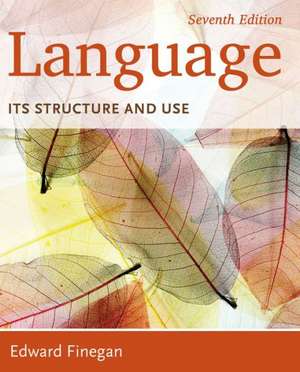
Language
Autor Edward Fineganen Limba Engleză Paperback – 2014
Aplicabilitatea practică a volumului Language rezidă în capacitatea sa de a transforma conceptele teoretice abstracte în instrumente de analiză a interacțiunilor cotidiene. Această a șaptea ediție, semnată de Edward Finegan, oferă un cadru riguros pentru înțelegerea modului în care funcționează limbajul uman, nu doar ca sistem formal, ci ca mecanism vital de interacțiune socială. Remarcăm structura modulară a lucrării, care ghidează cititorul de la întrebări fundamentale despre natura semnelor și arbitraritatea limbajului, către complexitatea structurilor gramaticale și morfologice.
Fiecare capitol este conceput pentru a stimula spiritul critic, începând cu secțiuni de tip „What Do You Think?” și finalizându-se cu exerciții aplicate. Reținem că autorul pune un accent deosebit pe distincția dintre competența gramaticală (limbajul ca structură tipizată) și competența comunicativă (utilizarea limbajului în context), oferind în același timp perspective moderne asupra lingvisticii computaționale. Lucrarea este comparabilă cu Contemporary Linguistics de Francis Katamba în ceea ce privește rigurozitatea științifică, dar se distinge prin actualizarea constantă a exemplelor și prin integrarea mai pronunțată a aspectelor ce țin de utilizarea limbajului în mediul digital și social contemporan.
Progresia conținutului este logică și pedagogică: prima parte a volumului, dedicată structurilor limbajului, analizează lexiconul și morfologia, oferind o bază solidă înainte de a trece la ramuri mai complexe. Merită menționat că, spre deosebire de alte manuale introductive, Edward Finegan reușește să mențină un echilibru între descrierea tehnică și curiozitatea naturală despre originea limbajului sau capacitatea altor specii de a învăța sisteme de comunicare umane. Este o resursă esențială pentru curriculumul de profil, fiind adaptată cerințelor academice actuale prin formatul său dens, dar accesibil.
Preț: 508.37 lei
Preț vechi: 651.24 lei
-22%
Carte disponibilă
Livrare economică 03-17 noiembrie
Livrare express 17-23 octombrie pentru 121.06 lei
Specificații
ISBN-10: 1285052455
Pagini: 608
Dimensiuni: 189 x 232 x 27 mm
Greutate: 0.91 kg
Ediția:7. Auflage
Editura: CENGAGE LEARNING INC
V-ar putea interesa
-
 Sociolinguistic Perspectives on RegisterDouglas Biber-33%Preț: 904.75 lei1341.04 lei
 -
 Language in the USAEdward Finegan-19%Preț: 458.43 lei565.97 lei
 -
 Handbook of Research on Teaching the English Language ArtsDouglas Fisher-9%Preț: 756.43 lei831.25 lei
 -
 -33%Preț: 582.81 lei863.75 lei
 -
 Keep Up Your Biblical Greek in Two Minutes a Day, Volume 1Jonathan G KlinePreț: 237.01 lei
 -
 -19%Preț: 570.91 lei704.82 lei
 -
 UNDERSTANDING THE PARAGRAPH &Iain McGee-19%Preț: 440.74 lei544.12 lei
 -
 Preț: 329.60 lei
 -
 Le Maroc, 1631-1812Abu Al-Qasim Ibn Ahmad Al-ZayyaniPreț: 177.39 lei
 -
 Basiswissen für Dolmetscher und Übersetzer - Deutschland und RusslandViktoria FedorovskajaPreț: 209.48 lei
 -
 L'Homme torturéKama Sywor KamandaPreț: 249.63 lei
 -
 La obsesión amorosa como esclavitud en La pasión turca de Antonio GalaYovany Salazar EstradaPreț: 318.96 lei
 -
 Preț: 38.44 lei
 -
 Dhatupatha HandbookAshwini Kumar AggarwalPreț: 138.54 lei
 -
 Dhatupatha Verbs in 5 Lakaras Vol2Ashwini Kumar AggarwalPreț: 267.72 lei
De ce să citești această carte
Recomandăm Language studenților și profesioniștilor din domeniul lingvisticii care caută o sinteză actualizată a modului în care funcționează limbajul uman. Ediția a 7-a aduce claritate în domenii complexe precum morfologia și lingvistica computațională, oferind cititorului nu doar teorie, ci și abilități analitice concrete. Este un instrument fundamental pentru oricine dorește să înțeleagă mecanismele din spatele comunicării zilnice, de la structura cuvintelor la influența tehnologiei asupra limbii.