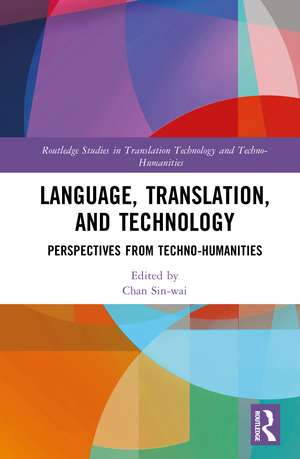
Language, Translation, and Technology: Perspectives from Techno-humanities: Routledge Studies in Translation Technology
Editat de Chan Sin-Waien Limba Engleză Hardback – 27 noi 2026
Featuring contributions from renowned scholars and emerging specialists across diverse regions, the book spans a wide range of disciplines, including archaeology, drama, education, fine arts, gender studies, history, language, language learning, literature, machine translation, medicine, and robotics. Each chapter showcases cutting-edge research findings that highlight the dynamic interplay between technology, culture, and language. The book offers insightful and inspiring perspectives in the application of technology to cultural and linguistic studies. By presenting innovative approaches and groundbreaking research, it provides a deeper understanding of how technology is transforming these fields and shaping new possibilities for exploration and development.
An essential book for scholars and researchers in the humanities, digital humanities, technology, and computing as well as those interested to explore the intersection of technology, culture, and language





Preț: 1127.43 lei
Preț vechi: 1485.46 lei
-24% Precomandă
Puncte Express: 1691
Carte nepublicată încă
Livrare prin curier în România Precomanda se expediază când titlul devine disponibil.
Transport gratuit pentru acest produs Plată online sau ramburs, în funcție de opțiunile comenzii.
Retur gratuit în 14 zile Comandă securizată și suport în română.
Doresc să fiu notificat când acest titlu va fi disponibil:
Se trimite...
Specificații
ISBN-13: 9781041329671
ISBN-10: 1041329679
Pagini: 250
Ilustrații: 88
Dimensiuni: 156 x 234 mm
Ediția:1
Editura: Taylor & Francis
Colecția Routledge
Seria Routledge Studies in Translation Technology
Locul publicării:Oxford, United Kingdom
ISBN-10: 1041329679
Pagini: 250
Ilustrații: 88
Dimensiuni: 156 x 234 mm
Ediția:1
Editura: Taylor & Francis
Colecția Routledge
Seria Routledge Studies in Translation Technology
Locul publicării:Oxford, United Kingdom
Public țintă
Academic and PostgraduateCuprins
Introduction Chan Sin-wai Part 1. Culture 1. AI Rethinks the Past: An Exhibition’s Perspective Maurizio Forte 2. Expanding the Expressive Power of Contemporary Ink through Digital Technology Lampo Leong 3. Encountering Digital Marginalization: Gender Disparity and Limitation in Cyberworld Geeta Ajit 4. Empowering Historical Studies with Computational Technologies: Ming Chinese Sources as a Showcase Yifang Cui and Andrea Nanetti 5. Foundations for a Japanese-Amazonian Dramaturgy: Ongoing Investigation Eduardo Okamoto 6. French Jesuits and their Scientific Contributions during the High Qing Era: A Case Study of Antoine Gaubil, S.J. (1689–1759) Xie Jingzhen 7. SDG Implementation Skills Development for SDG Acceleration – SDG#4/8/9 Sport & STEAM Services with Women Attributes Shirley Yeung Mo Ching Part 2. Language 8. Individualized Neuromodulation: The Dawn of Precision Neuro-rehabilitation in Post-stroke Aphasia Chester Yee-Nok Cheung, Anthony Pak-Hin Kong, and Mehdi Bakhtiar 9. Applying Tools and Techniques of Language Technology for Digitization of Folk Text Materials of Endangered Indigenous Languages Niladri Sekhar Dash 10. Explainability of Machine Translation Models: A Survey Xiaojun Zhang 11. A Corpus-based Study of Gendered Expressions across the Two Chinese Translations of The Second Sex Yin Hao and Liu Jianwen 12. Making Sense of How Machines Should Show Human-like Emotions Yeung Wing Lok 13. Ishiguro’s Techno-hallucinations: The AI Future of Klara and the Sun Lynda Ng 14. On the Role of Technology in the Meso-level of Critical Discourse Analysis of Feminist Messages in Music in Second Wave Feminism of the 1960s Lau Hok-Yin, Jeff
Notă biografică
Chan Sin-wai is Professor-cum-Dean of Ip Ying To Lee Yu Yee School of Humanities and Languages, Saint Francis University, Hong Kong. He was formerly Professor of the School of Humanities and Social Science, The Chinese University of Hong Kong, Shenzhen, and Professor at the Department of Translation, The Chinese University of Hong Kong. He has published 98 books in 124 volumes.
Descriere
Chan Sin-wai and contributors explore the latest advancements in culture and language within the realm of techno-humanities. An essential book for scholars and researchers in the humanities, digital humanities, technology, and computing as well as those interested to explore the intersection of technology, culture, and language