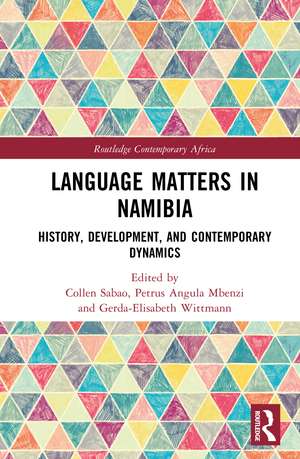
Language Matters in Namibia: History, Development, and Contemporary Dynamics: Routledge Contemporary Africa
Editat de Collen Sabao, Petrus Angula Mbenzi, Gerda-Elisabeth Wittmannen Limba Engleză Hardback – 23 noi 2026
Namibia is a country characterised by multilingualism, with 13 officially recognised languages (10 indigenous and 3 European-based). Within this diverse linguistic landscape, only 3.4% of Namibians speak English at home, despite it being the country’s officially recognised language. Historically, colonial languages have been used in social, educational, professional, and occupational contexts, meaning that language is deeply tied to unresolved aspects of identity, linguistic ideologies, hegemony, language practices and culture. Emerging at a crucial moment in Namibia’s decolonial agenda, this book considers how language usage, patterns, structures, and functions are now shifting and evolving.
Bringing together important contributions from Namibian scholars, this book will be an important read for researchers of African languages, education and sociolinguistics.
Din seria Routledge Contemporary Africa
-
 Preț: 416.93 lei
 - 8%
 Preț: 450.64 lei
 -
 Preț: 424.53 lei
 - 18%
 Preț: 1112.48 lei
 - 18%
 Preț: 1112.48 lei
 -
 Preț: 424.32 lei
 -
 Preț: 249.46 lei
 -
 Preț: 427.71 lei
 - 18%
 Preț: 1119.70 lei
 -
 Preț: 417.80 lei
 - 18%
 Preț: 1112.48 lei
 - 18%
 Preț: 1112.48 lei
 - 15%
 Preț: 430.16 lei
 -
 Preț: 424.32 lei
 - 18%
 Preț: 1117.60 lei
 - 18%
 Preț: 1149.69 lei
 - 18%
 Preț: 1115.51 lei
 - 18%
 Preț: 1113.77 lei
 - 18%
 Preț: 1121.80 lei
 - 18%
 Preț: 1112.48 lei
 - 5%
 Preț: 1344.08 lei
 - 5%
 Preț: 1555.32 lei
 - 18%
 Preț: 948.65 lei
 - 18%
 Preț: 1304.39 lei
 - 18%
 Preț: 1128.63 lei
 -
 Preț: 424.32 lei
 - 18%
 Preț: 1057.86 lei
 -
 Preț: 441.45 lei
 - 18%
 Preț: 1112.48 lei
 -
 Preț: 413.52 lei
 -
 Preț: 424.32 lei
 -
 Preț: 424.32 lei
 - 18%
 Preț: 948.65 lei
 - 18%
 Preț: 1113.42 lei
 - 18%
 Preț: 1121.09 lei
 - 18%
 Preț: 1108.55 lei
 - 15%
 Preț: 435.94 lei
 - 18%
 Preț: 1112.48 lei
 - 18%
 Preț: 1114.85 lei
 - 18%
 Preț: 1119.70 lei
 - 18%
 Preț: 1114.82 lei
 - 18%
 Preț: 1003.26 lei
 - 18%
 Preț: 1113.42 lei
 - 18%
 Preț: 1121.09 lei
 -
 Preț: 414.86 lei
Preț: 1347.75 lei
Preț vechi: 1643.60 lei
-18% Precomandă
Puncte Express: 2022
Carte nepublicată încă
Livrare prin curier în România Precomanda se expediază când titlul devine disponibil.
Transport gratuit pentru acest produs Plată online sau ramburs, în funcție de opțiunile comenzii.
Retur gratuit în 14 zile Comandă securizată și suport în română.
Doresc să fiu notificat când acest titlu va fi disponibil:
Se trimite...
Specificații
ISBN-13: 9781041276166
ISBN-10: 1041276168
Pagini: 302
Ilustrații: 12
Dimensiuni: 156 x 234 mm
Greutate: 0.6 kg
Ediția:1
Editura: Taylor & Francis
Colecția Routledge
Seria Routledge Contemporary Africa
Locul publicării:Oxford, United Kingdom
ISBN-10: 1041276168
Pagini: 302
Ilustrații: 12
Dimensiuni: 156 x 234 mm
Greutate: 0.6 kg
Ediția:1
Editura: Taylor & Francis
Colecția Routledge
Seria Routledge Contemporary Africa
Locul publicării:Oxford, United Kingdom
Public țintă
Academic and PostgraduateCuprins
1. Namibia and her “few people and many tongues”: The multilingual linguistic landscape of NamibiaCollen Sabao, Petrus Angula Mbezi & Gerda-Elisabeth Wittmann2. The Role of Mother Tongues in Shaping Namibian Ethnic IdentitiesIthindi Sylvia Ndapewa3. Constructing Identity in Multilingual Namibia: Language Choice, Bilingualism, and Sociolinguistic Positioning Linda Natacha Perestrelo 4. African Languages: A tool for DecolonialityMartha Nahole, Natalia Intja & Helena Miranda5. Navigating Identities: An Examination of Language and Gender Dynamics in the Kavango East Region of Namibia Irmgard Moyo & Anna Frugintta Mangundu, 6. Exploring Cultural Pluralism as a Shared Social Fabric in Kavango East Region of NamibiaNatalia Intja &Laura Johannes7. The Political and Historical Context of Silozi as Medium of Instruction in Zambezi Region: A Journey of Language and Power Begani Ziambo Mashinja 8. The Effects of Urbanisation on African Mother Tongues Rauha N. Nekongo & Coletta M. Kandemiri9. Quo vadis, German? Reflections on the role and status of a colonial national language in its former colony Gerda-Elisabeth Wittmann10. Tonal Analysis of Otjiherero Minimal PairsZenaune Karirao & Collen Sabao 11. Tracing language contact: A corpus-based study on the nativisation of loan words in the Oshiwambo dialect of Oshikwanyama in Oshana Region Clarina M Museta, Salomo Fikameni & Petrina Batholmeus12. Lexical Borrowing in Oshiwambo: Language Contact and the Influence of English in NamibiaLinda Natacha Perestrelo13. The historical development of Oshikwanyama orthography: From missionary influence to post-independence reforms Edward Shikesho & Eliaser Joseph14. Syllable count increase through phonological nativisation and re-syllabification of English loans in Oshiwambo Collen Sabao15. The state of Indigenous Languages in the Namibian Education System: Implications for Decolonization and De-Marginalization Sylvanus Job, H Pomuti & Cynthy Kalinasho Haihambo-Ya Otto16. Challenges of Teaching Afrikaans in the Junior Primary Phase in Namibia: Teacher Perspectives in a Changing Linguistic LandscapeJessica Jansen and Elsabe Potgieter17. Navigating Teaching and Learning through Translanguaging in Grade 3 classrooms of Southern NamibiaAnnaly M. Strauss & Joanne M. Marshall 18. Instructional Design and Language Development in the Digital Age: CALL Integration in Namibian Higher Education Lazarus Gawazah & Collen Sabao 19. Challenges Experienced by Junior Primary Schools Teachers Teaching Afrikaans as a Medium of Instruction in A Multilingual Setting In Windhoek, NamibiaJohanna Elizabeth De Koker, Cynthy Kalinasho Haihambo-Ya Otto & Job Uazembua Hengari 20. The Need to Revitalise Rukavango Languages: The Case of Rumanyo and Thimbukushu Natalia Intja, Helena Miranda & Fillemon Mungongi21. Towards a model for terminology modernisation in the Kavango languages of NamibiaAngelika Mate Mukoya, Erwina Mushinga Josef, Fillemon Mungongi & Faustinus Shikukutu22. When a language of the majority becomes a minority in its own home: Language shift and minoritisation of indigenous Namibian languagesTheresia Mushaandja & Collen Sabao23. Revitalisation strategies for endangered indigenous languages in Namibia: A case of the Rumanyo language in Kavango East Region Erwina Mushinga Josef, Mangundu, AFS; Selma Nangura Mutangara & Angelika Mate Mukoya, 24. The function of proverbs in the Oshiwambo judicial system with specific reference to Epale court proceedings Petrus Angula Mbenzi & Lukas Homateni Julius25. Language, Identity, and Political Rhetoric in Namibia: Shaping National Narratives in a Multilingual Context Frieda Nauyele Nanyeni-Kanyemba 26. The complex, yet fascinating, nature of multilingualism in varied contexts in Namibia (EPILOGUE) Collen Sabao, Gerda Wittmann & Petrus Angula Mbenzi
Notă biografică
Collen Sabao is a Professor of Linguistics, Literature and Communication, and Head of the Department of Languages and Literature at the University of Namibia. He is also a Research Associate in the Department of Linguistics and Modern Languages at the University of South Africa (UNISA). Professor Sabao’s research interests lie in the areas of Phonetics and Phonology, Political Discourse, Media Discourse, Pan Africanism, Afrocentricity, Appraisal Theory, Argumentation, World Literatures, and Rhetoric.
Petrus Angula Mbenzi is an Associate Professor for Oshiwambo at the University of Namibia. He teaches Oshiwambo advanced linguistics, orature and Oshiwambo for beginners. He acts as an ambassador for the annual Oshakati Totem EXPO and a regular presenter of oral tradition on Oshiwambo Radio Service. His research interests include lexicography, onomastics, orature, sociolinguistics, and linguistics.
Gerda-Elisabeth Wittmann is a Senior Lecturer in German at the University of Namibia. Dr Wittmann’s research interests lie in the teaching and learning of German as a Foreign language, German in Southern Africa, language politics, and teacher professional development. She is an educationalist at heart and serves in the Scientific Advisory Committee for the International German Teachers’ Conference. Dr Wittmann is responsible locally for the DAAD-funded project SANDD – Sub-Saharan Africa Network GFL Digital.
Petrus Angula Mbenzi is an Associate Professor for Oshiwambo at the University of Namibia. He teaches Oshiwambo advanced linguistics, orature and Oshiwambo for beginners. He acts as an ambassador for the annual Oshakati Totem EXPO and a regular presenter of oral tradition on Oshiwambo Radio Service. His research interests include lexicography, onomastics, orature, sociolinguistics, and linguistics.
Gerda-Elisabeth Wittmann is a Senior Lecturer in German at the University of Namibia. Dr Wittmann’s research interests lie in the teaching and learning of German as a Foreign language, German in Southern Africa, language politics, and teacher professional development. She is an educationalist at heart and serves in the Scientific Advisory Committee for the International German Teachers’ Conference. Dr Wittmann is responsible locally for the DAAD-funded project SANDD – Sub-Saharan Africa Network GFL Digital.
Descriere
Language Matters in Namibia investigates the diversity of Namibia’s ethnolinguistic communities and cultures, considering how languages intersect with questions of nationhood, memory, identity, and decoloniality.