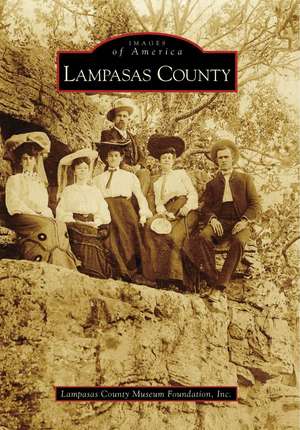
Lampasas County
Autor Lampasas County Museum Founden Limba Engleză Paperback – 16 feb 2009
Descoperim în această lucrare o cercetare riguroasă girată de Lampasas County Museum Found, organizație dedicată conservării patrimoniului local din Texas. Această monografie în limba engleză, publicată de Arcadia Publishing (SC), oferă o perspectivă detaliată asupra unui comitat situat la marginea nordică a regiunii Hill Country, a cărui istorie este indisolubil legată de resursele sale naturale. Suntem de părere că volumul reușește să sintetizeze tranziția de la așezările nativilor americani la stațiunea balneară de renume din secolul al XIX-lea. Textul extinde cadrul propus de Lampasas 1855-1895 de Bill O'Neal cu date noi despre perioada de după sosirea căii ferate Santa Fe în 1882, moment care a facilitat transformarea localității în „Saratoga a Sudului”. Spre deosebire de studiul general Taking the Waters in Texas de Janet Mace Valenza, care analizează fenomenul stațiunilor balneare la nivel statal, această lucrare se concentrează pe micro-istoria comunităților din Lometa și Kempner, evidențiind reziliența locuitorilor în fața incendiilor și inundațiilor repetate. Structura narativă urmărește cronologic dezvoltarea economică, de la primele băi terapeutice ale familiei Hughes în anii 1850 până la ascensiunea ranch-urilor specializate în creșterea caprelor și oilor pentru lână și mohair. Găsim în cele 128 de pagini o documentare vizuală și factuală ce transformă istoria regională într-o cronică a supraviețuirii și adaptării economice într-un peisaj geografic specific Texasului central.
Preț: 141.33 lei
Carte disponibilă
Livrare economică 17 noiembrie-01 decembrie
Specificații
ISBN-10: 0738558818
Pagini: 128
Dimensiuni: 166 x 235 x 10 mm
Greutate: 0.39 kg
Editura: Arcadia Publishing (SC)
V-ar putea interesa
-
 FrankfordBrian H HarrisPreț: 137.05 lei
 -
 Tropic of HopesHenry KnightPreț: 190.03 lei
 -
 SmogtownChip JacobsPreț: 123.10 lei
 -
 Selling Ronald Reagan: The Emergence of a PresidentGerard DeGroot-17%Preț: 359.20 lei434.66 lei
De ce să citești această carte
Această carte se adresează pasionaților de istorie regională americană și celor interesați de evoluția comunităților balneare din secolul al XIX-lea. Cititorul câștigă o înțelegere profundă a modului în care resursele naturale pot dicta destinul economic al unei regiuni. Este un instrument esențial pentru documentarea transformării Texasului dintr-o frontieră sălbatică într-un centru comercial și turistic prosper, oferind detalii concrete despre impactul căii ferate asupra dezvoltării urbane.
Despre autor
Lampasas County Museum Found este o fundație dedicată conservării și promovării istoriei bogate a comitatului Lampasas, Texas. Prin administrarea muzeului local, membrii fundației colectează artefacte, fotografii și documente de arhivă care atestă evoluția regiunii de la primele așezări ale coloniștilor până în prezent. Expertiza lor se reflectă în acuratețea datelor istorice prezentate, fundația fiind principala autoritate în documentarea patrimoniului cultural și social al zonei, inclusiv a faimoaselor sale izvoare minerale și a tradiției agricole locale.
Descriere
Recenzii
Author: Rebecca LaFlure
Publisher: Killeen Daily Herald
Date: 2/22/2009
It was the legendary sulfur springs that attracted Lampasas' first permanent settlers in 1853.
Texas pioneer Moses Hughes and his ill wife, Hannah, journeyed to the region after hearing rumors of the area's medicinal waters from Native Americans.
Hannah's health improved, and her recovery was credited to drinking and bathing in the springs. Others soon followed and settled throughout the region's wild Texas frontier.
The book "Images of America: Lampasas County," released Monday, offers a glimpse into the community's history through 128 pages of vintage photographs and captions spanning from the county's founding in 1856 to the early 1960s.
Compiled by the Lampasas County Museum Foundation, the paperback chronicles the area's natural resources and disasters, businesses, schools, architecture, and perhaps most intriguing a the people.
Amy Ellis McDaniel, president of the LCMF, authored the book along with Jane McMillin, a freelance writer and Lampasas native.
McDaniel said the idea for the photo-essay first developed in January 2008.
"We wanted to produce a book that would be affordable," she said. "We thought it would be a good idea for a souvenir, and also we knew there was a lot of interest in historic photographs in the area."
McDaniel said the photos were gathered from the Key Stone Square Museum, operated by the LCMF, as well as files from the Lampasas County Historical Commission and the private collections of local residents.
"It was all a matter of compiling things and deciding how to break up the bookin a way that would be interesting, but also cover everything we wanted to cover," she said. "The biggest problem was cutting down photographs because we could only include so many."
McDaniel, who moved to Lampasas four years ago, said researching for the book was a fun way to rediscover unexpected pieces of the county's past.
"We found several smaller towns that don't exist anymore," she said. "When the railroad stopped going through those towns, they eventually faded away."
The book is a part of Arcadia Publishing's Images of America series.
McDaniel said she approached the company after seeing a number of its books profiling other areas in the United States.
With more than 4,000 titles to date, the series offers historical photo-essays to share and preserve communities across the nation.
"We look at certain things like population size, a sense of community pride, and if it's been there a long time so it has a rich history," said Kai Oliver-Kurtin, Arcadia publicity manager.
The book's sales profits will all benefit the Keystone Square Museum in Lampasas.
The books are available for $21.99 at local retailers, online bookstores and through Arcadia Publishing.