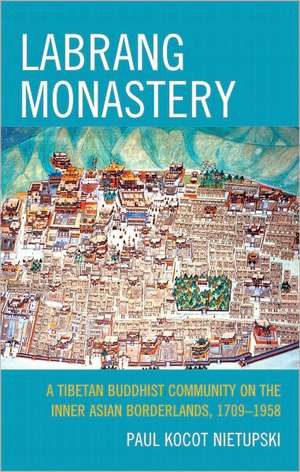
Labrang Monastery: A Tibetan Buddhist Community on the Inner Asian Borderlands, 1709-1958: Studies in Modern Tibetan Culture
Autor Paul Kocot Nietupskien Limba Engleză Hardback – 9 dec 2010
This book tells the story of the status and function of the Tibetan Buddhist religion in its fully developed monastic and public dimensions. It is an interdisciplinary project that examines the history of social and political conflict and compromise between the different local ethnic groups. The book presents new perspectives on Qing Dynasty and Republican-era Chinese politics, with far-reaching implications for contemporary China. It brings a new understanding of Sino-Tibetan-Mongol-Muslim histories and societies. This volume will be of interest to undergraduate and graduate student majors in Tibetan and Buddhist studies, in Chinese and Mongol studies, and to scholars of Asian social and political studies.
Din seria Studies in Modern Tibetan Culture
- 23%
 Preț: 320.09 lei
 - 34%
 Preț: 549.57 lei
 - 26%
 Preț: 286.85 lei
 - 32%
 Preț: 715.69 lei
 - 37%
 Preț: 658.65 lei
 - 35%
 Preț: 807.77 lei
 - 32%
 Preț: 583.59 lei
 - 23%
 Preț: 325.24 lei
 - 32%
 Preț: 398.58 lei
 - 23%
 Preț: 221.28 lei
 - 24%
 Preț: 259.03 lei
 -
 Preț: 351.67 lei
 - 24%
 Preț: 744.12 lei
 - 32%
 Preț: 570.96 lei
 - nou
 Preț: 730.76 lei
 - nou
 Preț: 629.08 lei
Preț: 711.03 lei
Preț vechi: 1054.32 lei
-33%
Puncte Express: 1067
Carte tipărită la comandă
Livrare economică 02-16 decembrie
Livrare prin curier în România Termenul estimat este afișat lângă disponibilitate.
Transport gratuit pentru acest produs Plată online sau ramburs, în funcție de opțiunile comenzii.
Retur gratuit în 14 zile Comandă securizată și suport în română.
Specificații
ISBN-13: 9780739164433
ISBN-10: 0739164430
Pagini: 306
Dimensiuni: 163 x 240 x 26 mm
Greutate: 0.6 kg
Ediția:New.
Editura: Bloomsbury Publishing
Colecția Lexington Books
Seria Studies in Modern Tibetan Culture
Locul publicării:New York, United States
ISBN-10: 0739164430
Pagini: 306
Dimensiuni: 163 x 240 x 26 mm
Greutate: 0.6 kg
Ediția:New.
Editura: Bloomsbury Publishing
Colecția Lexington Books
Seria Studies in Modern Tibetan Culture
Locul publicării:New York, United States
Cuprins
Chapter 1. Amdo: An Overview
Chapter 2. Tibetan Religion in Amdo
Chapter 3. Labrang's Society
Chapter 4. Growth and Development: The Evolution of Labrang Monastery
Chapter 5. Twentieth-Century Labrang
Chapter 6. Visions and Realities at Labrang
Chapter 2. Tibetan Religion in Amdo
Chapter 3. Labrang's Society
Chapter 4. Growth and Development: The Evolution of Labrang Monastery
Chapter 5. Twentieth-Century Labrang
Chapter 6. Visions and Realities at Labrang
Recenzii
One of the largest and most powerful institutions in Tibetan history, unique in its placement amid segmented territories ruled by several distinct inner Asian groups, Labrang Monastery has long been a site in need of critical study. Paul Kocot Nietupski's work brings us a thoroughly researched and sophisticated social and political history of Labrang Monastery. Drawing on a wide range of written and oral source material, Nietupski supplements a welcome survey of Amdo's religious and social structures with a careful study of the shifting social and political infrastructure underlying Labrang and its support communities. His examination of the spiritual and temporal authority of Labrang Monastery and the special forms of diplomacy needed for interaction with surrounding Manchu, Chinese, Mongol, and Muslim groups in this volatile region, makes a fundamental contribution to our knowledge of Asian history.
Labrang Tashikyil is one of the major Tibetan Buddhist monasteries and no contemporary Western scholar has researched its place in the Tibetan cultural world more deeply or more extensively than Paul Nietupski. This study is rich in detail in so many different areas. Labrang's history, economic structure, scholarly traditions, political role in the Tibetan Northeast, and much more are intricately described by Prof. Nietupski. He brings to the reader much that is new in the way of both information and insights. This is a most welcome volume...
Nietupski has provided us a fascinating snapshot on how multi-dimensional Buddhist monasteries can be and often were. The placement of the monastery in the frontier between Tibet and China, with significant Mongol and Muslim populations in the mix, reveals in detail the institutional, political and religious dynamics of the area. Far from the image of Buddhist monasteries as contemplative enclaves removed from society, Labrang is shown to be the major social force in its area of Chinese Central Asia. An excellent example of the intersection of written sources in Tibetan and Chinese with the oral histories that Nietupski secured during his lengthy fieldwork in Labrang.
Labrang Tashikyil is one of the major Tibetan Buddhist monasteries and no contemporary Western scholar has researched its place in the Tibetan cultural world more deeply or more extensively than Paul Nietupski. This study is rich in detail in so many different areas. Labrang's history, economic structure, scholarly traditions, political role in the Tibetan Northeast, and much more are intricately described by Prof. Nietupski. He brings to the reader much that is new in the way of both information and insights. This is a most welcome volume...
Nietupski has provided us a fascinating snapshot on how multi-dimensional Buddhist monasteries can be and often were. The placement of the monastery in the frontier between Tibet and China, with significant Mongol and Muslim populations in the mix, reveals in detail the institutional, political and religious dynamics of the area. Far from the image of Buddhist monasteries as contemplative enclaves removed from society, Labrang is shown to be the major social force in its area of Chinese Central Asia. An excellent example of the intersection of written sources in Tibetan and Chinese with the oral histories that Nietupski secured during his lengthy fieldwork in Labrang.