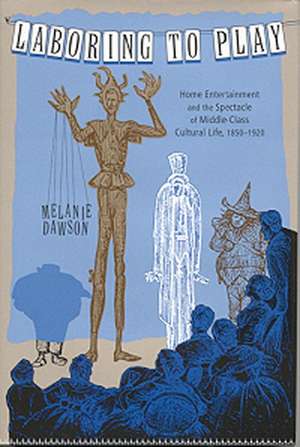
Laboring to Play: Home Entertainment and the Spectacle of Middle-Class Cultural Life, 1850-1920
Autor Melanie Dawsonen Limba Engleză Paperback – 5 sep 2013
The changing styles of middle-class home entertainments, Melanie Dawson argues, point to evolving ideas of class identity in U.S. culture. Drawing from 19th- and early-20th-century fiction, guidebooks on leisure, newspaper columns, and a polemical examination of class structures, Laboring to Play interrogates the ways that leisure performances (such as parlor games, charades, home dramas, and tableaux vivants) encouraged participants to test out the boundaries that were beginning to define middle-class lifestyles.
From 19th-century parlor games involving grotesque physical contortions to early-20th-century recitations of an idealized past, leisure employments mediated between domestic and public spheres, individuals and class-based affiliations, and ideals of egalitarian social life and visible hierarchies based on privilege. Negotiating these paradigms, home entertainments provided their participants with unique ways of performing displays of individual ambitions within a world of polite social interaction.
Laboring to Play deals with subjects as wide ranging as social performances, social history (etiquette and gentility), literary history, representations of childhood, and the history of the book.
Preț: 201.78 lei
Puncte Express: 303
Carte indisponibilă temporar
Doresc să fiu notificat când acest titlu va fi disponibil:
Se trimite...
Specificații
ISBN-13: 9780817357641
ISBN-10: 0817357645
Pagini: 272
Ilustrații: 20
Dimensiuni: 152 x 229 x 23 mm
Greutate: 0.4 kg
Ediția:First Edition
Editura: University Of Alabama Press
Colecția University Alabama Press
ISBN-10: 0817357645
Pagini: 272
Ilustrații: 20
Dimensiuni: 152 x 229 x 23 mm
Greutate: 0.4 kg
Ediția:First Edition
Editura: University Of Alabama Press
Colecția University Alabama Press
Notă biografică
Melanie Dawson is Visiting Assistant Professor of English at the College of William and Mary and coeditor of The American 1890s: A Cultural Reader.
Cuprins
List of Illustrations
Acknowledgments
Introduction
Chapter 1. Labor, Leisure, and the Scope of Ungenteel Play
Chapter 2. Dramatic Regression: The Borrowed Pleasures and Privileges of Youth
Chapter 3. Fracturing Genteel Identity: The Cultural Work of Grotesque Play
Chapter 4. Skills Rewarded: Women’s Lives Transformed through Entertainment
Chapter 5. Staging Disaster: Turn-of-the-Century Entertainment Scenes and the Failure of Personal Transformation
Chapter 6. Old Games, New Narratives, and the Specter of a Generational Divide
Chapter 7. Imagined Unity: Entertainment’s Communal Spectacles and Shared Histories
Epilogue
Notes
Selected Bibliography
Index
Acknowledgments
Introduction
Chapter 1. Labor, Leisure, and the Scope of Ungenteel Play
Chapter 2. Dramatic Regression: The Borrowed Pleasures and Privileges of Youth
Chapter 3. Fracturing Genteel Identity: The Cultural Work of Grotesque Play
Chapter 4. Skills Rewarded: Women’s Lives Transformed through Entertainment
Chapter 5. Staging Disaster: Turn-of-the-Century Entertainment Scenes and the Failure of Personal Transformation
Chapter 6. Old Games, New Narratives, and the Specter of a Generational Divide
Chapter 7. Imagined Unity: Entertainment’s Communal Spectacles and Shared Histories
Epilogue
Notes
Selected Bibliography
Index
Recenzii
“Dawson meticulously analyzes the subtle changes surrounding leisure forms and what those changes tell us about class status and women's roles at a time of dramatic change and instability. Her analysis is detailed and thoughtful. . . .Historians of middle-class cultural life will undoubtedly find this work useful and appreciate its insights into home entertainment during hte mid to late nineteenth century.” —American Historical Review
"The purposes of Laboring to Play are several: to give new and sustained attention to the parlor as an important site of social and cultural formation; to consider the ways in which home entertainment texts and practices helped shape an emerging middle-class identity in the United States; to chart the evolution of such texts and practices and thus also their changing effects on class formation; to extend existing scholarship on the middle class; to reexamine the inter-relationship of work and play in American culture; and to explore the roles of pleasure and game-playing in American identity. Highly effective are the detailed readings of the 'entertainment chronotope' in a number of important American literary texts, including Alcott's Little Women, Wharton's The House of Mirth, Lewis's Main Street, Gilman's Herland, and Cather's My Ántonia." —William Gleason, author of The Leisure Ethic: Work and Play in American Literature, 1840-1940.
“A learned and engaging analysis based on an impressive body of research. . . . Dawson's focus on entertainment in the home has the benefit of providing us with a close and careful look at the intersections between ideologies of domesticity, class, and leisure.” —Cynthia J. Davis, author of Bodily and Narrative Forms: The Influence of Medicine in American Literature, 1845-1915
“The book’s central thesis is interesting, and Dawson carefully and conscientiously explores the cultural and literary landscape of her subject. The scholarship is impressive. . . . Overall, the book is meticulously researched, and Dawson’s careful examination of . . . primary historical sources . . . should be especially interesting to scholars interested in interdisciplinary approaches to American culture. For literary scholars, the book’s strength lies in its interplay of associations and in the way in which the author moves easily between historical descriptions of cultural phenomena and literary analysis. This interplay of associations allows Dawson to re-read sections of familiar texts in new ways. . . .Laboring to Play does an admirable job of helping us to better understand the goals, fears, and concerns of nineteenth-century middle-class American society, and opens up new areas for exploration and discussion of the literary texts that reflect this era.”—American Literary Realism
"The purposes of Laboring to Play are several: to give new and sustained attention to the parlor as an important site of social and cultural formation; to consider the ways in which home entertainment texts and practices helped shape an emerging middle-class identity in the United States; to chart the evolution of such texts and practices and thus also their changing effects on class formation; to extend existing scholarship on the middle class; to reexamine the inter-relationship of work and play in American culture; and to explore the roles of pleasure and game-playing in American identity. Highly effective are the detailed readings of the 'entertainment chronotope' in a number of important American literary texts, including Alcott's Little Women, Wharton's The House of Mirth, Lewis's Main Street, Gilman's Herland, and Cather's My Ántonia." —William Gleason, author of The Leisure Ethic: Work and Play in American Literature, 1840-1940.
“A learned and engaging analysis based on an impressive body of research. . . . Dawson's focus on entertainment in the home has the benefit of providing us with a close and careful look at the intersections between ideologies of domesticity, class, and leisure.” —Cynthia J. Davis, author of Bodily and Narrative Forms: The Influence of Medicine in American Literature, 1845-1915
“The book’s central thesis is interesting, and Dawson carefully and conscientiously explores the cultural and literary landscape of her subject. The scholarship is impressive. . . . Overall, the book is meticulously researched, and Dawson’s careful examination of . . . primary historical sources . . . should be especially interesting to scholars interested in interdisciplinary approaches to American culture. For literary scholars, the book’s strength lies in its interplay of associations and in the way in which the author moves easily between historical descriptions of cultural phenomena and literary analysis. This interplay of associations allows Dawson to re-read sections of familiar texts in new ways. . . .Laboring to Play does an admirable job of helping us to better understand the goals, fears, and concerns of nineteenth-century middle-class American society, and opens up new areas for exploration and discussion of the literary texts that reflect this era.”—American Literary Realism
Descriere
In Laboring to Play: Home Entertainment and the Spectacle of Middle-Class Cultural Life, 1850–1920, literary and cultural historian Melanie Dawson uncovers the fascinating world of nineteenth- and early twentieth-century American home entertainment. Through an interdisciplinary analysis of parlor games, charades, tableaux vivants, amateur theatricals, etiquette manuals, fiction, and periodicals, Dawson reveals how seemingly ordinary leisure activities helped shape middle-class identity, gender expectations, social ambition, and cultural belonging. Blending literary criticism, social history, and cultural studies, this groundbreaking work demonstrates that entertainment was never merely recreation—it was a powerful performance through which Americans negotiated class status, domestic life, and the evolving meaning of respectability.