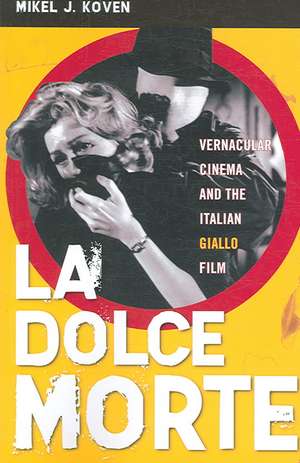
La Dolce Morte: Vernacular Cinema and the Italian Giallo Film
Autor Mikel J. Kovenen Limba Engleză Paperback – 2 oct 2006
In La Dolce Morte: Vernacular Cinema and the Italian Giallo Film, Koven explores the history and evolution of this aspect of cinema, and places these films within the context of Italian popular filmmaking. He addresses various themes, motifs, and tropes in these films: their use of space, the murders, the role of the detective, the identity of the killer, issues of belief, excess, and the set-piece.
In addition to being the first academic study of the giallo film in English, this book surveys more than fifty films of this subgenre. In addition to filmmakers like Mario Bava and Dario Argento, Koven also looks at the films of Lucio Fulci, Sergio Martino, Pupi Avati, Umberto Lenzi, and others. In all, the works of twenty-five different filmmakers are considered in this book. Also explored are the inter-relationships between these films: how one influences others, how certain filmmakers take ideas and build off of them, and how those ideas are further transformed by other filmmakers. Koven also explores the impact of the giallo on the later North American slasher genre.
Preț: 380.04 lei
Preț vechi: 578.23 lei
-34%
Puncte Express: 570
Carte tipărită la comandă
Livrare economică 28 noiembrie-12 decembrie
Livrare prin curier în România Termenul estimat este afișat lângă disponibilitate.
Transport gratuit de la 400.00 lei Plată online sau ramburs, în funcție de opțiunile comenzii.
Retur gratuit în 14 zile Comandă securizată și suport în română.
Specificații
ISBN-13: 9780810858701
ISBN-10: 0810858703
Pagini: 195
Dimensiuni: 154 x 233 x 11 mm
Greutate: 0.3 kg
Editura: Bloomsbury Publishing
Colecția Scarecrow Press
Locul publicării:New York, United States
ISBN-10: 0810858703
Pagini: 195
Dimensiuni: 154 x 233 x 11 mm
Greutate: 0.3 kg
Editura: Bloomsbury Publishing
Colecția Scarecrow Press
Locul publicării:New York, United States
V-ar putea interesa
-
 On Directing FilmDavid MametPreț: 108.86 lei
 -
 Japanese Cinema: Texts and ContextsAlastair PhillipsPreț: 491.33 lei
 -
 Crime FilmsThomas M. LeitchPreț: 278.04 lei
 -
 Jane Austen on ScreenAndrew McdonaldPreț: 258.52 lei
 -
 Grumpy Old MenStuart PrebblePreț: 114.31 lei
 -
 Alan Rickman: The Unauthorised BiographyMaureen Paton-20%Preț: 91.66 lei113.96 lei
 -
 The Films of Steven SpielbergCharles L. P. Silet-33%Preț: 384.81 lei578.01 lei
 -
 -21%Preț: 144.43 lei183.28 lei
 -
 John WayneAissa WaynePreț: 143.67 lei
 -
 100 VideogamesJames Newman-46%Preț: 121.37 lei223.44 lei
 -
 Art and the CityNicolas Whybrow-27%Preț: 169.51 lei230.81 lei
 -
 Grammar of the Film LanguageDaniel Arijon-19%Preț: 219.57 lei271.79 lei
Cuprins
Part 1 Preface
Part 2 Acknowledgments
Chapter 3 1. What is Giallo?
Chapter 4 2. Toward an Understanding of Vernacular Cinema
Chapter 5 3. Space and Place in Italian Giallo Cinema: The Ambivalence of Modernity
Chapter 6 4. Murder and Other Sexual Perversions
Chapter 7 5. Watching the Detectives: Amateur Detectives and the Giallo as Detective Cinema
Chapter 8 6. The Killer's Identity
Chapter 9 7. "Weird Science of the Most Egregious Kind": The Ambivalence of Belief in the Giallo Film
Part 10 8. "A Perverse Sublime": Excess and the Set Piece in the Giallo
Part 11 9. The Giallo as Cinema of Poetry
Part 12 10. From Giallo to Slasher
Part 13 Filmography
Part 14 Bibliography
Part 15 Index
Part 16 About the Author
Part 2 Acknowledgments
Chapter 3 1. What is Giallo?
Chapter 4 2. Toward an Understanding of Vernacular Cinema
Chapter 5 3. Space and Place in Italian Giallo Cinema: The Ambivalence of Modernity
Chapter 6 4. Murder and Other Sexual Perversions
Chapter 7 5. Watching the Detectives: Amateur Detectives and the Giallo as Detective Cinema
Chapter 8 6. The Killer's Identity
Chapter 9 7. "Weird Science of the Most Egregious Kind": The Ambivalence of Belief in the Giallo Film
Part 10 8. "A Perverse Sublime": Excess and the Set Piece in the Giallo
Part 11 9. The Giallo as Cinema of Poetry
Part 12 10. From Giallo to Slasher
Part 13 Filmography
Part 14 Bibliography
Part 15 Index
Part 16 About the Author
Recenzii
...an interesting study of Giallo...a very detailed analysis of the main themes of the genre...
La Dolce Morte is an informed and engaging examination of neglected and marginalized films that purposely provokes readers to re-examine biases against the giallo.
La Dolce Morte presents sound and interesting textual analysis of an impressive number of gialli.
...this is a serious contribution to film studies. It opens a side of Italian cinema that is rarely studied. Recommended.
...a carefully constructed presentation and discussion of one of the most important phenomena in modern cinema.
"Giallo," Italian for "yellow," is applied to a vernacular film genre (e.g., Sergio Martino's Torso, 1973) based on mystery novels with bright yellow covers that an Italian publisher has been producing since the 1920s. In the context of psychodynamics and Italian audiences, Koven (film and television studies, U. of Wales, Aberystwyth) explores themes including the outsider, sexually-driven murder, the amateur detective's role, and a view of these films from Pasolini's theory of a "cinema of poetry." He concludes that gialli, like other horror cinema, reflect modernity's ambivalence toward both traditional folk beliefs and science.
Koven's study is highly detailed and wide ranging. Koven clearly adores his chosen subject and explores it with an eye to accessibility-he often writes wittily but always lucidly-and these are reasons why the book is so engaging.
Koven's well-organized catalog of the subgenre's characteristics makes his book a valuable reference tool as well as an incisive critical study.
La Dolce Morte is an informed and engaging examination of neglected and marginalized films that purposely provokes readers to re-examine biases against the giallo.
La Dolce Morte presents sound and interesting textual analysis of an impressive number of gialli.
...this is a serious contribution to film studies. It opens a side of Italian cinema that is rarely studied. Recommended.
...a carefully constructed presentation and discussion of one of the most important phenomena in modern cinema.
"Giallo," Italian for "yellow," is applied to a vernacular film genre (e.g., Sergio Martino's Torso, 1973) based on mystery novels with bright yellow covers that an Italian publisher has been producing since the 1920s. In the context of psychodynamics and Italian audiences, Koven (film and television studies, U. of Wales, Aberystwyth) explores themes including the outsider, sexually-driven murder, the amateur detective's role, and a view of these films from Pasolini's theory of a "cinema of poetry." He concludes that gialli, like other horror cinema, reflect modernity's ambivalence toward both traditional folk beliefs and science.
Koven's study is highly detailed and wide ranging. Koven clearly adores his chosen subject and explores it with an eye to accessibility-he often writes wittily but always lucidly-and these are reasons why the book is so engaging.
Koven's well-organized catalog of the subgenre's characteristics makes his book a valuable reference tool as well as an incisive critical study.