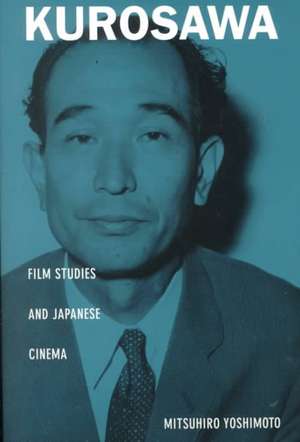
Kurosawa
Autor Mitsuhiro Yoshimotoen Limba Engleză Paperback – 31 mar 2000
Cinematografia japoneză postbelică rămâne un pilon central al culturii vizuale globale, iar relevanța sa actuală este reconfirmată de această analiză exhaustivă semnată de Mitsuhiro Yoshimoto. În volumul Kurosawa, experimentăm o incursiune densă și riguroasă în universul unuia dintre cei mai influenți regizori ai secolului XX. Apreciem modul în care autorul refuză clișeele interpretative obișnuite, alegând în schimb să exploreze modul în care filmele lui Kurosawa problematizează imaginea de sine a Japoniei și proiecțiile Occidentului asupra acestei culturi. Colecționarii care au apreciat The Warrior`s Camera – The Cinema of Akira Kurosawa – Revised and Expanded Edition de Stephen Prince vor găsi aici aceeași calitate a analizei, însă dintr-o perspectivă mai ancorată în studiile culturale și globalizarea capitalului simbolic. Structura cărții este impresionantă prin minuțiozitate, fiind organizată cronologic pentru a reflecta evoluția stilistică a regizorului pe parcursul a cinci decenii. După o introducere teoretică despre disciplina studiilor de film japonez, cuprinsul ne ghidează prin fiecare etapă creativă: de la primele producții din timpul războiului, la perioada de aur a anilor '50 cu Seven Samurai și Rashomon, până la epopeile vizuale târzii precum Kagemusha sau Ran. Tonul este unul academic, dar vibrant, oferind un comentariu continuu care îmbogățește experiența vizionării fiecărui cadru. Această ediție de la Duke University Press reușește să transforme analiza tehnică într-o meditație asupra istoriei moderne și a identității naționale.
Preț: 251.08 lei
Carte tipărită la comandă
Livrare economică 18 noiembrie-02 decembrie
Specificații
ISBN-10: 0822325195
Pagini: 496
Dimensiuni: 152 x 229 x 33 mm
Greutate: 0.74 kg
Ediția:New.
Editura: Duke University Press
V-ar putea interesa
-
 On the Scale of the WorldMusab YounisPreț: 202.33 lei
 -
 Preț: 252.65 lei
 -
 Preț: 364.34 lei
 -
 AftermathSusan J. BrisonPreț: 143.60 lei
 -
 Building BreakthroughsRaju Prasad-5%Preț: 146.19 lei153.88 lei
 -
 Nature's LaboratoryElizabeth Grennan BrowningPreț: 381.55 lei
 -
 Hard Luck and Heavy RainJoseph C. RussoPreț: 162.65 lei
 -
 New GrowthJasmine Nichole CobbPreț: 163.23 lei
 -
 Invited to WitnessJennifer Lynn KellyPreț: 187.69 lei
 -
 Preț: 132.55 lei
 -
 Infertile EnvironmentsJanelle LamoreauxPreț: 169.45 lei
 -
 People Get ReadySusan Bigelow ReynoldsPreț: 226.11 lei
 -
 Modern Construction HandbookAndrew Watts-11%Preț: 418.75 lei470.51 lei
 -
 Building with BambooGernot MinkePreț: 377.44 lei
 -
 Preț: 303.65 lei
 -
 Reframing Friedrich NerlyClaudia DenkPreț: 500.34 lei
 -
 Planetary Atmospheres and Urban Society After FukushimaChristophe Thouny-15%Preț: 597.90 lei703.41 lei
De ce să citești această carte
Recomandăm această lucrare oricărui cinefil care dorește să înțeleagă profunzimea dincolo de estetica vizuală a lui Akira Kurosawa. Cititorul câștigă o perspectivă critică asupra modului în care cinematografia modelează istoria și identitatea culturală. Este o resursă indispensabilă pentru studenții de film și pentru cei pasionați de cultura japoneză, oferind contextul necesar pentru a revedea întreaga filmografie a maestrului cu o privire mult mai avizată.
Cuprins
Introduction 1
I Japanese Cinema in Search of a Discipline 7
II The Films of Kurosawa Akira 51
Kurosawa Criticism and the Name of the Author 53
Sanshiro Sugata 69
The Most Beautiful 81
Sanshiro Sagata, Part 2 89
The Men Who Tread on the Tiger’s Tail 93
No Regrets for Our Youth 114
One Wonderful Sunday 135
Drunken Angel 138
The Quiet Duel 140
Stray Dog 147
Scandal 179
Rashomon 182
The Idiot 190
Ikiru 194
Seven Samurai 205
Record of a Living Being 246
Throne of Blood 250
The Lower Depths 270
The Hidden Fortress 272
The Bad Sleep Well 274
Yojimbo 289
Sanjuro 293
High and Low 303
Red Beard 332
Dodeskaden 334
Dersu Uzala 344
Kagemusha 348
Ran 355
Dreams 359
Rhapsody in August 364
Madadayo 372
Epilogue 375
Notes 379
Filmography 433
Bibliography 451
Index 471