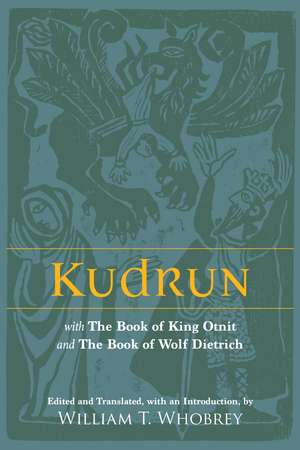
Kudrun: with The Book of King Otnit and The Book of Wolf Dietrich
William T. Whobreyen Limba Engleză Paperback – 21 feb 2025
—Kathryn Starkey, Stanford University
Preț: 172.55 lei
Preț vechi: 220.34 lei
-22%
Puncte Express: 259
Carte disponibilă
Livrare economică 17 noiembrie-01 decembrie
Livrare express 03-07 noiembrie pentru 80.45 lei
Livrare prin curier în România Termenul estimat este afișat lângă disponibilitate.
Transport gratuit de la 400.00 lei Plată online sau ramburs, în funcție de opțiunile comenzii.
Retur gratuit în 14 zile Comandă securizată și suport în română.
Specificații
ISBN-13: 9781647922108
ISBN-10: 1647922100
Pagini: 344
Ilustrații: 1 b-w line chart
Dimensiuni: 152 x 229 x 20 mm
Greutate: 0.45 kg
Editura: Hackett Publishing Company,Inc
Colecția Hackett Publishing Company, Inc.
Locul publicării:Indianapolis, United States
ISBN-10: 1647922100
Pagini: 344
Ilustrații: 1 b-w line chart
Dimensiuni: 152 x 229 x 20 mm
Greutate: 0.45 kg
Editura: Hackett Publishing Company,Inc
Colecția Hackett Publishing Company, Inc.
Locul publicării:Indianapolis, United States
Recenzii
"Whobrey's precise and robust translation renders these three lesser-known Middle High German heroic epics accessible to scholars and students of medieval studies, as well as any reader generally interested in myth and legends. Featuring an extensive Introduction and clear notes—offering linguistic details and manuscript history as well as general background in medieval literature—this book will be an excellent resource, particularly for undergraduates. Whobrey’s deep understanding of Germanic literatures and cultures here combines with his linguistic expertise to create an 'honest' translation, bringing the forms and features of Germanic oral storytelling (characteristic of these older epics) into an updated translation for a wide variety of contemporary readers to learn from and enjoy."
—Alexandra Sterling-Hellenbrand, Appalachian State University
“This book is an impressive collection of English versions of three post-Nibelungenlied medieval German heroic (or epic) narratives, meticulously edited and masterfully translated, including a concise, thorough introduction. Whobrey's rendering of the Middle High German texts is accurate and lively, with detailed textual notes on all relevant issues (transmission, semantics, style). Kudrun, the longest of the three tales, is—like Wolf Dietrich A—only preserved in the famous Ambraser Heldenbuch, a collection of 25 medieval tales once kept in Castle Ambras (near Innsbruck), now at the Austrian National Library. Whobrey (Yale Univ.) has included 100 strophes from another manuscript containing the ending to Wolf DietrichA. Otinit, often transmitted with Wolf Dietrich, also exists in a 14th-century manuscript. Together, these texts represent stellar examples of tales of intrigue, conflict, and adventure (especially noteworthy: bridal quests). Stylistically, the three stories present variants on the strophic meter found in the Nibelungenlied, no small hurdle for a translator. Consultation with the original German versions is easy, as each four-verse strophe is numbered throughout. Welcome appendixes include helpful personal and place names, a composite family tree (for Kudrun), manuscripts, and a fine bibliography. This volume stands proudly alongside Whobrey's renditions of Gottfried von Strassburg, Ulrich von Türheim, the Nibelungenlied, and Klage.”
—J. M. Jeep, Miami University, in CHOICE
“William Whobrey’s recent translation activity has been a boon for English-speaking readers of medieval German texts. Also with Hackett, Whobrey has published translations of The Nibelungenlied (2018) and Tristan and Isolde (2020). Both volumes feature not only the well-known texts of the anonymous epic and Gottfried von Strassburg, but also lesser-known texts, at least among wider audiences, associated with them: respectively, the Klage and the continuation of Ulrich von Türheim. Students, scholars, and anyone else interested in these narratives now have access to affordable . . . updated, quality translations with additional materials unavailable in the standard translations of previous generations. Kudrun and its supplemental texts surpass their predecessors.
“In striking a balance between readability and scholarly rigor, this book provides a classroom-ready introduction to lesser-known German medieval literature, and its apparatus, back matter, and contextual framing in the introduction are rich sources for further reading and discussion. Whobrey has succeeded once again in updating translations for a new generation of readers.”
—Adam Oberlin, Princeton University, in Delos
“[T]he signature strength of the present volume lies in its pedagogic potential. Each text is accompanied by extensive footnotes, detailing manuscript variations and philological considerations, providing co-textual and comparative analyses with other Middle High German texts, and offering broader explanations of medieval German history, cultural practices, concepts, and terminology. With such supporting elements, the volume would especially excel in the undergraduate classroom, though with obvious relevance to both more specialized instruction as well as to personal study. . . . The translation itself is clear and accurate. . . . Whobrey’s edition is supplemented with very frequent footnotes (averaging three on every page) which also highlight passages of particularly opaque syntax and meaning, and, most welcome, provide competing interpretations and translations from earlier editions, including the English versions mentioned above, as well as from modern German editions and translations. The reader is therefore provided, on the same page as the text, with an assembled package of alternative readings and perspectives from its entire translation history—a veritable one-stop shop of medieval German epic! . . . A well-conceived, artistically fluid, and meticulously researched contribution. I sincerely hope his series of translations continues.”
—Walker Horsfall, University of Illinois Urbana-Champaign, in Arthuriana
—Alexandra Sterling-Hellenbrand, Appalachian State University
“This book is an impressive collection of English versions of three post-Nibelungenlied medieval German heroic (or epic) narratives, meticulously edited and masterfully translated, including a concise, thorough introduction. Whobrey's rendering of the Middle High German texts is accurate and lively, with detailed textual notes on all relevant issues (transmission, semantics, style). Kudrun, the longest of the three tales, is—like Wolf Dietrich A—only preserved in the famous Ambraser Heldenbuch, a collection of 25 medieval tales once kept in Castle Ambras (near Innsbruck), now at the Austrian National Library. Whobrey (Yale Univ.) has included 100 strophes from another manuscript containing the ending to Wolf DietrichA. Otinit, often transmitted with Wolf Dietrich, also exists in a 14th-century manuscript. Together, these texts represent stellar examples of tales of intrigue, conflict, and adventure (especially noteworthy: bridal quests). Stylistically, the three stories present variants on the strophic meter found in the Nibelungenlied, no small hurdle for a translator. Consultation with the original German versions is easy, as each four-verse strophe is numbered throughout. Welcome appendixes include helpful personal and place names, a composite family tree (for Kudrun), manuscripts, and a fine bibliography. This volume stands proudly alongside Whobrey's renditions of Gottfried von Strassburg, Ulrich von Türheim, the Nibelungenlied, and Klage.”
—J. M. Jeep, Miami University, in CHOICE
“William Whobrey’s recent translation activity has been a boon for English-speaking readers of medieval German texts. Also with Hackett, Whobrey has published translations of The Nibelungenlied (2018) and Tristan and Isolde (2020). Both volumes feature not only the well-known texts of the anonymous epic and Gottfried von Strassburg, but also lesser-known texts, at least among wider audiences, associated with them: respectively, the Klage and the continuation of Ulrich von Türheim. Students, scholars, and anyone else interested in these narratives now have access to affordable . . . updated, quality translations with additional materials unavailable in the standard translations of previous generations. Kudrun and its supplemental texts surpass their predecessors.
“In striking a balance between readability and scholarly rigor, this book provides a classroom-ready introduction to lesser-known German medieval literature, and its apparatus, back matter, and contextual framing in the introduction are rich sources for further reading and discussion. Whobrey has succeeded once again in updating translations for a new generation of readers.”
—Adam Oberlin, Princeton University, in Delos
“[T]he signature strength of the present volume lies in its pedagogic potential. Each text is accompanied by extensive footnotes, detailing manuscript variations and philological considerations, providing co-textual and comparative analyses with other Middle High German texts, and offering broader explanations of medieval German history, cultural practices, concepts, and terminology. With such supporting elements, the volume would especially excel in the undergraduate classroom, though with obvious relevance to both more specialized instruction as well as to personal study. . . . The translation itself is clear and accurate. . . . Whobrey’s edition is supplemented with very frequent footnotes (averaging three on every page) which also highlight passages of particularly opaque syntax and meaning, and, most welcome, provide competing interpretations and translations from earlier editions, including the English versions mentioned above, as well as from modern German editions and translations. The reader is therefore provided, on the same page as the text, with an assembled package of alternative readings and perspectives from its entire translation history—a veritable one-stop shop of medieval German epic! . . . A well-conceived, artistically fluid, and meticulously researched contribution. I sincerely hope his series of translations continues.”
—Walker Horsfall, University of Illinois Urbana-Champaign, in Arthuriana