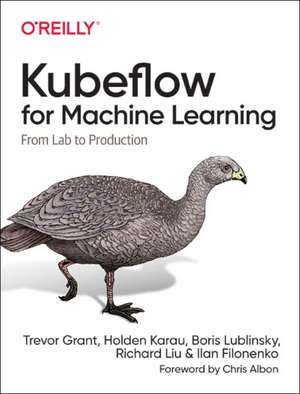
Kubeflow for Machine Learning: From Lab to Production
Autor Trevor Grant, Holden Karau, Boris Lublinsky, Richard Liu, Ilan Filonenkoen Limba Engleză Paperback – 17 noi 2020
STRUCTURA progresivă: de la concept la implementare, ghidează cititorul prin complexitatea ecosistemului Kubeflow, transformând fluxurile de lucru experimentale în sisteme de producție robuste. Descoperim aici o abordare tehnică riguroasă a modului în care containerele și orchestrarea Kubernetes pot fi utilizate pentru a gestiona ciclul de viață al modelelor de învățare automată. Găsim în această carte explicații detaliate despre componentele de bază ale Kubeflow, punând accent pe rezolvarea problemelor de scalabilitate cu care se confruntă inginerii de date și cercetătorii în prezent. Autorii demonstrează cum pot fi antrenate modelele folosind biblioteci consacrate precum Scikit-learn sau TensorFlow, integrându-le în același timp cu Apache Spark pentru procesarea seturilor mari de date. Ca și Josh Patterson în Kubeflow Operations Guide, echipa de autori distilează experiență reală în principii acționabile, oferind soluții pentru portabilitatea sarcinilor de lucru între diferite tipuri de clustere. Diferența majoră constă în focalizarea pe utilizatorul final care trebuie să mențină aceste modele prin Kubeflow Pipelines și să gestioneze metadatele de antrenament. Textul analizează și aspecte critice precum reglarea hiperparametrilor și servirea modelelor în medii de producție, asigurând o înțelegere profundă a designului cloud-native. Într-o manieră similară cu abordarea prezentată de Yuan Tang în Distributed Machine Learning Patterns, volumul de față prioritizează tiparele de scalare, însă rămâne strâns ancorat în utilitățile specifice oferite de platforma Kubeflow pentru automatizarea fluxurilor MLOps.
Preț: 247.52 lei
Preț vechi: 309.40 lei
-20%
Carte disponibilă
Livrare economică 17 noiembrie-01 decembrie
Specificații
ISBN-10: 1492050121
Pagini: 261
Dimensiuni: 179 x 233 x 21 mm
Greutate: 0.47 kg
Editura: O'Reilly
V-ar putea interesa
-
 Modern App Deployment with Azure KubernetesDawid Borycki-20%Preț: 326.88 lei408.60 lei
 -
 Machine Learning in ProductionChristian Kastner-20%Preț: 582.06 lei727.58 lei
 -
 -38%Preț: 398.93 lei646.62 lei
 -
 Preț: 369.17 lei
 -
 Keras 3Mohammad Nauman-20%Preț: 317.95 lei397.44 lei
 -
 -20%Preț: 36.76 lei45.95 lei
 -
 Kubernetes in ActionMarko Luksa-20%Preț: 332.50 lei415.63 lei
 -
 Data Pipelines with Apache AirflowBas Harenslak-20%Preț: 398.25 lei497.81 lei
 -
 Pipeline as CodeMohamed Labouardy-20%Preț: 343.10 lei428.88 lei
 -
 Core KubernetesJay Vyas-20%Preț: 343.02 lei428.78 lei
 -
 Distributed Machine Learning PatternsYuan Tang-20%Preț: 326.97 lei408.71 lei
 -
 Effective Data Science InfrastructureVille Tuulos-20%Preț: 339.77 lei424.72 lei
 -
 -20%Preț: 337.30 lei421.62 lei
 -
 Practical Deep Learning, 2nd Edition: A Python-Based IntroductionRonald T. Kneusel-35%Preț: 333.73 lei515.68 lei
 -
 Preț: 462.84 lei
 -
 Generative AI with KubernetesJonathan Baier-20%Preț: 232.52 lei290.65 lei
 -
 Deploying Secure Data Science Applications in the CloudLucas H. Benevides e Braga-20%Preț: 225.24 lei281.55 lei
De ce să citești această carte
Recomandăm această carte cercetătorilor de date și inginerilor care doresc să depășească etapa de notebook și să livreze modele scalabile. Cititorul câștigă expertiză practică în utilizarea Kubeflow pe Kubernetes, învățând să automatizeze antrenarea și servirea modelelor. Este un ghid esențial pentru oricine dorește să construiască o infrastructură de Machine Learning fiabilă, utilizând instrumente open-source de top.
Despre autor
Trevor Grant, Holden Karau, Boris Lublinsky, Richard Liu și Ilan Filonenko formează o echipă de experți cu un istoric solid în sisteme distribuite și Machine Learning. Holden Karau este recunoscută la nivel mondial pentru contribuțiile sale la Apache Spark și pentru expertiza în procesarea datelor la scară largă. Boris Lublinsky are o experiență vastă în arhitecturi software și sisteme de streaming, în timp ce Trevor Grant este un membru activ al comunității Apache Software Foundation. Împreună, autorii aduc o perspectivă multidisciplinară asupra ecosistemului Kubeflow, combinând ingineria software cu știința datelor.
Descriere scurtă
Using examples throughout the book, authors Holden Karau, Trevor Grant, Ilan Filonenko, Richard Liu, and Boris Lublinsky explain how to use Kubeflow to train and serve your machine learning models on top of Kubernetes in the cloud or in a development environment on-premises.
- Understand Kubeflow's design, core components, and the problems it solves
- Understand the differences between Kubeflow on different cluster types
- Train models using Kubeflow with popular tools including Scikit-learn, TensorFlow, and Apache Spark
- Keep your model up to date with Kubeflow Pipelines
- Understand how to capture model training metadata
- Explore how to extend Kubeflow with additional open source tools
- Use hyperparameter tuning for training
- Learn how to serve your model in production