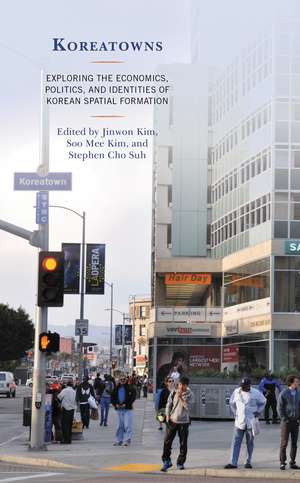
Koreatowns: Exploring the Economics, Politics, and Identities of Korean Spatial Formation: Korean Communities across the World
Editat de Jinwon Kim, Soo Mee Kim, Stephen Cho Suh Contribuţii de Carolyn Areum Choi, Yuri W. Doolan, Cassandra Gutierrez, Minjeong Kim, Hyo Kyung Woo, Sharon J. Yoonen Limba Engleză Hardback – 9 iun 2020
| Toate formatele și edițiile | Preț | Express |
|---|---|---|
| Paperback (1) | 243.09 lei 43-57 zile | |
| Bloomsbury Publishing – 21 dec 2021 | 243.09 lei 43-57 zile | |
| Hardback (1) | 624.93 lei 43-57 zile | |
| Bloomsbury Publishing – 9 iun 2020 | 624.93 lei 43-57 zile |
Din seria Korean Communities across the World
- nou
 Preț: 582.85 lei
 - nou
 Preț: 511.64 lei
 - 34%
 Preț: 584.45 lei
 - 34%
 Preț: 582.11 lei
 - 19%
 Preț: 659.97 lei
 - 34%
 Preț: 522.13 lei
 - 26%
 Preț: 245.15 lei
 - 34%
 Preț: 663.41 lei
 - 34%
 Preț: 522.13 lei
 - 15%
 Preț: 655.90 lei
 - 27%
 Preț: 241.24 lei
 - 26%
 Preț: 267.55 lei
 - 25%
 Preț: 255.83 lei
 - 26%
 Preț: 243.09 lei
 - 34%
 Preț: 582.97 lei
 - 24%
 Preț: 211.52 lei
 - 26%
 Preț: 243.70 lei
 - 34%
 Preț: 501.64 lei
 - 34%
 Preț: 498.27 lei
 - 34%
 Preț: 499.73 lei
 - 34%
 Preț: 568.12 lei
 - 34%
 Preț: 524.39 lei
 - 25%
 Preț: 209.36 lei
 - 34%
 Preț: 552.62 lei
 - 34%
 Preț: 586.54 lei
 - 24%
 Preț: 211.71 lei
 - 25%
 Preț: 255.67 lei
 - 31%
 Preț: 491.12 lei
 - 34%
 Preț: 614.77 lei
 - 34%
 Preț: 523.38 lei
 - 34%
 Preț: 523.74 lei
Preț: 624.93 lei
Preț vechi: 735.21 lei
-15%
Puncte Express: 937
Preț estimativ în valută:
110.64€ • 128.83$ • 96.11£
110.64€ • 128.83$ • 96.11£
Carte tipărită la comandă
Livrare economică 23 februarie-09 martie
Preluare comenzi: 021 569.72.76
Specificații
ISBN-13: 9781498584524
ISBN-10: 1498584527
Pagini: 218
Dimensiuni: 161 x 231 x 21 mm
Greutate: 0.53 kg
Editura: Bloomsbury Publishing
Colecția Lexington Books
Seria Korean Communities across the World
Locul publicării:New York, United States
ISBN-10: 1498584527
Pagini: 218
Dimensiuni: 161 x 231 x 21 mm
Greutate: 0.53 kg
Editura: Bloomsbury Publishing
Colecția Lexington Books
Seria Korean Communities across the World
Locul publicării:New York, United States
Cuprins
Part I: Koreatowns as Economic Formations
Chapter One: The Emergence of a Transborder Koreatown in the U.S.-Mexico Border Region
Minjeong Kim
Chapter Two: A Tale of Two Enclaves: Divergent Trajectories among South Korean Educational Migrants in Los Angeles' Koreatown
Carolyn Choi
Chapter Three: Transnational Entrepreneurship in Manhattan's Koreatown
Jinwon Kim
Part II: Politics of Koreatowns
Chapter Four: The Split Enclave: Transnationalism and Co-ethnic Conflict in Beijing's Koreatown
Sharon J. Yoon
Chapter Five: Another Koreatown: Korean Military Brides and Their Forgotten Communities
Yuri W. Doolan
Chapter Six: Being Seen and Not Heard: Impact of Redistricting on Koreatown
Soo Mee Kim
Part III: Koreatowns and Culture
Chapter Seven: The Emergence of Koreatown in Singapore and a Global Community of K-culture Fans
Hyo Kyung Woo
Chapter Eight: The Reterritorialization of Mexico City's Koreatown, "Little Seoul," through the Overseas Popularity of Hallyu
Cassandra Gutierrez
Chapter Nine: Reframing the "Riots": Locating Koreatown in Contemporary Korean American Retellings of the 1992 Los Angeles Uprising
Stephen Cho Suh
Chapter One: The Emergence of a Transborder Koreatown in the U.S.-Mexico Border Region
Minjeong Kim
Chapter Two: A Tale of Two Enclaves: Divergent Trajectories among South Korean Educational Migrants in Los Angeles' Koreatown
Carolyn Choi
Chapter Three: Transnational Entrepreneurship in Manhattan's Koreatown
Jinwon Kim
Part II: Politics of Koreatowns
Chapter Four: The Split Enclave: Transnationalism and Co-ethnic Conflict in Beijing's Koreatown
Sharon J. Yoon
Chapter Five: Another Koreatown: Korean Military Brides and Their Forgotten Communities
Yuri W. Doolan
Chapter Six: Being Seen and Not Heard: Impact of Redistricting on Koreatown
Soo Mee Kim
Part III: Koreatowns and Culture
Chapter Seven: The Emergence of Koreatown in Singapore and a Global Community of K-culture Fans
Hyo Kyung Woo
Chapter Eight: The Reterritorialization of Mexico City's Koreatown, "Little Seoul," through the Overseas Popularity of Hallyu
Cassandra Gutierrez
Chapter Nine: Reframing the "Riots": Locating Koreatown in Contemporary Korean American Retellings of the 1992 Los Angeles Uprising
Stephen Cho Suh
Recenzii
Based on a rich compilation of research studies conducted by up-and-coming scholars across the field, Koreatowns offers readers the most up-to-date analyses on thepolitical, economic, and cultural re-formation of contemporary Koreatown communities across the world. Based on new and old Koreatowns from gateway and mid-western U.S. cities to Asia, Mexico, and the U.S.-Mexico borderlands, this collection analyzes how economic restructuring, cultural consumption, globalization, and social inequality have triggered the transnational extension and re-formation of Korean communities in ways that both connect as well as stratify. Readers can learn about emerging phenomenon, such as K-wave cultural communities, post-riot political and cultural formations, trans-border U.S.-Mexico Korean enclaves, Korean military bride camptowns, and stratified international student pathways. This book is a must-read for anyone looking for a fresh perspective on Koreatown and the Korean diaspora and is sure to generate new ideas and discussions on global ethnic enclaves today.
Covering a wide and varied range of Korean diasporic neighborhoods such as metropolitan areas to border towns, this book examines "Koreatowns" through economics, politics, and culture, while exploring how Korean descendants came to be emplaced throughout the world, especially North America and Asia. It succeeds in advancing literature on immigrant communities, which had focused on spatial concentrations of immigrant enterprises. It also updates Korean socio-spatial formation in the contemporary transnational and global context. It is refreshing to read a sociological work that grounds itself in physical space before engaging topics such as online community and pop culture.
Covering a wide and varied range of Korean diasporic neighborhoods such as metropolitan areas to border towns, this book examines "Koreatowns" through economics, politics, and culture, while exploring how Korean descendants came to be emplaced throughout the world, especially North America and Asia. It succeeds in advancing literature on immigrant communities, which had focused on spatial concentrations of immigrant enterprises. It also updates Korean socio-spatial formation in the contemporary transnational and global context. It is refreshing to read a sociological work that grounds itself in physical space before engaging topics such as online community and pop culture.