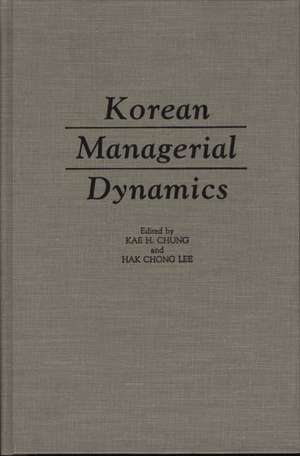
Korean Managerial Dynamics
Autor Hak Chong Lee Editat de Kae H. Chungen Limba Engleză Hardback – 3 noi 1989
"Korean Managerial Dynamics" raises a series of questions relating to the managerial practices of Korean firms and offers answers to these questions: What makes Korean managers tick? How does the government influence managerial practices? What kind of strategies and structure have Korean firms developed? To what extent do they rely on foreign technology? What are the similarities and differences with American or Japanese firms? Do traditional values influence managerial practices? Can Korean firms develop a corporate culture that can effectively function in an advanced industrial society? These are but a few of the questions discussed in this book.
Preț: 489.81 lei
Preț vechi: 686.24 lei
-29%
Puncte Express: 735
Carte tipărită la comandă
Livrare economică 21 decembrie 26 - 04 ianuarie 27
Livrare prin curier în România Termenul estimat este afișat lângă disponibilitate.
Transport gratuit pentru acest produs Plată online sau ramburs, în funcție de opțiunile comenzii.
Retur gratuit în 14 zile Comandă securizată și suport în română.
Specificații
ISBN-13: 9780275931902
ISBN-10: 0275931900
Pagini: 254
Dimensiuni: 162 x 236 x 22 mm
Greutate: 0.5 kg
Ediția:New.
Editura: Praeger
ISBN-10: 0275931900
Pagini: 254
Dimensiuni: 162 x 236 x 22 mm
Greutate: 0.5 kg
Ediția:New.
Editura: Praeger
V-ar putea interesa
-
 KristallnachtMartin GilbertPreț: 116.46 lei
-
 The Lost Life of Eva BraunAngela LambertPreț: 131.11 lei
-
 -9%Preț: 399.01 lei440.81 lei
-
 Cambodia: The Legacy and Lessons of UNTACTrevor Findlay-19%Preț: 297.51 lei367.95 lei
-
 -15%Preț: 263.35 lei311.60 lei
-
 KarzaiNick B MillsPreț: 157.51 lei
-
 Freedom Next TimeJohn Pilger-18%Preț: 88.22 lei108.19 lei
-
 Oracle BonesPeter Hessler-26%Preț: 74.15 lei100.08 lei
-
 In the Bunker with Hitler: The Last Witness SpeaksBernd Freytag von Loringhoven-26%Preț: 57.98 lei78.87 lei
-
 Preț: 137.42 lei
-
 Thabo Mbeki and the Battle for the Soul of the ANCWilliam Mervin Gumede-13%Preț: 297.47 lei340.14 lei
-
 After They Killed Our FatherLoung Ung-19%Preț: 64.20 lei79.03 lei
Descriere
This contributor volume is the first effort to examine the management practices behind Korea's successful transformation from an underdeveloped nation into a major player in world trade. Economists, journalists, and policy makers worldwide study the success story and point to the economic policies of government, a well-disciplined labor force, and a homogeneous culture. However, these factors should not overshadow the important roles played by corporate entrepreneurs and managers. Divided into five parts, this volume focuses on the business environment in which Korean firms operate, the corporate ownership structure, corporate strategies, managerial practices, and finally human resource management within Korean firms.
Korean Managerial DynamicS≪/i> raises a series of questions relating to the managerial practices of Korean firms and offers answers to these questions: What makes Korean managers tick? How does the government influence managerial practices? What kind of strategies and structure have Korean firms developed? To what extent do they rely on foreign technology? What are the similarities and differences with American or Japanese firms? Do traditional values influence managerial practices? Can Korean firms develop a corporate culture that can effectively function in an advanced industrial society? These are but a few of the questions discussed in this book.
Korean Managerial DynamicS≪/i> raises a series of questions relating to the managerial practices of Korean firms and offers answers to these questions: What makes Korean managers tick? How does the government influence managerial practices? What kind of strategies and structure have Korean firms developed? To what extent do they rely on foreign technology? What are the similarities and differences with American or Japanese firms? Do traditional values influence managerial practices? Can Korean firms develop a corporate culture that can effectively function in an advanced industrial society? These are but a few of the questions discussed in this book.
Notă biografică
KAE H. CHUNG is Professor and Chairman of the Department of Management at Wichita State University. His books include Management: Critical Success Factors (1987), Organizational Behavior (1981), and Motivational Theory and Practice (1977.
HAK CHONG LEE is Dean of the Graduate School of Business at Yonsei University, Seoul. His recent books include Corporate Culture (1989), Organizational Behavior (1987), and Strategic Management (1988).
HAK CHONG LEE is Dean of the Graduate School of Business at Yonsei University, Seoul. His recent books include Corporate Culture (1989), Organizational Behavior (1987), and Strategic Management (1988).