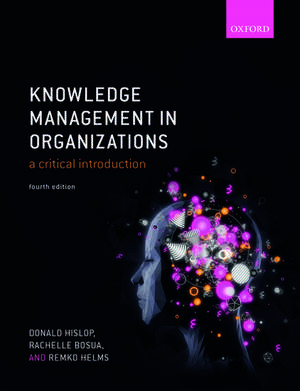
Knowledge Management in Organizations: A critical introduction
Autor Donald Hislop, Rachelle Bosua, Remko Helmsen Limba Engleză Paperback – 29 mar 2018
Preț: 451.47 lei
Preț vechi: 557.36 lei
-19%
Puncte Express: 677
Carte tipărită la comandă
Livrare economică 03-17 noiembrie
Livrare express 26 septembrie-02 octombrie pentru 140.04 lei
Livrare prin curier în România Termenul estimat este afișat lângă disponibilitate.
Transport gratuit pentru acest produs Plată online sau ramburs, în funcție de opțiunile comenzii.
Retur gratuit în 14 zile Comandă securizată și suport în română.
Specificații
ISBN-13: 9780198724018
ISBN-10: 0198724012
Pagini: 344
Dimensiuni: 190 x 246 x 16 mm
Greutate: 0.58 kg
Ediția:4
Editura: OUP OXFORD
Colecția OUP Oxford
Locul publicării:Oxford, United Kingdom
ISBN-10: 0198724012
Pagini: 344
Dimensiuni: 190 x 246 x 16 mm
Greutate: 0.58 kg
Ediția:4
Editura: OUP OXFORD
Colecția OUP Oxford
Locul publicării:Oxford, United Kingdom
Recenzii
Finally a text book that provides a refreshing and global insight into knowledge management and is a rich learning resource to both academic tutors and students.
Hislop et al.'s book provides students with a perfect introduction to knowledge management that develops critical and scholarly understanding of the key concepts and issues concerning how KM is developed and managed in organizations. Packed with learning materials such as case studies, self-reflection and discussion topics, together with access to online resources that provide further materials, this book is core reading for all students and academics engaged in KM study.
The main strength of Hislop et al.'s book is that it helps the reader to think beyond differences in perspective and to explore the assumptions that may underlie these differences. I think, in addition, the book scores well in terms of clarity of reading and spread of examples.
Far better than most in its overview, detail and critical points.
Hislop et al.'s book provides students with a perfect introduction to knowledge management that develops critical and scholarly understanding of the key concepts and issues concerning how KM is developed and managed in organizations. Packed with learning materials such as case studies, self-reflection and discussion topics, together with access to online resources that provide further materials, this book is core reading for all students and academics engaged in KM study.
The main strength of Hislop et al.'s book is that it helps the reader to think beyond differences in perspective and to explore the assumptions that may underlie these differences. I think, in addition, the book scores well in terms of clarity of reading and spread of examples.
Far better than most in its overview, detail and critical points.