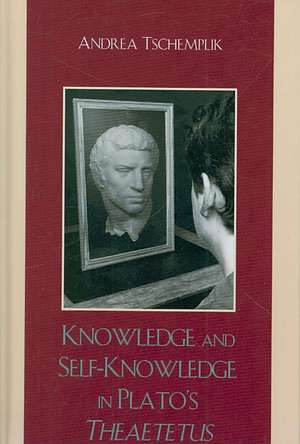
Knowledge and Self-Knowledge in Plato's Theaetetus
Autor Andrea Tschempliken Limba Engleză Hardback – 22 aug 2008
This book will be of interest to scholars and graduate students in the history of philosophy with a special interest in ancient philosophy, and will also be accessible to upper-level undergraduates in ancient philosophy.
Preț: 594.11 lei
Preț vechi: 910.31 lei
-35%
Puncte Express: 891
Carte tipărită la comandă
Livrare economică 20 noiembrie-04 decembrie
Livrare prin curier în România Termenul estimat este afișat lângă disponibilitate.
Transport gratuit pentru acest produs Plată online sau ramburs, în funcție de opțiunile comenzii.
Retur gratuit în 14 zile Comandă securizată și suport în română.
Specificații
ISBN-13: 9780739125731
ISBN-10: 0739125737
Pagini: 183
Dimensiuni: 162 x 240 x 18 mm
Greutate: 0.43 kg
Editura: Bloomsbury Publishing
Colecția Lexington Books
Locul publicării:New York, United States
ISBN-10: 0739125737
Pagini: 183
Dimensiuni: 162 x 240 x 18 mm
Greutate: 0.43 kg
Editura: Bloomsbury Publishing
Colecția Lexington Books
Locul publicării:New York, United States
Cuprins
Chapter 1 Introduction
Chapter 2 Chapter One: Framing the Question of Knowledge in the Theaetetus
Chapter 3 Chapter Two: Intellectual Midwifery, Intellectual Pregnancy
Chapter 4 Chapter Three: Perception and Knowledge
Chapter 5 Chapter Four: Doxa-Logy
Chapter 6 Chapter Five: Mathematics and Beyond
Chapter 2 Chapter One: Framing the Question of Knowledge in the Theaetetus
Chapter 3 Chapter Two: Intellectual Midwifery, Intellectual Pregnancy
Chapter 4 Chapter Three: Perception and Knowledge
Chapter 5 Chapter Four: Doxa-Logy
Chapter 6 Chapter Five: Mathematics and Beyond
Recenzii
A striking study of crucial themes in Plato's thought. Erudite, insightful, and imaginative.
Tschemplik's monograph emphasizes aspects of the Theaetetus that are often overlooked (e.g., knowledge of ignorance) and aspects of dialogue construction that are not widely understood (e.g., their dramatic and literary frames). She has an answer to the rarely discussed but valid question of why it takes Socrates so long to give a refutation of Theaetetus' second account of knowledge, when that refutation could have been given in the first place. This is a welcome contribution to the new Platonic scholarship that seeks to understand the dialogues holistically, with equal sensitivity to the arguments and to their literary and dramatic nuances. The volume is important reading for students of the Theaetetus and of Plato generally.
The book's angle is to take a work best known for its analyses of knowledge, observe its aporetic conclusion, and suggest a new reason for that impasse. Tschemplik is very justified in making another go at the problem of self-knowledge in Plato.
I particularly admire and concur with Tschemplik's central thesis that even in the Theaetetus the general problem of knowledge cannot be divorced from the Socratic notion that all knowledge is self-knowledge. What makes this reading so forceful in its contribution to the scholarship is that it successfully refutes the oft-claimed notion that in Plato's later dialogues (such as the Theaetetus) he broke rank with Socrates and developed a theory of knowledge that stands on its own apart from the conversion of the soul that was a key component of Plato's early dialogues. Her arguments and the evidence she mounts that no such break is evident in the Theaetetus has far ranging implications for a holistic reading of the Platonic dialogues that does not assume a straightforward philosophical division between the early and late dialogues.
Tschemplik's monograph emphasizes aspects of the Theaetetus that are often overlooked (e.g., knowledge of ignorance) and aspects of dialogue construction that are not widely understood (e.g., their dramatic and literary frames). She has an answer to the rarely discussed but valid question of why it takes Socrates so long to give a refutation of Theaetetus' second account of knowledge, when that refutation could have been given in the first place. This is a welcome contribution to the new Platonic scholarship that seeks to understand the dialogues holistically, with equal sensitivity to the arguments and to their literary and dramatic nuances. The volume is important reading for students of the Theaetetus and of Plato generally.
The book's angle is to take a work best known for its analyses of knowledge, observe its aporetic conclusion, and suggest a new reason for that impasse. Tschemplik is very justified in making another go at the problem of self-knowledge in Plato.
I particularly admire and concur with Tschemplik's central thesis that even in the Theaetetus the general problem of knowledge cannot be divorced from the Socratic notion that all knowledge is self-knowledge. What makes this reading so forceful in its contribution to the scholarship is that it successfully refutes the oft-claimed notion that in Plato's later dialogues (such as the Theaetetus) he broke rank with Socrates and developed a theory of knowledge that stands on its own apart from the conversion of the soul that was a key component of Plato's early dialogues. Her arguments and the evidence she mounts that no such break is evident in the Theaetetus has far ranging implications for a holistic reading of the Platonic dialogues that does not assume a straightforward philosophical division between the early and late dialogues.