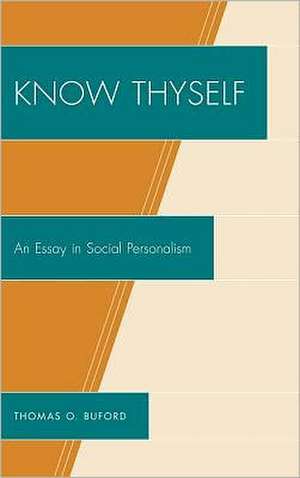
Know Thyself: An Essay on Social Personalism
Autor Thomas O. Buforden Limba Engleză Hardback – 25 noi 2011
Self-knowledge developed in this book shows how persons in relation to the Personal learn who they are, what they are to become, and what they must do to achieve that goal. It also shows that the achievement of self-knowledge is supported by a natural, social, and cultural environment rooted in trust. In this humane and timely discussion, Thomas O. Buford offers a personalist understanding of self-knowledge that avoids the impersonalisms that erode the dignity of persons and their moral life which characterize modern life.
Preț: 633.31 lei
Preț vechi: 958.44 lei
-34%
Puncte Express: 950
Carte tipărită la comandă
Livrare economică 21 noiembrie-05 decembrie
Livrare prin curier în România Termenul estimat este afișat lângă disponibilitate.
Transport gratuit pentru acest produs Plată online sau ramburs, în funcție de opțiunile comenzii.
Retur gratuit în 14 zile Comandă securizată și suport în română.
Specificații
ISBN-13: 9780739146187
ISBN-10: 0739146181
Pagini: 212
Dimensiuni: 161 x 241 x 22 mm
Greutate: 0.5 kg
Editura: Bloomsbury Publishing
Colecția Lexington Books
Locul publicării:New York, United States
ISBN-10: 0739146181
Pagini: 212
Dimensiuni: 161 x 241 x 22 mm
Greutate: 0.5 kg
Editura: Bloomsbury Publishing
Colecția Lexington Books
Locul publicării:New York, United States
Cuprins
Chapter 1: Gnothi Seauton and the Problem of Suspicion
Chapter 2: Our Haunting Hopes
Chapter 3: A New Master Image
Chapter 4: Whole Persons and the Natural
Chapter 5: Society and Culture
Chapter 6: The Personal
Chapter 7: Dancing
Chapter 8: Broken Dances
Chapter 2: Our Haunting Hopes
Chapter 3: A New Master Image
Chapter 4: Whole Persons and the Natural
Chapter 5: Society and Culture
Chapter 6: The Personal
Chapter 7: Dancing
Chapter 8: Broken Dances
Recenzii
The author develops his positions with assiduous care. He periodically recapitulates for clarity. Both specialists and simply curious persons will find the work a thought-provoking read. Readers will likely find the approach to persons richer than often seen in contemporary Anglophonic philosophy. The author also treats personalist themes in Trust, Our Second Nature (Lexington, 2009).
The inscription 'know thyself' on the Greek temple at Delphi was the center of Socrates' philosophy and, to a great extent, the basis of all ancient philosophy. The importance of this dictum has been all but forgotten in the world of modern philosophy, with its emphasis on methods of logical analysis, deconstruction, hermeneutics, and post-modern perspectives. Professor Buford's revival of the philosophy of self-knowledge, as well as its connection to personalism, is a welcome event for those still concerned with philosophy as it has bearing on human life and the human condition.
The project of American personalism is alive and well in the work of Tom Buford. He advances well beyond the thought of Bowne, Brightman, and Bertocci to offer a subtle understanding of personal and social life. The humane values he advocates engage both the intellect and our emotions. Reading this book is deeply instructive and an unmitigated pleasure.
The inscription 'know thyself' on the Greek temple at Delphi was the center of Socrates' philosophy and, to a great extent, the basis of all ancient philosophy. The importance of this dictum has been all but forgotten in the world of modern philosophy, with its emphasis on methods of logical analysis, deconstruction, hermeneutics, and post-modern perspectives. Professor Buford's revival of the philosophy of self-knowledge, as well as its connection to personalism, is a welcome event for those still concerned with philosophy as it has bearing on human life and the human condition.
The project of American personalism is alive and well in the work of Tom Buford. He advances well beyond the thought of Bowne, Brightman, and Bertocci to offer a subtle understanding of personal and social life. The humane values he advocates engage both the intellect and our emotions. Reading this book is deeply instructive and an unmitigated pleasure.