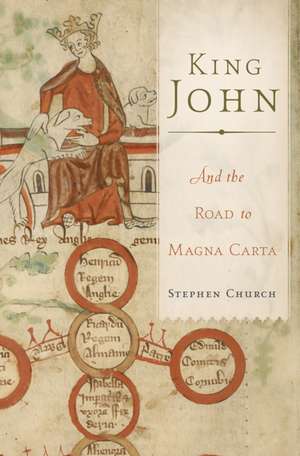
King John: And the Road to Magna Carta
Autor Stephen Churchen Limba Engleză Hardback – 6 apr 2015
Analiza conflictului de șase ani dintre suveran și papalitate pentru numirea Arhiepiscopului de Canterbury reprezintă un punct central în această biografie, oferind o perspectivă clară asupra modului în care autoritatea absolută a început să se fisureze. În King John, istoricul Stephen Church propune o reevaluare a uneia dintre cele mai controversate figuri ale monarhiei britanice, depășind stereotipurile literare pentru a expune mecanismele politice ale epocii. Remarcăm modul în care autorul leagă eșecurile militare de pe continent ale lui Ioan — pierderea posesiunilor din Franța moștenite de la părinții săi, Henric al II-lea și Eleanor de Aquitaine — de presiunea fiscală insuportabilă care a declanșat revolta baronilor.
Suntem de părere că volumul excelează în descrierea procesului prin care un conducător considerat inapt a devenit, paradoxal, catalizatorul pentru Magna Carta. Textul este structurat riguros, urmărind transformarea unei crize de legitimitate într-un moment de cotitură pentru istoria europeană: nașterea guvernanței bazate pe reguli și limitarea puterii regale. Notăm cu interes rigoarea cu care Stephen Church documentează manipulările politice ale lui Ioan, oferind un context vast care explică de ce ideile tradiționale de suveranitate necontrolată au încetat să mai fie acceptate de subiecții săi.
Lucrarea este comparabilă cu Magna Carta and the England of King John de Janet S. Loengard în ceea ce privește precizia istorică, dar este actualizată pentru a pune un accent mai mare pe biografia personală a regelui și pe modul în care temperamentul acestuia a influențat direct prăbușirea imperiului Angevin. Spre deosebire de abordările pur constituționale, Stephen Church reușește să integreze dinamica familială a Plantageneților în marea narațiune a democrației moderne.
Preț: 193.40 lei
Carte tipărită la comandă
Livrare economică 30 noiembrie-14 decembrie
Specificații
ISBN-10: 0465092993
Pagini: 328
Dimensiuni: 168 x 241 x 29 mm
Greutate: 0.5 kg
Editura: BASIC BOOKS
Colecția Basic Books
V-ar putea interesa
-
 Henry III (Penguin Monarchs)Stephen Church-21%Preț: 44.24 lei55.71 lei
 -
 -15%Preț: 134.87 lei157.94 lei
 -
 Preț: 187.50 lei
 -
 The Amorous Heart: An Unconventional History of LoveMarilyn Yalom-26%Preț: 116.28 lei156.71 lei
 -
 Robert the BruceRonald Mcnair ScottPreț: 127.58 lei
 -
 The Battle of DienbienphuJules RoyPreț: 231.47 lei
 -
 The Austrians: A Thousand-Year OdysseyGordon Brook-ShepherdPreț: 225.87 lei
 -
 Chasing Churchill: The Travels of Winston ChurchillCelia SandysPreț: 178.87 lei
 -
 -23%Preț: 824.84 lei1071.22 lei
 -
 Le Cri de la vérité, sur les causes de la révolution de 1815Jean FenouillotPreț: 95.05 lei
 -
 Preț: 146.26 lei
 -
 Campagnes de la Révolution française dans les Pyrénées-Orientales, 1793-1794-1795. Tome 1Joseph Napoléon FervelPreț: 170.07 lei
 -
 Le quinze novembreGeorges FéryPreț: 72.57 lei
 -
 De l'Espagne et des conséquences de l'intervention arméeJoseph FiévéePreț: 101.17 lei
 -
 Aux Espagnols, à propos de l'EspagneS. Filippi De FabjPreț: 78.95 lei
 -
 Notice sur le P. Jérôme NatalisHonoré FisquetPreț: 78.95 lei
 -
 Histoire du comte de Chambord (Henri de France)X. de FitjacPreț: 87.04 lei
 -
 Le cardinal Ximénès régent d'EspagneEsprit FléchierPreț: 130.50 lei
 -
 France et panslavismeProsper Fleury De VillecardetPreț: 72.57 lei
 -
 Roch Marcandier. Études révolutionnairesÉdouard FleuryPreț: 86.57 lei
 -
 Réponse à M. ThiersAlexandre FloriPreț: 79.38 lei
 -
 La France démocratiqueEugène FlotardPreț: 130.60 lei
 -
 Le Crédit territorial en France et la réforme hypothécaire.2e éditionVictor-Bénigne Flour de Saint-GenisPreț: 177.39 lei
 -
 De ce que coûtent les colonies à la FranceAlexandre FoignetPreț: 79.03 lei
 -
 Réflexions d'un prisonnier de guerreJacques Alfred FolloppePreț: 87.17 lei
 -
 La vérité sur la question archéologique de Cétobriga en PortugalEugène de FontainieuPreț: 78.95 lei
 -
 Preț: 79.50 lei
De ce să citești această carte
Această biografie este esențială pentru cei interesați de istoria politică a Europei și de originile democrației. Cititorul câștigă o înțelegere profundă a modului în care eșecurile administrative și militare ale unui singur monarh au forțat apariția Magna Carta. Este o recomandare certă pentru studenții la istorie și drept, oferind un studiu de caz fascinant despre limitele puterii suverane.
Despre autor
Stephen Church este un istoric medievist de renume, specializat în perioada Plantageneților și în istoria constituțională a Angliei. Expertiza sa se concentrează pe dinastia Angevină, fiind recunoscut pentru capacitatea de a extrage detalii biografice relevante din documente administrative complexe. În acest volum publicat de BASIC BOOKS, Church utilizează cercetările sale extinse pentru a oferi o imagine nuanțată a regelui Ioan, reușind să echilibreze rigoarea academică cu o narațiune accesibilă despre transformarea fundamentală a guvernării engleze în secolul al XIII-lea.
Notă biografică
Recenzii
"A thoughtful and suggestive book, instructive for anyone interested in comparative government and essential for students of early medieval England and France."—Weekly Standard
"A fair and rounded picture of the king and his reign."—Spectator (UK)
"Church presents an analysis of a king besieged by traditions, his French neighbors, and his own family. We learn to appreciate the circumstances that caused him to act as he did, but we also come to appreciate that this king's actions set the stage for American constitutional government."—Roanoke Times
"Church plumbs historical documents, such letters and treaties to recreate the up-and-down life of John. Luckily, like all rulers, John's reign had a bureaucracy, and bureaucracies run on paper. The portrait of the king is richer for the minutiae Church has mined from archives."—McClatchy
"Church dramatically relates the tragic twists of the king's fall in this story of power gone awry, with echoes that resonate in the present."—Publishers Weekly
"Highly recommended for anyone interested in medieval history or history in general."—
"Scholarly but readable... an insightful, likely definitive, biography."—Kirkus
"In a biography that ties together the year 1215, Magna Carta, and 'wicked' King John, Stephen Church vividly explains the dawn of democracy."—Robert Lacey, co-author of The Year 1000: What Life Was Like at the Turn of the First Millennium--An Englishman's World
"Stephen Church has written a romp through King John's life, full of surprising and intriguing details--even though John ends up as 'a catastrophic failure.'"—Terry Jones, director of Monty Python and the Holy Grail, Monty Python's Life of Brian, and Monty Python's The Meaning of Life, and author of Terry Jones' Medieval Lives and Who Murdered Chaucer: A Medieval History
"Riveting. A refreshingly multi-faceted look at the man who, inadvertently, gave us the Magna Carta, still a cornerstone of our democracy. Stephen Church's achievement is to look behind the baddie of many a Robin Hood story and find a ruler who didn't know he'd go down as the worst monarch in British history."—Sarah Gristwood, author of Blood Sisters: The Women Behind the Wars of the Roses