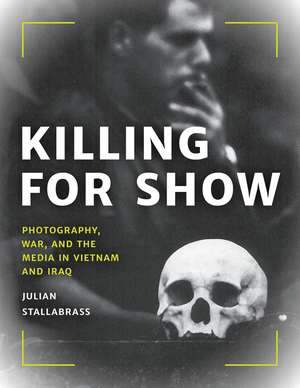
Killing for Show: Photography, War, and the Media in Vietnam and Iraq
Autor Julian Stallabrassen Limba Engleză Hardback – 30 oct 2020
In the autumn of 2014, the Royal Air Force released blurry video of a missile blowing up a pick-up truck which may have had a weapon attached to its flatbed. This was a lethal form of gesture politics: to send a £9-million bomber from Cyprus to Iraq and back, burning £35,000 an hour in fuel, to launch a smart missile costing £100,000 to destroy a truck or, rather, to create a video that shows it being destroyed. Some lives are ended-it is impossible to tell whose-so that the government can pretend that it taking effective action by creating a high-budget snuff movie. This is killing for show.
Since the Vietnam War the way we see conflict-through film, photographs, and pixels-has had a powerful impact on the political fortunes of the campaign, and the way that war has been conducted. In this fully illustrated and passionately argued account of war imagery, Julian Stallabrass tells the story of post-war conflict, how it was recorded and remembered through its iconic photography.
The relationship between war and photograph is constantly in transition, forming new perspectives, provoking new challenges: what is allowed to be seen? Does an image have the power to change political opinion? How are images used to wage war? Stallabrass shows how photographs have become a vital weapon in the modern war: as propaganda-from close-quarters fighting to the drone's electronic vision-as well as a witness to the barbarity of events such as the My Lai massacre, the violent suppression of insurgent Fallujah or the atrocities in Abu Ghraib.
Through these accounts Stallabrass maps a comprehensive theoretical re-evaluation of the relationship between war, politics and visual culture.
Killing for Show offers:
190 photographs encompassing photojournalism, artists' images, photographs by soldiers and amateurs and dronesA comprehensive comparison of the role of photography in the Vietnam and Iraq WarsAn explanation of the waning power of iconic images in collective memoryAn analysis of the failure of military PR and the public display of killingA focus on what can and cannot be seen, photographed and publishedAn exploration of the power and limits of amateur photographyArguments about how violent images act on democracy This full-color book is an essential volume in the history of warfare and photography
Preț: 402.14 lei
Preț vechi: 563.23 lei
-29%
Puncte Express: 603
Carte indisponibilă temporar
Doresc să fiu notificat când acest titlu va fi disponibil:
Se trimite...
Specificații
ISBN-13: 9781538141809
ISBN-10: 1538141809
Pagini: 336
Ilustrații: 187 colour photos; 1 table
Dimensiuni: 224 x 289 x 27 mm
Greutate: 1.23 kg
Editura: Bloomsbury Publishing
Colecția Rowman & Littlefield
Locul publicării:New York, United States
ISBN-10: 1538141809
Pagini: 336
Ilustrații: 187 colour photos; 1 table
Dimensiuni: 224 x 289 x 27 mm
Greutate: 1.23 kg
Editura: Bloomsbury Publishing
Colecția Rowman & Littlefield
Locul publicării:New York, United States
Cuprins
Acknowledgements
Preface
Illustrations: Full Captions and Credits
Brief Chronology
List of Abbreviations and Acronyms
Chapter 1. The War of Images
Part I. PR
Chapter 2: Operation Snapshot
Chapter 3: From Vietnam to Iraq
Chapter 4: The Triumph of PR
Chapter 5: The Enemy and the Press
Part II. Speed
Chapter 6: Photographic Acceleration
Chapter 7: Don't Show Me That
Chapter 8: The Look and Speed of War
Part III. Gulag
Chapter 9: Captives on Display
Chapter 10: Black Sites
Part IV. Murder
Chapter 11: Killing Regimes
Chapter 12: Depicting the Guilty
Chapter 13: Patterns of Killing in Iraq
Chapter 14: Circles of Invisibility
Part V. Amateurs
Chapter 15: Instamatic Terror
Chapter 16: Photographic Citizens
Part VI. Memory
Chapter 17: The Iconic Image and Modern Memory
Chapter 18: The Fading Icon in Iraq
Chapter 19: The Great Exception
Chapter 20: Fire and Forget
Part VII. Democracy
Chapter 21: Barbarity and Lies
Chapter 22: Repression and Resistance
Endnotes
Bibliography
Index
Preface
Illustrations: Full Captions and Credits
Brief Chronology
List of Abbreviations and Acronyms
Chapter 1. The War of Images
Part I. PR
Chapter 2: Operation Snapshot
Chapter 3: From Vietnam to Iraq
Chapter 4: The Triumph of PR
Chapter 5: The Enemy and the Press
Part II. Speed
Chapter 6: Photographic Acceleration
Chapter 7: Don't Show Me That
Chapter 8: The Look and Speed of War
Part III. Gulag
Chapter 9: Captives on Display
Chapter 10: Black Sites
Part IV. Murder
Chapter 11: Killing Regimes
Chapter 12: Depicting the Guilty
Chapter 13: Patterns of Killing in Iraq
Chapter 14: Circles of Invisibility
Part V. Amateurs
Chapter 15: Instamatic Terror
Chapter 16: Photographic Citizens
Part VI. Memory
Chapter 17: The Iconic Image and Modern Memory
Chapter 18: The Fading Icon in Iraq
Chapter 19: The Great Exception
Chapter 20: Fire and Forget
Part VII. Democracy
Chapter 21: Barbarity and Lies
Chapter 22: Repression and Resistance
Endnotes
Bibliography
Index
Recenzii
Killing for Show is an urgent contribution to photographic and war history. Drawing together the barbarous histories of America's wars in Vietnam and Iraq through an unflinching analysis of the photographic images they produced (and those they didn't), Stallabrass manages the exceptional feat of writing reasonably and perceptively about a catalogue of mindless cruelty. His incisive readings of a vast, and largely neglected, archive of photographs underpins a persuasive and chilling account of how images of war are used to wage war. Arguing that to resist the ever-expanding reach of our militarism of the image requires a detailed understanding of how killing and showing (and not-showing) interact, Stallabrass provides an agile and uncompromising model of activist looking.
A huge achievement, equal to the subject. This illuminating book recognises the full diversity of photographic material to emerge from the conflicts and provides a more balanced account than any previously available. As a guide to these terrible events, Stallabrass is consistently attentive, judicious, and humane. There are memorable discussions of everything from the formal qualities of North Vietnamese photography to the politics and aesthetics of amateur photography in Iraq.
In this incisive and insightful examination of the role of visual culture in the depiction of war and violence in the late twentieth and early twenty-first century, Stallabrass delivers a devastating critique of the various ways in which photography is implicated, consciously or not, in the neo-imperial machinations of America and its allies. He draws out the crucial similarities and connections but also the significant differences in how American administrations attempted to manipulate and control the media in the conflicts in Vietnam and South East Asia and those in Iraq and the Middle East as 'force multipliers' to enhance their combat capabilities into the wider geopolitical arena and to try to garner support domestically. But he also explores how dissenting voices of independent photographers, artists and citizen journalists have found cracks in the armour of the monolith of state power, and the vital role that these alternative viewpoints play in defending the core values of civic society.
Julian Stallabrass's lucid and quietly angry publication.traces complex forms of power and counter-power across the two major US wars of the past half-century.. This book builds on years of work to offer a complex and nuanced historical understanding of its subjects.
Julian Stallabrass's Killing for Show is an exacting, meticulous encyclopedia of war photography. Spanning the decades of the Vietnam War and the so-called War on Terror, the book is a gruesomely detailed analysis of war photography's double act: both as art and testimony, subject to aesthetic as well as-at least potentially-ethical evaluation. The range of examples covered is breathtaking. It includes the most varied types of photography, from Magnum-type shots to propaganda items, memes and amateur pictures, from leaked footage to pr releases, from embedded collaborator to partisan perspective. It catalogues its developments as a series of relentless horrors hoping for moments of redemption-which remain few and far between.
In the main Stallabrass does what he sets out to do: to show how images are woven into the very fabric of war and the institutions that support it[.]
A huge achievement, equal to the subject. This illuminating book recognises the full diversity of photographic material to emerge from the conflicts and provides a more balanced account than any previously available. As a guide to these terrible events, Stallabrass is consistently attentive, judicious, and humane. There are memorable discussions of everything from the formal qualities of North Vietnamese photography to the politics and aesthetics of amateur photography in Iraq.
In this incisive and insightful examination of the role of visual culture in the depiction of war and violence in the late twentieth and early twenty-first century, Stallabrass delivers a devastating critique of the various ways in which photography is implicated, consciously or not, in the neo-imperial machinations of America and its allies. He draws out the crucial similarities and connections but also the significant differences in how American administrations attempted to manipulate and control the media in the conflicts in Vietnam and South East Asia and those in Iraq and the Middle East as 'force multipliers' to enhance their combat capabilities into the wider geopolitical arena and to try to garner support domestically. But he also explores how dissenting voices of independent photographers, artists and citizen journalists have found cracks in the armour of the monolith of state power, and the vital role that these alternative viewpoints play in defending the core values of civic society.
Julian Stallabrass's lucid and quietly angry publication.traces complex forms of power and counter-power across the two major US wars of the past half-century.. This book builds on years of work to offer a complex and nuanced historical understanding of its subjects.
Julian Stallabrass's Killing for Show is an exacting, meticulous encyclopedia of war photography. Spanning the decades of the Vietnam War and the so-called War on Terror, the book is a gruesomely detailed analysis of war photography's double act: both as art and testimony, subject to aesthetic as well as-at least potentially-ethical evaluation. The range of examples covered is breathtaking. It includes the most varied types of photography, from Magnum-type shots to propaganda items, memes and amateur pictures, from leaked footage to pr releases, from embedded collaborator to partisan perspective. It catalogues its developments as a series of relentless horrors hoping for moments of redemption-which remain few and far between.
In the main Stallabrass does what he sets out to do: to show how images are woven into the very fabric of war and the institutions that support it[.]