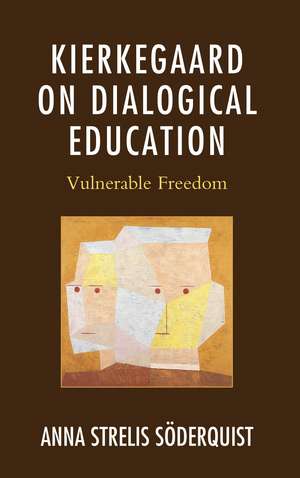
Kierkegaard on Dialogical Education: Vulnerable Freedom
Autor Anna Strelis Soderquisten Limba Engleză Hardback – 14 iul 2016
Kierkegaard's method, in both form and content, hinges upon the narrativity of human experience. No human being is immune to the seductive force of stories. Kierkegaard recognizes the power of a story to captivate and to change us, to empower and to humble us, and he makes use of them as formative teachers with whom we enter into dialogue. Through its examination of indirect formation in Kierkegaard through poetry and storytelling, Kierkegaard on Dialogical Education explores the reaches and limits of narrative imagination and inquires into the dialogical and narrative struggle inherent in the formation of identity.
This book will be of interest to philosophers and educators, as well as those who meet at the crossroads of philosophy, education, and art.
Preț: 529.87 lei
Preț vechi: 768.25 lei
-31%
Puncte Express: 795
Carte tipărită la comandă
Livrare economică 07-21 decembrie
Livrare prin curier în România Termenul estimat este afișat lângă disponibilitate.
Transport gratuit pentru acest produs Plată online sau ramburs, în funcție de opțiunile comenzii.
Retur gratuit în 14 zile Comandă securizată și suport în română.
Specificații
ISBN-13: 9781498533775
ISBN-10: 1498533779
Pagini: 180
Dimensiuni: 161 x 233 x 19 mm
Greutate: 0.43 kg
Editura: Bloomsbury Publishing
Colecția Lexington Books
Locul publicării:New York, United States
ISBN-10: 1498533779
Pagini: 180
Dimensiuni: 161 x 233 x 19 mm
Greutate: 0.43 kg
Editura: Bloomsbury Publishing
Colecția Lexington Books
Locul publicării:New York, United States
Cuprins
Introduction
1. Narrativity
2. Personality
3. Capability
4. Receptivity
5. Grace
Conclusion: The Case of Children
1. Narrativity
2. Personality
3. Capability
4. Receptivity
5. Grace
Conclusion: The Case of Children
Recenzii
In her book Kierkegaard on Dialogical Education, Anna Strelis Söderquist takes a different route. She turns to a philosopher, Søren Kierkegaard, and explores the weltanschauung-worldviews, ways, and views of life-that emerge through a close reading of his work. She turns both to his published works, most of which were published pseudonymously, and to his journals and other unpublished texts. This gives a sense of intimacy to the encounter with Kierkegaard's thought, which is a fertile route into a way of thinking that proceeds from the idea that the individual cannot be understood from the outside, as an object of study, but rather must be studied from the inside. By entering into the thought of Kierkegaard from the inside, by trying to see the world with his eyes or his words, Strelis Söderquist creates a pedagogical world of thought. We encounter Kierkegaard's texts in close contact with his life, and, in that encounter, a pedagogy emerges. Pedagogy, or a pedagogical reading, creates new conditions for understanding Kierkegaard's philosophy as much as his philosophy sheds light on pedagogical issues.
Freedom, anxiety, and possibility were key terms in existentialism's account of being human.
But where the existentialists saw such categories as entwined with the necessarily godless and
self-assertive character of human life, this new study by Anna Strelis Söderquist offers a more
complex, subtle, and ultimately persuasive view. As she tells the tale, these categories are used
by Kierkegaard as integral elements in the process by which we come to ourselves through a
humble and courageous readiness that involves openness to the other that is essentially dialogical.
A Kierkegaardian education therefore leads not (as many have thought) to isolation and despair,
but to a realistic and vulnerable, yet hopeful, self-knowledge and self-commitment.
Though not concentrated in any particular text, Kierkegaard's writings are rife with
reflections on the philosophy of education. In a book as rigorously argued as it is creative,
Anna Strelis Söderquist deftly presents Kierkegaard as educator, but much more than that,
she generates beguiling possibilities for applying Kierkegaard's pedagogical prescriptions.
Kierkegaard was hard to please, but I am sure that this is one interpretation of his work that
he would have smiled upon.
Freedom, anxiety, and possibility were key terms in existentialism's account of being human.
But where the existentialists saw such categories as entwined with the necessarily godless and
self-assertive character of human life, this new study by Anna Strelis Söderquist offers a more
complex, subtle, and ultimately persuasive view. As she tells the tale, these categories are used
by Kierkegaard as integral elements in the process by which we come to ourselves through a
humble and courageous readiness that involves openness to the other that is essentially dialogical.
A Kierkegaardian education therefore leads not (as many have thought) to isolation and despair,
but to a realistic and vulnerable, yet hopeful, self-knowledge and self-commitment.
Though not concentrated in any particular text, Kierkegaard's writings are rife with
reflections on the philosophy of education. In a book as rigorously argued as it is creative,
Anna Strelis Söderquist deftly presents Kierkegaard as educator, but much more than that,
she generates beguiling possibilities for applying Kierkegaard's pedagogical prescriptions.
Kierkegaard was hard to please, but I am sure that this is one interpretation of his work that
he would have smiled upon.