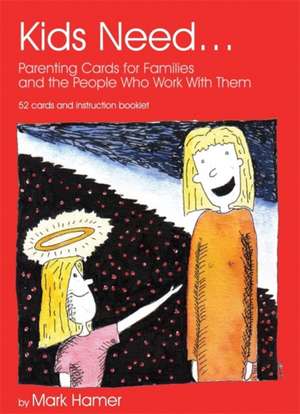
Kids Need...: Parenting Cards for Families and the People who Work With Them
Autor Mark Hameren Limba Engleză Cards – 15 dec 2007
The cards encourage participants to raise general discussions and can be used as part of a therapeutic tool or as an assessment of parenting skills.'
- ChildRight
What is the difference between children's 'needs' and 'wants'? How should parents respond to the demands of their children? Do all children need the same things?
Kids Need... cards present a creative approach to exploring children's needs and parents' knowledge. Each card features a child's 'need', for example 'a room of their own', 'pocket money', 'to make mistakes' or 'to be criticized', and participants are invited to place cards under one of the three header cards: 'Kids Need', 'Kids Sometimes Need' and 'Kids Don't Need'. The cards are designed to be flexible and adaptable, and can be used to encourage general discussions, as therapeutic tool, or as an aid to the assessment of parenting skills.
Kids Need... is a fun, accessible and effective game that will be particularly useful to professionals working with parents and families, including social care workers, counsellors and educators.
Preț: 166.99 lei
Preț vechi: 215.92 lei
-23%
Puncte Express: 250
Disponibil
Livrare economică 17 noiembrie-01 decembrie
Livrare express 31 octombrie-06 noiembrie pentru 72.03 lei
Livrare prin curier în România Termenul estimat este afișat lângă disponibilitate.
Transport gratuit de la 400.00 lei Plată online sau ramburs, în funcție de opțiunile comenzii.
Retur gratuit în 14 zile Comandă securizată și suport în română.
Specificații
ISBN-13: 9781843105244
ISBN-10: 1843105241
Pagini: 64
Dimensiuni: 102 x 138 x 28 mm
Greutate: 0.29 kg
Ediția:CRDS
Editura: JESSICA KINGSLEY PUBLISHERS
Colecția Jessica Kingsley Publishers
Locul publicării:London, United Kingdom
ISBN-10: 1843105241
Pagini: 64
Dimensiuni: 102 x 138 x 28 mm
Greutate: 0.29 kg
Ediția:CRDS
Editura: JESSICA KINGSLEY PUBLISHERS
Colecția Jessica Kingsley Publishers
Locul publicării:London, United Kingdom
V-ar putea interesa
-
 Toddlers Made Easy: Become the Parent Every Child NeedsDr Cathryn Tobin-17%Preț: 91.12 lei109.87 lei
 -
 A Kids Book About Social WorkersTimisha K Wilson-17%Preț: 79.28 lei95.44 lei
 -
 Preț: 97.69 lei
 -
 -8%Preț: 440.19 lei478.47 lei
 -
 Understanding Your Child Beyond Words: Psychoanalytic Techniques for ParentsCayetano Garcia-Castrillón ArmengouPreț: 228.06 lei
 -
 Super DIY Card Kit: Many Thanks!Bianca GottesmanPreț: 96.74 lei
 -
 Preț: 235.48 lei
 -
 -19%Preț: 119.61 lei147.40 lei
 -
 Preț: 173.82 lei
 -
 Therapeutic Parenting Jumbo CardsSarah NaishPreț: 170.76 lei
 -
 A Therapeutic Treasure Deck of Strengths and Self-Esteem CardsDr. Karen Treisman-5%Preț: 186.73 lei196.55 lei
 -
 -23%Preț: 228.12 lei297.20 lei
 -
 All About Neurodiversity: The Card DeckKathy HoopmannPreț: 239.17 lei
 -
 -21%Preț: 129.32 lei163.10 lei
 -
 -19%Preț: 125.86 lei155.89 lei
 -
 The Parents’ and Professionals’ Simple Guide to PDALaura KerbeyPreț: 94.02 lei
 -
 Parent Yourself FirstBryana KappadakunnelPreț: 121.63 lei
 -
 Conversations That MatterMargot SunderlandPreț: 248.07 lei
 -
 Preț: 144.20 lei
Recenzii
Kids Need... is a simple and creative approach to exploring children's needs and parents' understanding and we will be recommending this to other colleagues working with families. We found it was a non-threatening way to explore parent's perceptions without patronising them and opened some honest dialogue. It can be used across a lot of different presenting issues such as therapeutic work, family support and assessment, when working with adults, children and young people, individually or in groups. The graphics are relevant and humorous and the resources can be adapted in lots of different ways, the only limit is your imagination!.
Altogether a simple yet effective tool for practitioners and highly recommended.
Playing this game with my daughter, I was amazed at how much discussion it generated between us. They were easy to use, and the use of pictures and symbols mean they are user friendly to parents with literacy difficulties or for whom English is not their first language. Not only do they give the opportunity to open up discussion and explore feelings, they also give the practicitioner an understanding of what parents understanding of their child's needs are, in order to facilitate client-generated changes to behaviour. Sessions of 40 minutes to two hours are recommended, and the benefits easily justify the initial time spent. This is a good value tool to support preventative and supportive public health work.
Altogether a simple yet effective tool for practitioners and highly recommended.
Playing this game with my daughter, I was amazed at how much discussion it generated between us. They were easy to use, and the use of pictures and symbols mean they are user friendly to parents with literacy difficulties or for whom English is not their first language. Not only do they give the opportunity to open up discussion and explore feelings, they also give the practicitioner an understanding of what parents understanding of their child's needs are, in order to facilitate client-generated changes to behaviour. Sessions of 40 minutes to two hours are recommended, and the benefits easily justify the initial time spent. This is a good value tool to support preventative and supportive public health work.
Cuprins
(Instruction booklet): Introduction. Who can use them? Why use cards? Using the Cards. Recording the session. Solution-focused communication. A therapeutic tool. Cognitive dissonance. An assessment tool. Analysis and planning. How do the cards fit in with the Assessment Framework? The difference between saying and doing. It all adds up. Working with children and young people. Working with individuals and groups. More ideas. Ending the session. How long does it take. The Author. Acknowledgements. Useful Reading.