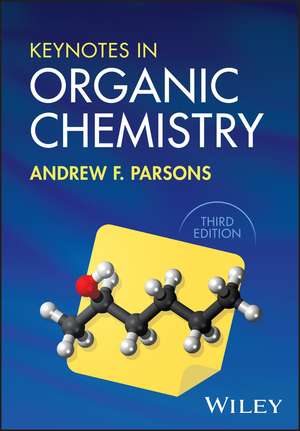
Keynotes in Organic Chemistry
Autor Andrew F. Parsonsen Limba Engleză Paperback – 3 dec 2026
Modular chemistry curricula demand focused texts that distil organic chemistry to its key principles without sacrificing rigour. Now in its Third Edition, Keynotes in Organic Chemistry delivers an authoritative, visually driven treatment of fundamental concepts and functional group chemistry. The material introduces core principles early and builds systematically, enabling rapid assimilation and reliable recall of critical information throughout undergraduate study.
New to this edition are full-colour figures, extra margin notes linking related topics, additional hints and worked examples, and end-of-chapter multiple choice problems with answers for self-assessment. Links to practical laboratory techniques ground theoretical understanding in the structural characterization of organic compounds. A companion website supplies further practice problems, worked solutions, and revision summaries supporting exam preparation across all major topics.
Readers will also find:
- A structure designed for rapid access to key facts, definitions, and reaction mechanisms across all core functional groups
- Graphical presentation throughout that aids visual learners in assimilating and retaining complex reaction pathways and stereochemical concepts
- New margin notes highlighting connections between topics to reinforce understanding of recurring themes
- Online revision summaries paired with additional worked solutions offering targeted support for exam study and self-directed review
- Coverage organized to complement detailed standard texts, providing a focused alternative for efficient concept review and revision
- New synoptic problems bridge chemical knowledge and its integrated application in real-world research.
Preț: 360.26 lei
Precomandă
Carte nepublicată încă
Specificații
Notă biografică
Cuprins
About the author xi
Preface xiii
A roadmap for using this book xv
1 Structure and bonding 1
1.1 Ionic versus covalent bonds 1
1.2 The octet rule 2
1.3 Formal charge 3
1.4 Sigma (¿) and pi (¿) bonds 3
1.5 Hybridisation 4
1.6 Inductive effects, hyperconjugation and mesomeric effects 7
1.7 Acidity and basicity 10
1.8 Summary 17
2 Functional groups, nomenclature and drawing organic compounds 25
2.1 Functional groups 25
2.2 Alkyl and aryl groups 26
2.3 Alkyl substitution 27
2.4 Naming carbon chains 27
2.5 Drawing organic structures 31
2.6 Summary 32
3 Stereochemistry 37
3.1 Isomerism 37
3.2 Conformational isomers 38
3.3 Configurational isomers 42
3.4 Summary 51
4 Reactivity and mechanism 59
4.1 Reactive intermediates: ions versus radicals 59
4.2 Nucleophiles and electrophiles 61
4.3 Carbocations, carbanions and carbon radicals 64
4.4 Steric effects 66
4.5 Oxidation levels 67
4.6 General types of reaction 68
4.7 Ions versus radicals 71
4.8 Reaction selectivity 72
4.9 Reaction thermodynamics and kinetics 74
4.10 Orbital overlap and energy 82
4.11 Guidelines for drawing reaction mechanisms 84
4.12 Summary 86
5 Halogenoalkanes 97
5.1 Structure 97
5.2 Preparation 98
5.3 Reactions 103
5.4 Summary 121
6 Alkenes and alkynes 129
6.1 Structure 129
6.2 Alkenes 131
6.3 Alkynes 150
6.4 Summary 153
7 Benzenes 161
7.1 Structure 161
7.2 Reactions 162
7.3 Reactivity of substituted benzenes 169
7.4 Nucleophilic aromatic substitution (the SNAr mechanism) 173
7.5 The formation of benzyne 174
7.6 Transformation of side chains 175
7.7 Reduction of the benzene ring 178
7.8 The synthesis of substituted benzenes 179
7.9 Electrophilic substitution of naphthalene 183
7.10 Electrophilic substitution of pyridine 183
7.11 Electrophilic substitution of pyrrole, furan and thiophene 183
7.12 Summary 184
8 Carbonyl compounds: Aldehydes and ketones 193
8.1 Structure 193
8.2 Reactivity 194
8.3 Nucleophilic addition reactions 196
8.4 ¿-Substitution reactions 214
8.5 Carbonyl-Carbonyl condensation reactions 219
8.6 Summary 226
9 Carbonyl compounds: Carboxylic acids and derivatives 233
9.1 Structure 233
9.2 Reactivity 234
9.3 Nucleophilic acyl substitution reactions 236
9.4 Nucleophilic substitution reactions of carboxylic acids 238
9.5 Nucleophilic substitution reactions of acyl (acid) chlorides 240
9.6 Nucleophilic substitution reactions of acid anhydrides 242
9.7 Nucleophilic substitution reactions of esters 244
9.8 Nucleophilic substitution and reduction reactions of amides 246
9.9 Nucleophilic addition reactions of nitriles 248
9.10 ¿-Substitution reactions of carboxylic acids 249
9.11 Carbonyl-Carbonyl condensation reactions 250
9.12 A summary of carbonyl reactivity 253
9.13 Summary 255
10 Spectroscopy 265
10.1 Mass spectrometry 265
10.2 The electromagnetic spectrum 272
10.3 UV spectroscopy 272
10.4 IR spectroscopy 275
10.5 NMR spectroscopy 279
10.6 Summary 292
11 Natural products and synthetic polymers 301
11.1 Carbohydrates 301
11.2 Lipids 306
11.3 Amino acids, peptides and proteins 308
11.4 Nucleic acids 315
11.5 Synthetic polymers 318
11.6 Summary 325
12 Synoptic problems 333
12.1 Tips for tackling synoptic problems 333
12.2 The synthesis of cetirizine 334
12.3 The biosynthesis of limonene 335
12.4 Retrosynthetic analysis and paracetamol synthesis 336
12.5 Green industrial synthesis of ibuprofen via the BHC process 337
12.6 Using a chiral auxiliary in the enantioselective synthesis of (+)-fislatifolione 338
12.7 Answers 340
Appendix 1: Bond dissociation enthalpies 351
Appendix 2: Bond lengths 353
Appendix 3: Approximate pKa values (relative to water) 355
Appendix 4: Useful abbreviations 357
Appendix 5: Infrared absorptions 361
Appendix 6: Approximate NMR chemical shifts 363
Appendix 7: Key reactions of major functional groups 367
Appendix 8: Glossary 373
Further reading 389
Outline answers 391
Index 429