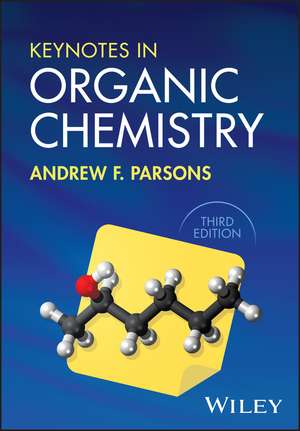
Keynotes in Organic Chemistry
Autor Andrew F. Parsonsen Limba Engleză Paperback – 26 noi 2026
Modular chemistry curricula demand focused texts that distil organic chemistry to its key principles without sacrificing rigour. Now in its Third Edition, Keynotes in Organic Chemistry delivers an authoritative, visually driven treatment of fundamental concepts and functional group chemistry. The material introduces core principles early and builds systematically, enabling rapid assimilation and reliable recall of critical information throughout undergraduate study.
New to this edition are full-colour figures, extra margin notes linking related topics, additional hints and worked examples, and end-of-chapter multiple choice problems with answers for self-assessment. Links to practical laboratory techniques ground theoretical understanding in the structural characterization of organic compounds. A companion website supplies further practice problems, worked solutions, and revision summaries supporting exam preparation across all major topics.
Readers will also find:
- A structure designed for rapid access to key facts, definitions, and reaction mechanisms across all core functional groups
- Graphical presentation throughout that aids visual learners in assimilating and retaining complex reaction pathways and stereochemical concepts
- New margin notes highlighting connections between topics to reinforce understanding of recurring themes
- Online revision summaries paired with additional worked solutions offering targeted support for exam study and self-directed review
- Coverage organized to complement detailed standard texts, providing a focused alternative for efficient concept review and revision
- New synoptic problems bridge chemical knowledge and its integrated application in real-world research.
Preț: 352.59 lei
Precomandă
Puncte Express: 529
Carte nepublicată încă
Livrare prin curier în România Precomanda se expediază când titlul devine disponibil.
Transport gratuit de la 400.00 lei Plată online sau ramburs, în funcție de opțiunile comenzii.
Retur gratuit în 14 zile Comandă securizată și suport în română.
Doresc să fiu notificat când acest titlu va fi disponibil:
Se trimite...
Specificații
ISBN-13: 9781394340071
ISBN-10: 1394340079
Pagini: 352
Ediția:3. Auflage
Editura: John Wiley & Sons, Inc.
ISBN-10: 1394340079
Pagini: 352
Ediția:3. Auflage
Editura: John Wiley & Sons, Inc.
Notă biografică
Andrew F. Parsons is professor of organic chemistry at the University of York. A National Teaching Fellow and Senior Fellow of the Higher Education Academy, he received the Royal Society of Chemistry Horizon Prize in 2021 and the RSC higher education teaching award. He is also academic author of York 's MOOC 'Exploring Everyday Chemistry,' with over 31,000 enrolments, and served as the 2025-26 editor of the A-level magazine 'Chemistry Review'.
Cuprins
Preface
Statement on Use of AI
Chapter 1. Structure and Bonding
1.1 Ionic versus covalent bonds
1.2 The octet rule
1.3 Formal charge
1.4 Sigma (s-) and pi (¿-) bonds
1.5 Hybridisation
1.6 Inductive effects, hyperconjugation and mesomeric effects
1.7 Acidity and basicity
Chapter 2. Functional Groups, Nomenclature and Drawing Organic Compounds
2.1 Functional groups
2.2 Alkyl and aryl groups
2.3 Alkyl substitution
2.4 Naming carbon chains
2.5 Drawing organic structures
Chapter 3. Stereochemistry
3.1 Isomerism
3.2 Conformational isomers
3.3 Configurational isomers
Chapter 4. Reactivity and Mechanism
4.1 Reactive intermediates: ions versus radicals
4.2 Nucleophiles and electrophiles
4.3 Carbocations, carbanions and carbon radicals
4.4 Steric effects
4.5 Oxidation levels
4.6 General types of reaction
4.7 Ions versus radicals
4.8 Reaction selectivity
4.9 Reaction thermodynamics and kinetics
4.10 Orbital overlap and energy
4.11 Guidelines for drawing reaction mechanisms
Chapter 5. Halogenoalkanes
5.1 Structure
5.2 Preparation
5.3 Reactions
Chapter 6. Alkenes and Alkynes
6.1 Structure
6.2 Alkenes
6.3 Alkynes
Chapter 7. Benzenes
7.1 Structure
7.2 Reactions
7.3 Reactivity of substituted benzenes
7.4 Nucleophilic aromatic substitution (the SNAr mechanism)
7.5 The formation of benzyne
7.6 Transformation of side chains
7.7 Reduction of the benzene ring
7.8 The synthesis of substituted benzenes
7.9 Electrophilic substitution of naphthalene
7.10 Electrophilic substitution of pyridine
7.11 Electrophilic substitution of pyrrole, furan and thiophene
Chapter 8. Carbonyl Compounds: Aldehydes and Ketones
8.1 Structure
8.2 Reactivity
8.3 Nucleophilic addition reactions
8.4 a-Substitution reactions
8.5 Carbonyl-carbonyl condensation reactions
Chapter 9. Carbonyl Compounds: Carboxylic Acids and Derivatives
9.1 Structure
9.2 Reactivity
9.3 Nucleophilic acyl substitution reactions
9.4 Nucleophilic substitution reactions of carboxylic acids
9.5 Nucleophilic substitution reactions of acyl (acid) chlorides
9.6 Nucleophilic substitution reactions of acid anhydrides
9.7 Nucleophilic substitution reactions of esters
9.8 Nucleophilic substitution and reduction reactions of amides
9.9 Nucleophilic addition reactions of nitriles
9.10 a-Substitution reactions of carboxylic acids
9.11 Carbonyl-carbonyl condensation reactions
9.12 A summary of carbonyl reactivity
Chapter 10. Spectroscopy
10.1 Mass spectrometry (MS)
10.2 The electromagnetic spectrum
10.3 Ultraviolet (UV) spectroscopy
10.4 Infrared (IR) spectroscopy
10.5 Nuclear magnetic resonance (NMR) spectroscopy
Chapter 11. Natural Products and Synthetic Polymers
11.1 Carbohydrates
11.2 Lipids
11.3 Amino acids, peptides and proteins
11.4 Nucleic acids
11.5 Synthetic polymers
Chapter 12. Synoptic Problems
12.1 Tips for tackling synoptic problems
12.2 The synthesis of cetirizine
12.3 The biosynthesis of limonene
12.4 Retrosynthetic analysis and paracetamol synthesis
12.5 Green industrial synthesis of ibuprofen via the BHC process
12.6 Using a chiral auxiliary in the enantioselective synthesis of (+)-fislatifolione
Outline Answers
Further Reading
Appendix 1. Bond dissociation enthalpies
Appendix 2. Bond lengths
Appendix 3. Approximate pKa values (relative to water)
Appendix 4. Useful abbreviations
Appendix 5. Infrared absorptions
Appendix 6. Approximate NMR chemical shifts
Appendix 7. Key reactions of major functional groups
Appendix 8. Glossary
Index
Statement on Use of AI
Chapter 1. Structure and Bonding
1.1 Ionic versus covalent bonds
1.2 The octet rule
1.3 Formal charge
1.4 Sigma (s-) and pi (¿-) bonds
1.5 Hybridisation
1.6 Inductive effects, hyperconjugation and mesomeric effects
1.7 Acidity and basicity
Chapter 2. Functional Groups, Nomenclature and Drawing Organic Compounds
2.1 Functional groups
2.2 Alkyl and aryl groups
2.3 Alkyl substitution
2.4 Naming carbon chains
2.5 Drawing organic structures
Chapter 3. Stereochemistry
3.1 Isomerism
3.2 Conformational isomers
3.3 Configurational isomers
Chapter 4. Reactivity and Mechanism
4.1 Reactive intermediates: ions versus radicals
4.2 Nucleophiles and electrophiles
4.3 Carbocations, carbanions and carbon radicals
4.4 Steric effects
4.5 Oxidation levels
4.6 General types of reaction
4.7 Ions versus radicals
4.8 Reaction selectivity
4.9 Reaction thermodynamics and kinetics
4.10 Orbital overlap and energy
4.11 Guidelines for drawing reaction mechanisms
Chapter 5. Halogenoalkanes
5.1 Structure
5.2 Preparation
5.3 Reactions
Chapter 6. Alkenes and Alkynes
6.1 Structure
6.2 Alkenes
6.3 Alkynes
Chapter 7. Benzenes
7.1 Structure
7.2 Reactions
7.3 Reactivity of substituted benzenes
7.4 Nucleophilic aromatic substitution (the SNAr mechanism)
7.5 The formation of benzyne
7.6 Transformation of side chains
7.7 Reduction of the benzene ring
7.8 The synthesis of substituted benzenes
7.9 Electrophilic substitution of naphthalene
7.10 Electrophilic substitution of pyridine
7.11 Electrophilic substitution of pyrrole, furan and thiophene
Chapter 8. Carbonyl Compounds: Aldehydes and Ketones
8.1 Structure
8.2 Reactivity
8.3 Nucleophilic addition reactions
8.4 a-Substitution reactions
8.5 Carbonyl-carbonyl condensation reactions
Chapter 9. Carbonyl Compounds: Carboxylic Acids and Derivatives
9.1 Structure
9.2 Reactivity
9.3 Nucleophilic acyl substitution reactions
9.4 Nucleophilic substitution reactions of carboxylic acids
9.5 Nucleophilic substitution reactions of acyl (acid) chlorides
9.6 Nucleophilic substitution reactions of acid anhydrides
9.7 Nucleophilic substitution reactions of esters
9.8 Nucleophilic substitution and reduction reactions of amides
9.9 Nucleophilic addition reactions of nitriles
9.10 a-Substitution reactions of carboxylic acids
9.11 Carbonyl-carbonyl condensation reactions
9.12 A summary of carbonyl reactivity
Chapter 10. Spectroscopy
10.1 Mass spectrometry (MS)
10.2 The electromagnetic spectrum
10.3 Ultraviolet (UV) spectroscopy
10.4 Infrared (IR) spectroscopy
10.5 Nuclear magnetic resonance (NMR) spectroscopy
Chapter 11. Natural Products and Synthetic Polymers
11.1 Carbohydrates
11.2 Lipids
11.3 Amino acids, peptides and proteins
11.4 Nucleic acids
11.5 Synthetic polymers
Chapter 12. Synoptic Problems
12.1 Tips for tackling synoptic problems
12.2 The synthesis of cetirizine
12.3 The biosynthesis of limonene
12.4 Retrosynthetic analysis and paracetamol synthesis
12.5 Green industrial synthesis of ibuprofen via the BHC process
12.6 Using a chiral auxiliary in the enantioselective synthesis of (+)-fislatifolione
Outline Answers
Further Reading
Appendix 1. Bond dissociation enthalpies
Appendix 2. Bond lengths
Appendix 3. Approximate pKa values (relative to water)
Appendix 4. Useful abbreviations
Appendix 5. Infrared absorptions
Appendix 6. Approximate NMR chemical shifts
Appendix 7. Key reactions of major functional groups
Appendix 8. Glossary
Index