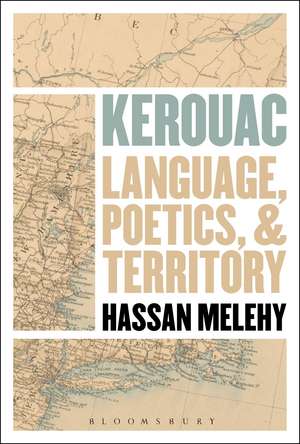
Kerouac: Language, Poetics, and Territory
Autor Professor Hassan Melehyen Limba Engleză Paperback – 21 sep 2017
Of the more than twenty-five biographies of Kerouac, few have seriously examined his relationship to the French language and the reason for his bilingualism, the Québec Diaspora. Although this background has long been recognized in French-language treatments, it is a new dimension in Anglophone studies of his writing. In a theoretically informed discussion, Hassan Melehy explores how Kerouac's poetics of exile involves meditations on moving between territories and languages. Far from being a naïve pursuit, Kerouac's writing practice not only responded but contributed to some of the major aesthetic and philosophical currents of the twentieth century in which notions such as otherness and nomadism took shape. Kerouac: Language, Poetics, and Territory offers a major reassessment of a writer who, despite a readership that extends over much of the globe, remains poorly appreciated at home.
Preț: 257.65 lei
Preț vechi: 305.93 lei
-16%
Puncte Express: 386
Carte tipărită la comandă
Livrare economică 07-21 decembrie
Livrare prin curier în România Termenul estimat este afișat lângă disponibilitate.
Transport gratuit de la 400.00 lei Plată online sau ramburs, în funcție de opțiunile comenzii.
Retur gratuit în 14 zile Comandă securizată și suport în română.
Specificații
ISBN-13: 9781501336065
ISBN-10: 1501336061
Pagini: 272
Dimensiuni: 148 x 226 x 18 mm
Greutate: 0.4 kg
Ediția:NIPPOD
Editura: Bloomsbury Publishing
Colecția Bloomsbury Academic
Locul publicării:New York, United States
ISBN-10: 1501336061
Pagini: 272
Dimensiuni: 148 x 226 x 18 mm
Greutate: 0.4 kg
Ediția:NIPPOD
Editura: Bloomsbury Publishing
Colecția Bloomsbury Academic
Locul publicării:New York, United States
V-ar putea interesa
-
 Every Book Its ReaderNicholas A BasbanesPreț: 114.42 lei
 -
 Latin American Mystery Writers: An A-To-Z GuideDarrell B. Lockhart-45%Preț: 279.02 lei507.17 lei
 -
 The Complete Guide to Middle-EarthRobert FosterPreț: 129.60 lei
 -
 -15%Preț: 508.07 lei597.72 lei
 -
 The GothicDavid PunterPreț: 300.00 lei
 -
 Jonathan Franzen: The Comedy of RageProfessor Philip Weinstein-45%Preț: 90.07 lei163.16 lei
 -
 The Heirs of Anthony BoucherMarvin LachmanPreț: 80.46 lei
 -
 The Essential Mystery Lists (2007 Ed.)Roger M SobinPreț: 113.02 lei
 -
 Preț: 282.06 lei
 -
 The Business of BooksAndre SchiffrinPreț: 113.63 lei
 -
 -8%Preț: 582.66 lei633.32 lei
Cuprins
Introduction: Kerouac, Exile, and the Force of Literature
1. Unsettlements
2. On and Off the Franco-American Road
3. Writing in Real Time
4. Movements of Return
5. The Roots of Abandonment
Conclusion: Transnational American Literatures
Bibliography
Index
1. Unsettlements
2. On and Off the Franco-American Road
3. Writing in Real Time
4. Movements of Return
5. The Roots of Abandonment
Conclusion: Transnational American Literatures
Bibliography
Index
Recenzii
Hassan Melehy's groundbreaking study begins with a simple yet overlooked fact-Kerouac, originally from the French-Canadian community of Lowell, Massachusetts, was a native Francophone speaker. The author reintroduces his readers to Kerouac as not only an astute reader and craftsman of literature, but also a transcultural author whose work explores tensions between roots and travel, settlement and motion, home and the road . Melehy's work is a timely and vital contribution not just to Beat Generation scholarship, but also to Francophone studies more broadly as the field tends toward inscribing Francophone Literatures in global and transnational paradigms.
Kerouac: Language, Poetry, & Territory provides rich analysis, further evidence-if that is needed-to show why this mid-century author's critical stock goes up even as I write . Focused on Kerouac's French Canadian roots as key to understanding his literary achievement, Hassan Melehy assumes Kerouac's importance as a writer, and illuminates the role his French-Canadian bilingual background has on his art.
As a professor of French and Francophone studies, Melehy (Univ. of North Carolina, Chapel Hill) has an excellent perspective on Jack Kerouac (1922-69) as a Franco-American writer. Kerouac was born in Lowell, Massachusetts, the home of many immigrants from Quebec, including his parents, and he spoke French at home. Melehy illuminates the way this background influenced the writer's attitudes toward race, his love of world literature, and his transnational point of view. More important, Melehy discusses the influence of the grammar of the French language on the famous style of Kerouac's fiction. The author provides remarkable close readings of early novels-for example, The Town and the City (1950), Dr. Sax (1959)-in which Kerouac's Franco-American heritage is especially important. Melehy packs the book with insights, and these are expanded in the stimulating notes. Including a helpful bibliography and a thorough index, this study makes a significant contribution to the understanding of Kerouac's work and to American studies in general. Summing Up: Highly recommended. Lower-division undergraduates through faculty.
While some literary critics rescue Kerouac from the impulse to collapse textuality into biography by erasing Kerouac's cultural specificity, Melehy instead traces the impact of his French-Canadian background on a formal and a thematic level, finding in it a source of Kerouac's literary innovations. In its attention to Kerouac's cultural background, Melehy's critical intervention joins the recent publication of Jack Kerouac's French writings ... to point to the fundamental importance of Kerouac's biculturalism to his literary project. ... An innovative exploration of Kerouac's poetics.
Melehy's Kerouac: Language, Poetics, and Territory is an innovative exploration of Kerouac's poetics, exposing the importance of the specificity of Jack Kerouac's own French-Canadian cultural background to Kerouac's "energetic reformation of American literature as North American, with suggestions for reaching a global scope"(179-80).
Melehy aims to revitalize our thinking on one of the most widely and enthusiastically read of twentieth-century American authors. Through excellent exposition, careful analysis, and valuable critical readings that draw on recent French notions of 'minority' and 'nomadic' writing, Melehy explores the role of the French language in Kerouac's life and work, bringing this important and fascinating topic to formal academic discussion
Kerouac: Language, Poetics, and Territory argues persuasively that Kerouac's literariness is thoroughly sophisticated, and that his relationship to French and French Canada are at the root of this literary achievement. Melehy's examination of Kerouac's countercultural poetics and the relationship of those poetics to social locations and dislocations will be of interest to both scholars and Kerouac aficionados.
Hassan Melehy's Kerouac: Language, Poetics, and Territory offers a much-needed reassessment of Kerouac's work. Through a groundbreaking analysis of Kerouac's vexed relationship to his Québécois ancestry and his experience of exile from his own history, Melehy provides a context in which many of the main features of Kerouac's writing come alive anew. Melehy shows why Kerouac is a central figure for a re-imagination of American literature that would-for the first time-take into account our multilingual and vagabond past.
Kerouac: Language, Poetry, & Territory provides rich analysis, further evidence-if that is needed-to show why this mid-century author's critical stock goes up even as I write . Focused on Kerouac's French Canadian roots as key to understanding his literary achievement, Hassan Melehy assumes Kerouac's importance as a writer, and illuminates the role his French-Canadian bilingual background has on his art.
As a professor of French and Francophone studies, Melehy (Univ. of North Carolina, Chapel Hill) has an excellent perspective on Jack Kerouac (1922-69) as a Franco-American writer. Kerouac was born in Lowell, Massachusetts, the home of many immigrants from Quebec, including his parents, and he spoke French at home. Melehy illuminates the way this background influenced the writer's attitudes toward race, his love of world literature, and his transnational point of view. More important, Melehy discusses the influence of the grammar of the French language on the famous style of Kerouac's fiction. The author provides remarkable close readings of early novels-for example, The Town and the City (1950), Dr. Sax (1959)-in which Kerouac's Franco-American heritage is especially important. Melehy packs the book with insights, and these are expanded in the stimulating notes. Including a helpful bibliography and a thorough index, this study makes a significant contribution to the understanding of Kerouac's work and to American studies in general. Summing Up: Highly recommended. Lower-division undergraduates through faculty.
While some literary critics rescue Kerouac from the impulse to collapse textuality into biography by erasing Kerouac's cultural specificity, Melehy instead traces the impact of his French-Canadian background on a formal and a thematic level, finding in it a source of Kerouac's literary innovations. In its attention to Kerouac's cultural background, Melehy's critical intervention joins the recent publication of Jack Kerouac's French writings ... to point to the fundamental importance of Kerouac's biculturalism to his literary project. ... An innovative exploration of Kerouac's poetics.
Melehy's Kerouac: Language, Poetics, and Territory is an innovative exploration of Kerouac's poetics, exposing the importance of the specificity of Jack Kerouac's own French-Canadian cultural background to Kerouac's "energetic reformation of American literature as North American, with suggestions for reaching a global scope"(179-80).
Melehy aims to revitalize our thinking on one of the most widely and enthusiastically read of twentieth-century American authors. Through excellent exposition, careful analysis, and valuable critical readings that draw on recent French notions of 'minority' and 'nomadic' writing, Melehy explores the role of the French language in Kerouac's life and work, bringing this important and fascinating topic to formal academic discussion
Kerouac: Language, Poetics, and Territory argues persuasively that Kerouac's literariness is thoroughly sophisticated, and that his relationship to French and French Canada are at the root of this literary achievement. Melehy's examination of Kerouac's countercultural poetics and the relationship of those poetics to social locations and dislocations will be of interest to both scholars and Kerouac aficionados.
Hassan Melehy's Kerouac: Language, Poetics, and Territory offers a much-needed reassessment of Kerouac's work. Through a groundbreaking analysis of Kerouac's vexed relationship to his Québécois ancestry and his experience of exile from his own history, Melehy provides a context in which many of the main features of Kerouac's writing come alive anew. Melehy shows why Kerouac is a central figure for a re-imagination of American literature that would-for the first time-take into account our multilingual and vagabond past.