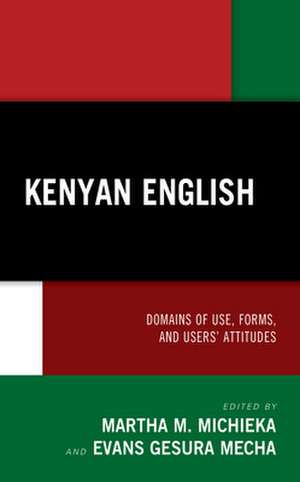
Kenyan English: Domains of Use, Forms, and Users' Attitudes
Editat de Martha M. Michieka, Dr Evans Gesura Mecha Contribuţii de Leonora Anyango, Nicholas Anyuor, Omukule Emojong, Joshua M. Itumo, Daniel Nyongesa Khaemba, Reuben Kigame, Ann Hildah Gatakaa Kinyua, Sarah Marjie, Peter N. Mose, Martin C. Njoroge, Benard Omenge Nyatuka, Eucabeth Ong’au-Mong’are, Peter Nyansera Otienoen Limba Engleză Hardback – 26 oct 2021
Preț: 524.42 lei
Preț vechi: 815.47 lei
-36%
Puncte Express: 787
Carte tipărită la comandă
Livrare economică 21 noiembrie-05 decembrie
Livrare prin curier în România Termenul estimat este afișat lângă disponibilitate.
Transport gratuit pentru acest produs Plată online sau ramburs, în funcție de opțiunile comenzii.
Retur gratuit în 14 zile Comandă securizată și suport în română.
Specificații
ISBN-13: 9781793641083
ISBN-10: 1793641080
Pagini: 216
Ilustrații: 12 b/w illustrations; 12 tables;
Dimensiuni: 154 x 232 x 16 mm
Greutate: 0.43 kg
Editura: Bloomsbury Publishing
Colecția Lexington Books
Locul publicării:New York, United States
ISBN-10: 1793641080
Pagini: 216
Ilustrații: 12 b/w illustrations; 12 tables;
Dimensiuni: 154 x 232 x 16 mm
Greutate: 0.43 kg
Editura: Bloomsbury Publishing
Colecția Lexington Books
Locul publicării:New York, United States
Cuprins
Introduction: Kenyan English or Kenyan Englishes?
Martha. M. Michieka and Evans Gesura Mecha
Chapter 1: An Empirical Study of Regional Variations in the Kenyan English Vowel System
Peter Nyansera Otieno
Chapter 2: The Kenyan English Accent: Segmental Features
Joshua Itumo and Martin C. Njoroge
Chapter 3: Error or flavor: An Account of the Lexical, Phrasal, and Syntactic Character of Fossilize Errors in Kenyan English Grammar
Ann Hildah Gatakaa Kinyua
Chapter: 4: Teaching English in Kenya: Reforms and Challenges in Early Years Education
Benard Omenge Nyatuka,
Chapter 5: English across the Curriculum in Kenya: The Reality in Primary School Classrooms and Implications on Epistemic Access
Peter Mose
Chapter 6: English Language Proficiency Among Secondary School Learners in Kenya: A Case of One Kenyan Rural Sub County
Daniel Nyongesa Khaemba and Eucabeth Ong'au- Mong'are
Chapter 7: Patterns of English Use in Kiswahili-Based Kenyan Mass Media
Sarah Marjie
Chapter 8: The English Language and Media
Martha. M. Michieka and Evans Gesura Mecha
Chapter 1: An Empirical Study of Regional Variations in the Kenyan English Vowel System
Peter Nyansera Otieno
Chapter 2: The Kenyan English Accent: Segmental Features
Joshua Itumo and Martin C. Njoroge
Chapter 3: Error or flavor: An Account of the Lexical, Phrasal, and Syntactic Character of Fossilize Errors in Kenyan English Grammar
Ann Hildah Gatakaa Kinyua
Chapter: 4: Teaching English in Kenya: Reforms and Challenges in Early Years Education
Benard Omenge Nyatuka,
Chapter 5: English across the Curriculum in Kenya: The Reality in Primary School Classrooms and Implications on Epistemic Access
Peter Mose
Chapter 6: English Language Proficiency Among Secondary School Learners in Kenya: A Case of One Kenyan Rural Sub County
Daniel Nyongesa Khaemba and Eucabeth Ong'au- Mong'are
Chapter 7: Patterns of English Use in Kiswahili-Based Kenyan Mass Media
Sarah Marjie
Chapter 8: The English Language and Media
Recenzii
This is a book that university departments of English and/or linguistics in Africa and the whole world should find invaluable in providing a comprehensive, user-friendly, and up-to-date guide to an African outer circle variety of English. It eloquently and intelligently navigates the variety's structural homogeneity and heterogeneity, and contextualizes its functions across the socio-political spectrum in both public and private spaces in Kenya, thereby broadening the reader's understanding of the sociolinguistics of English as a global language.
It is my pleasure to endorse the book Kenyan English: Domains of Use, Forms, and Users' Attitudes by Martha M. Michieka and Evans Gesura Mecha. I would first comment about the author Martha M. Michieka since I have seen her talk about Kenyan English and African Englishes in general in various academic conferences. Her presentations on issues surrounding African Englishes and advocacy for the recognition of these varieties as distinct from the British English, the parent language, are interesting and thought-provoking. In this book, Martha Michieka and Evans Gesura Mecha explore the structure, development, and use of the English variety spoken in Kenya. The chapters argue for the existence of a Kenyan variety of English that came into being from the legacies of the British colonialism. This book is a must-read for anyone who is interested in understanding the influence of the colonial languages on language policy and language choice in Africa.
This book is an enlightening read and a great resource for anyone working on indigenous languages and Englishes of the world. Drawing on varied theoretical and philosophical insights from several empirical sites, the God sent authors in this volume creatively explore the distinct nature of Kenyan English, from the perspective of its unique concepts, rules of engagement, regional variations, structural character and patterns of use in such domains as education, the church, the mass media, politics, urban and rural settings. The book provides a powerful lens for examining, understanding, and moving forward the significant, but rarely appreciated, discussions about the use of and existing elements of linguistic (dis)similarity between Kenyan English and other Englishes, more so, the standard British English. As an educator and Applied linguist, I enjoyed reading this amazing text and would most sincerely encourage every educator, language expert, political scientist, policy maker, and scholar of any standing to read it and share it with everyone everywhere in the world!
This is a long awaited update on the linguistic ecology of English in Kenya, including educational contexts but also the media, religion, and private domains. The volume will sit nicely on the shelf of everyone interested in East African Englishes and in scholarship originating from within the Kenyan English user community.
A timely and insightful book on Kenyan English that informs the reader on the uniqueness of Kenyan English through carefully researched contributions. The chapters in the book are data driven allowing the reader to have a good understanding of what characterizes the Kenyan English variety. The chapters assembled by a diverse group of both scholars and language practitioners provide a much-needed resource for students of language, policy makers, and curriculum designers.
It is my pleasure to endorse the book Kenyan English: Domains of Use, Forms, and Users' Attitudes by Martha M. Michieka and Evans Gesura Mecha. I would first comment about the author Martha M. Michieka since I have seen her talk about Kenyan English and African Englishes in general in various academic conferences. Her presentations on issues surrounding African Englishes and advocacy for the recognition of these varieties as distinct from the British English, the parent language, are interesting and thought-provoking. In this book, Martha Michieka and Evans Gesura Mecha explore the structure, development, and use of the English variety spoken in Kenya. The chapters argue for the existence of a Kenyan variety of English that came into being from the legacies of the British colonialism. This book is a must-read for anyone who is interested in understanding the influence of the colonial languages on language policy and language choice in Africa.
This book is an enlightening read and a great resource for anyone working on indigenous languages and Englishes of the world. Drawing on varied theoretical and philosophical insights from several empirical sites, the God sent authors in this volume creatively explore the distinct nature of Kenyan English, from the perspective of its unique concepts, rules of engagement, regional variations, structural character and patterns of use in such domains as education, the church, the mass media, politics, urban and rural settings. The book provides a powerful lens for examining, understanding, and moving forward the significant, but rarely appreciated, discussions about the use of and existing elements of linguistic (dis)similarity between Kenyan English and other Englishes, more so, the standard British English. As an educator and Applied linguist, I enjoyed reading this amazing text and would most sincerely encourage every educator, language expert, political scientist, policy maker, and scholar of any standing to read it and share it with everyone everywhere in the world!
This is a long awaited update on the linguistic ecology of English in Kenya, including educational contexts but also the media, religion, and private domains. The volume will sit nicely on the shelf of everyone interested in East African Englishes and in scholarship originating from within the Kenyan English user community.
A timely and insightful book on Kenyan English that informs the reader on the uniqueness of Kenyan English through carefully researched contributions. The chapters in the book are data driven allowing the reader to have a good understanding of what characterizes the Kenyan English variety. The chapters assembled by a diverse group of both scholars and language practitioners provide a much-needed resource for students of language, policy makers, and curriculum designers.