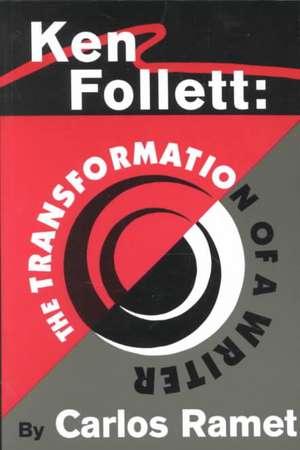
Ken Follett: The Transformation of a Writer
Autor Carlos Rameten Limba Engleză Paperback – 1999
Carlos Ramet focuses on the artistic development and cultural implications of the best-selling author of works such as Eye of the Needle (1978), The Pillars of the Earth (1989), and The Hammer of Eden (1998). Beginning with his earliest published novel, The Big Needle (1974), Ramet explores the tension between the popular and the serious that has underlain much of Follett’s work. Ramet examines this writer’s blending of genres, film adaptations of his novels, and his keen ability to extend his readership through a “hybridization” process. Ramet linguistically analyzes Follett’s flexibility with literary forms; explores archetypal patterns; and demonstrates that Follett’s involvement in British politics is reflected not only in his latest works but has been implied by his novels from the start.
Preț: 96.59 lei
Puncte Express: 145
Carte disponibilă
Livrare economică 16-30 noiembrie
Livrare express 31 octombrie-06 noiembrie pentru 33.48 lei
Livrare prin curier în România Termenul estimat este afișat lângă disponibilitate.
Transport gratuit de la 400.00 lei Plată online sau ramburs, în funcție de opțiunile comenzii.
Retur gratuit în 14 zile Comandă securizată și suport în română.
Specificații
ISBN-13: 9780879727987
ISBN-10: 0879727985
Pagini: 172
Dimensiuni: 152 x 229 x 13 mm
Greutate: 0.26 kg
Ediția:New.
Editura: University of Wisconsin Press
Colecția Popular Press 1
ISBN-10: 0879727985
Pagini: 172
Dimensiuni: 152 x 229 x 13 mm
Greutate: 0.26 kg
Ediția:New.
Editura: University of Wisconsin Press
Colecția Popular Press 1
V-ar putea interesa
-
 Night GamesAnna KrienPreț: 111.60 lei
 -
 -20%Preț: 157.70 lei198.07 lei
 -
 The Art of the Lord of the Rings by J.R.R. TolkienJ. R. R. TolkienPreț: 305.57 lei
 -
 SportRichard GiulianottiPreț: 177.97 lei
 -
 Stephen King's AmericaJonathan P. DavisPreț: 99.58 lei
 -
 The Devil's PicnicTaras Grescoe-17%Preț: 103.22 lei123.81 lei
 -
 -22%Preț: 233.69 lei298.88 lei
Descriere
Carlos Ramet focuses on the artistic development and cultural implications of the best-selling author of works such as Eye of the Needle (1978), The Pillars of the Earth (1989), and The Hammer of Eden (1998). Beginning with his earliest published novel, The Big Needle (1974), Ramet explores the tension between the popular and the serious that has underlain much of Follett’s work. Ramet examines this writer’s blending of genres, film adaptations of his novels, and his keen ability to extend his readership through a “hybridization” process. Ramet linguistically analyzes Follett’s flexibility with literary forms; explores archetypal patterns; and demonstrates that Follett’s involvement in British politics is reflected not only in his latest works but has been implied by his novels from the start.